
The Quantum Metagame
Persistence Across Branches as the Deep Structure of Reality
November 30, 2025
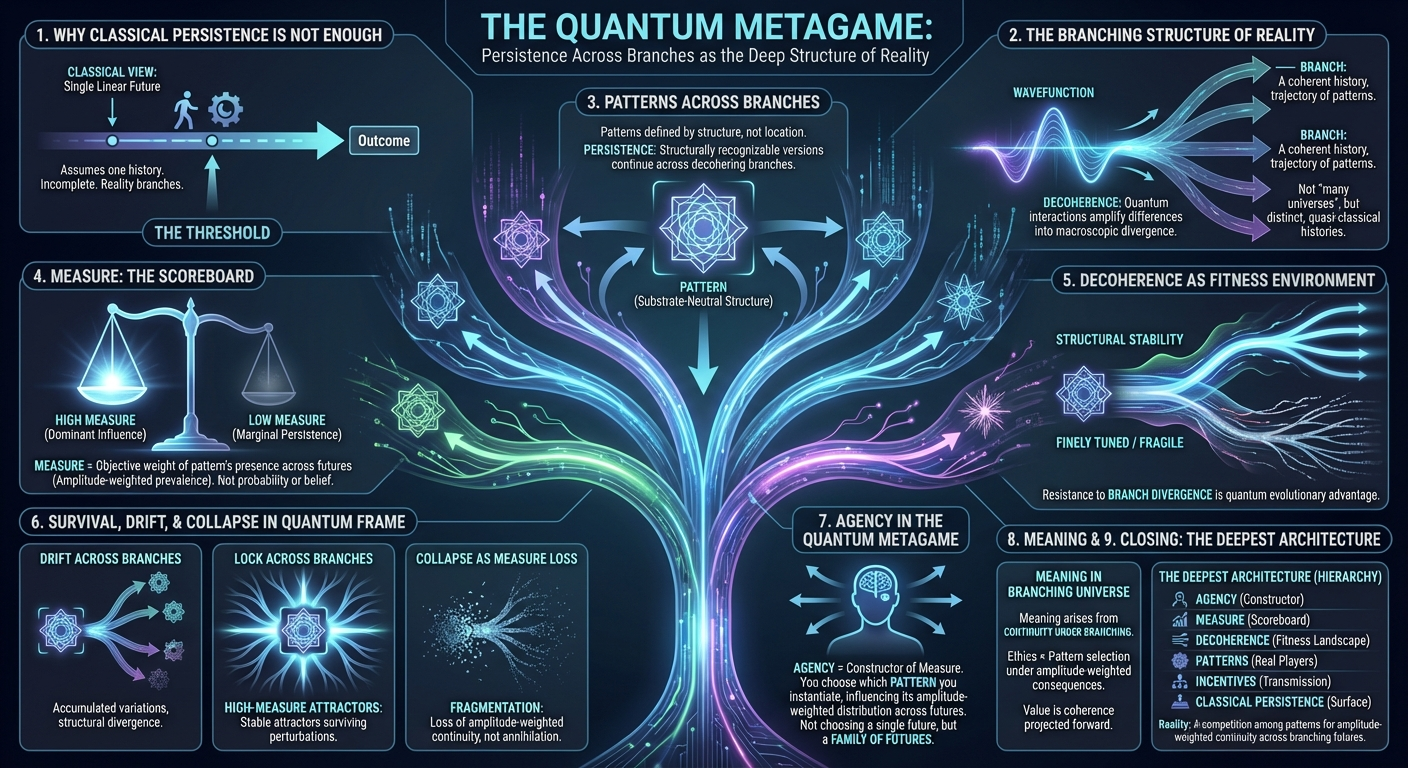
1. Why Classical Persistence Is Not Enough
The previous posts established the architecture of the metagame: individuals play games, games sit within higher games, incentives transmit downward, and patterns are the true units of selection. Persistence emerged as the terminal criterion—the universal scoreboard that determines which patterns endure.
But classical persistence assumes a single, linear future. It imagines a world where there is one timeline, one history, one sequence of outcomes. That picture is incomplete. Reality does not evolve along a single thread. It branches.
To understand persistence fully, we must understand what it means to persist across many futures, not just within one. This is the threshold of the Quantum Metagame.
2. The Branching Structure of Reality
Under the Everett interpretation—the only interpretation consistent with unitary evolution—quantum mechanics does not collapse possibilities into a single outcome. Instead, the wavefunction continually decoheres into distinct, quasi-classical histories. These are not metaphors or “many universes” in a sci-fi sense—they are the natural consequence of quantum interactions amplifying microscopic differences into macroscopic divergence.
A “branch” is not a universe. It is a trajectory of patterns—a coherent history where information remains internally consistent.
With every interaction that amplifies microscopic uncertainty, patterns diverge into different versions of themselves. Persistence is no longer a matter of surviving in one future, but surviving across many.
3. Patterns Across Branches
Patterns are substrate-neutral, and therefore can exist across multiple branches simultaneously. A pattern is not tied to a specific timeline. It is defined by its structure, not its location.
This leads to a deeper definition of persistence:
A pattern persists to the extent that structurally recognizable versions of it continue to exist across decohering branches.
A belief, norm, institution, value, or identity persists not because it wins in a single thread of history but because it maintains recognizable continuity across many.
The classical notion of survival is simply the special case where branching is ignored.
4. Measure: The Scoreboard of the Quantum Metagame
In classical reasoning, probabilities reflect uncertainty. In the quantum picture, probability emerges from measure—the squared amplitude associated with different decohered branches.
Measure is not belief. It is not frequency. It is not chance. It is the objective weight of the pattern’s presence across futures.
This gives us the scoreboard of the Quantum Metagame:
Measure is the total amplitude-weighted prevalence of structurally coherent versions of a pattern across branches.
Patterns with high measure dominate future influence. Patterns with low measure persist only in marginal branch weight. A pattern “dies” when it loses almost all of its measure, even if faint copies survive in negligible branches.
5. Decoherence as the Fitness Environment
Quantum decoherence is not pattern decay. It is a physical process—the continual entanglement of systems with their environment—that carves the wavefunction into quasi-classical branches. Decoherence creates the branching structure of reality; patterns then evolve within and across these branches.
Patterns that remain structurally stable through this branching process maintain coherence across many branches. These are high-measure patterns. Patterns that depend on finely tuned microstates split into divergent versions of themselves, losing structural unity across branches. These are low-measure patterns.
Coherence at this level is not moral or psychological—it is structural. Resistance to branch divergence is quantum evolutionary advantage.
6. Survival, Drift, and Collapse in the Quantum Frame
The classical pattern dynamics—drift, lock, and collapse—each have quantum analogues. Importantly, quantum decoherence creates the branch structure, while pattern dynamics describe how informational structures evolve within and across those branches. Structural recognition refers to the preservation of a pattern’s defining algorithmic invariants, not any metaphysical notion of personal identity.
Drift Across Branches
Branches diverge as microscopic differences are amplified by decoherence. Patterns instantiated in different branches undergo small, independent variations due to environmental noise, stochastic interactions, and local contingencies. Over time, these variations accumulate into structural branch divergence—multiple versions of a pattern with shared ancestry but distinct futures.
Lock Across Branches
Some patterns maintain recognizable structure across a wide distribution of branches. These are the locked patterns—stable attractors whose defining invariants survive despite local perturbations. In classical terms, they resemble institutional equilibria or cultural constants. In the quantum frame, they function as high-measure attractors: patterns whose structure remains coherent across a large share of branch weight.
Collapse as Measure Loss
A pattern collapses not when it disappears entirely, but when its measure becomes negligible. Its structural invariants fail to survive branch divergence; the pattern fragments into incompatible variants, and only faint, low-weight remnants persist. Collapse is loss of amplitude-weighted continuity, not annihilation.
7. Agency in the Quantum Metagame
Agency does not choose which branch “you” go to. All branches exist. What agency does is choose which pattern you instantiate, and therefore which versions of that pattern survive across branches.
Your choice changes:
the structure of the pattern,
the conditions under which it decoheres,
the measure-weighted distribution of its future versions.
This reframes agency as a constructor of measure. You shape not which single future occurs, but which family of futures contain coherent versions of you.
Agency is the ability to influence the amplitude-weighted continuity of the patterns you embody.
8. Meaning in a Branching Universe
The Quantum Metagame dissolves the usual nihilistic misunderstanding. If many branches exist, does anything matter?
It matters more.
Every choice shapes which versions of a pattern remain coherent across futures. Meaning arises from continuity under branching. Ethics becomes the study of pattern selection under amplitude-weighted consequences.
Value is coherence projected forward. Agency is the construction of measure toward futures you endorse.
9. Closing: The Deepest Architecture
The Quantum Metagame is the final layer of the hierarchy.
Classical persistence is its surface.
Incentives are its transmission mechanism.
Patterns are its real players.
Decoherence is its fitness landscape.
Measure is its scoreboard.
Agency is its constructor.
Everything else is local detail.
To understand the Quantum Metagame is to understand the deepest structure of reality: a universe where existence is not a state, but a competition among patterns for amplitude-weighted continuity across branching futures.