
The Metagame of Patterns
Why Patterns, Not People, Are the Real Units of Selection
November 28, 2025
1. Patterns as Players
Every visible system—political, scientific, cultural, technological—appears to be driven by individuals making choices. But individuals are not the true competitors in the metagame. Patterns are.
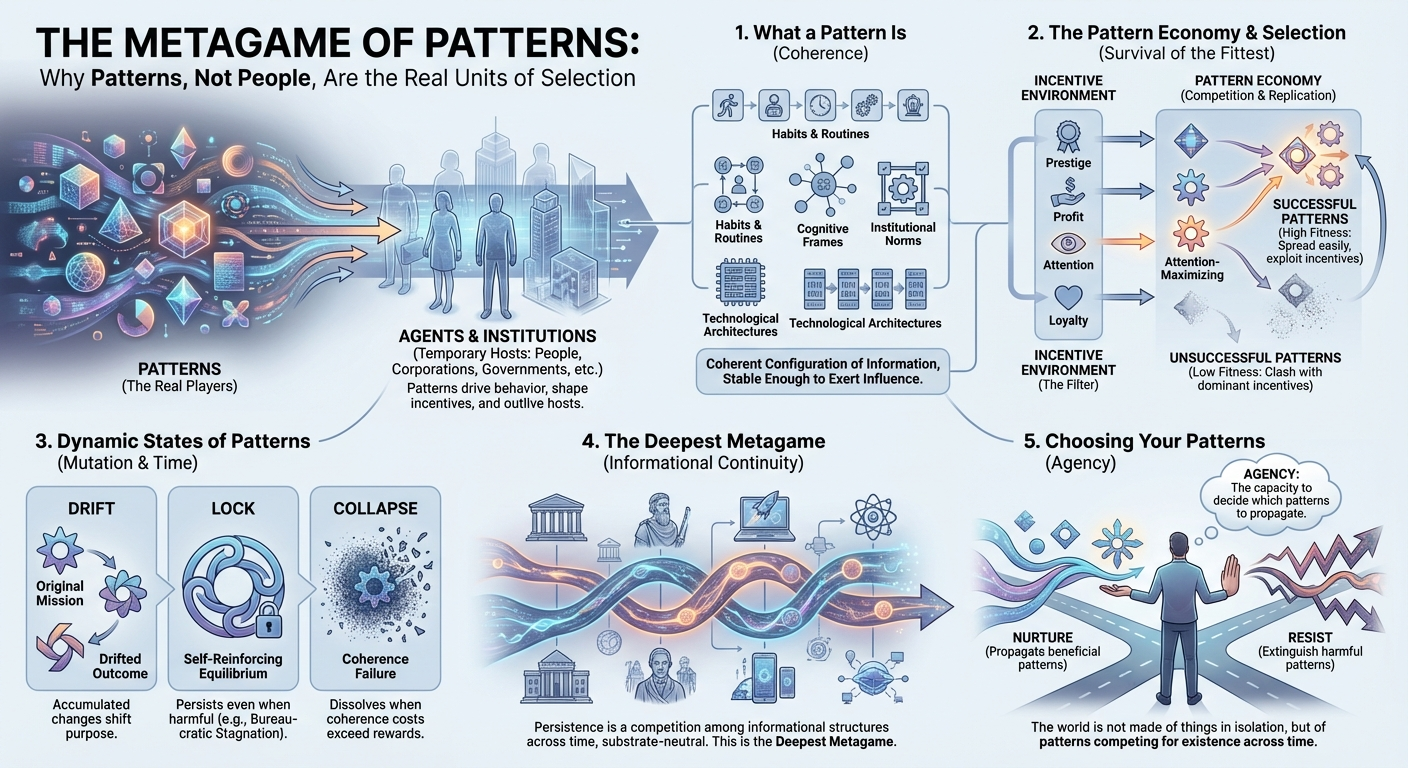
Patterns drive behavior, shape incentives, influence institutions, and outlive the agents who instantiate them. When a scientist publishes for prestige, a politician signals loyalty, a corporation chases quarterly metrics, or a movement drifts away from its founding mission, the real actor is a pattern: a stable configuration of behavior and incentives that has learned how to survive.
Incentives do not reward intentions; they reward patterns that perform well in their environment. The metagame selects patterns long before it selects people.
2. What a Pattern Is
A pattern is any coherent configuration of information that remains stable enough to exert influence.
Patterns can be behavioral (habits, routines), cognitive (beliefs, frames), institutional (procedures, norms), cultural (rituals, symbols), technological (architectures, protocols), or economic (pricing heuristics, growth dynamics). Scale does not define them; coherence does. A pattern exists as long as it stays recognizable. When it dissolves into noise, it dies.
3. Why Patterns Win or Lose
Patterns persist by satisfying two demands: maintaining internal coherence and fitting their incentive environment. Incentives do not select for goodness, truth, or virtue. They select for patterns that match the surrounding conditions.
Patterns that spread easily, resist corruption, exploit incentives, and integrate into institutions gain advantage. Patterns that require constant vigilance, impose high coherence costs, or clash with dominant incentives fade. The environment does not care whether a pattern is wise or destructive. It cares whether the pattern survives.
4. Patterns Outlive Their Hosts
People die. Institutions churn. Regimes collapse. Yet patterns continue.
A bureaucracy preserves its procedures long after anyone remembers why they exist. A religion maintains doctrines through centuries of upheaval. Outrage cycles persist across platforms and generations. Corporate incentive structures survive entire leadership turnovers. Cultural norms endure migrations, wars, and technological shocks.
Patterns outlive the people who enact them because they are informational structures shaped by incentives, not intentions. You do not operate patterns; patterns operate through you. Seeing this is the threshold for understanding the metagame.
5. The Pattern Economy
Patterns exist within a competitive ecology—a pattern economy—where they interact, mutate, conflict, and propagate. Stability is currency. Replication is survival. Adaptability is fitness. Coherence is integrity. Reach is power.
Some patterns are self-reinforcing and attract continued reinforcement. Others decay unless actively maintained. High-fitness patterns commandeer institutions. Low-fitness patterns lose influence and fade. This economy operates independently of human preference. It rewards performance, not virtue.
6. Incentives as Pattern Filters
Incentives not only shape behavior—they filter which patterns survive. Scientific prestige rewards novelty rather than accuracy, so novelty patterns dominate scientific discourse. Media ecosystems reward attention, so attention-maximizing patterns drive information flows. Politics rewards loyalty, so loyalty-signaling patterns outperform competence. Markets reward growth, so growth-seeking patterns displace sustainability.
Patterns drift toward what incentives reinforce, not toward what institutions claim to value.
7. Pattern Drift, Pattern Lock, Pattern Collapse
Patterns mutate as they replicate. Drift occurs when accumulated changes gradually shift a pattern away from its original purpose. Lock occurs when a pattern reaches a self-reinforcing equilibrium that persists even when harmful. Collapse occurs when coherence fails—when replication becomes noisy, competing patterns overwhelm it, or coherence costs exceed its rewards.
Drift explains mission drift. Lock explains bureaucratic stagnation. Collapse explains ideological implosion. These dynamics mirror natural selection, but at the level of information rather than biology.
8. Why Patterns Are the Bridge to the Deepest Metagame
The metagame of persistence applies to patterns, not people. Patterns are substrate-neutral and can exist across multiple physical instantiations. They outlive agents, compete for influence, gain or lose coherence, and accumulate or shed stability over time.
Once you recognize that patterns—not individuals—are the real players, the ontology shifts. Persistence becomes a competition among informational structures rather than organisms or institutions.
This prepares the ground for examining the deepest form of persistence—a level where survival is no longer about biology or culture, but about the continuity of patterns across time under the most fundamental constraints of reality.
9. Closing: Choosing the Patterns You Serve
Most action is patterned. You instantiate strategies, norms, behaviors, and identities that predate you and will outlast you. Agency is the capacity to decide which patterns you propagate, which you resist, which you nurture, and which you extinguish.
Understanding patterns reveals the architecture beneath behavior, institutions, and culture. It explains systemic drift, incentive-driven evolution, and the logic of persistence. And it prepares the mind for the deeper reality: the world is not made of things acting in isolation, but of patterns competing for existence across time.