
The Ultimate Metagame
The Architecture That Makes Meaning Possible
November 26, 2025
1. The Question at the Top of the Ladder
When you start noticing games within games, an obvious question eventually appears: How far does the ladder go? If every game is shaped by incentives from a larger game, you can keep climbing—strategic games above tactical ones, institutional games above strategic ones, cultural games above institutional ones, evolutionary games above cultural ones.
It can feel like an endless ascent. But the ladder has a highest rung. The ladder of metagames does not rise indefinitely. At some point, you reach a level that is not just another game within a larger structure. You reach the game that governs all others—the one that makes the very existence of games possible.
This is the subject of this post: the ultimate metagame.
2. Why the Ladder Must End
A metagame is defined by its ability to:
provide the goals that lower-level games optimize for,
impose the incentives that shape strategies,
and determine the meaning of success inside the systems beneath it.
But this process cannot continue upward forever. If every metagame relied on another metagame above it, the system would lack any grounding. Goals would have no origin. Incentives would have no source. Strategies would serve no end. A hierarchy of evaluation requires a point at which evaluation becomes self-sustaining.
The ladder stops at the one criterion every game presupposes.
3. The Criterion All Games Depend On
Every game depends on a simple fact: the player must exist long enough to play it. If the pattern disappears, its goals disappear with it.
You cannot:
optimize for checkmate if you are not alive to move the pieces,
pursue reputation if the system that grants it collapses,
perform science if the institution evaporates,
maintain values if the agent holding them dissolves.
In every game, at every level, the precondition for any goal is the continued persistence of the agent or pattern doing the optimizing.
This is not morality. It is not psychology. It is not biology. It is structural.
If a pattern fails to persist, nothing it values, builds, or plays can continue.
4. Defining the Ultimate Metagame
We can now state it clearly:
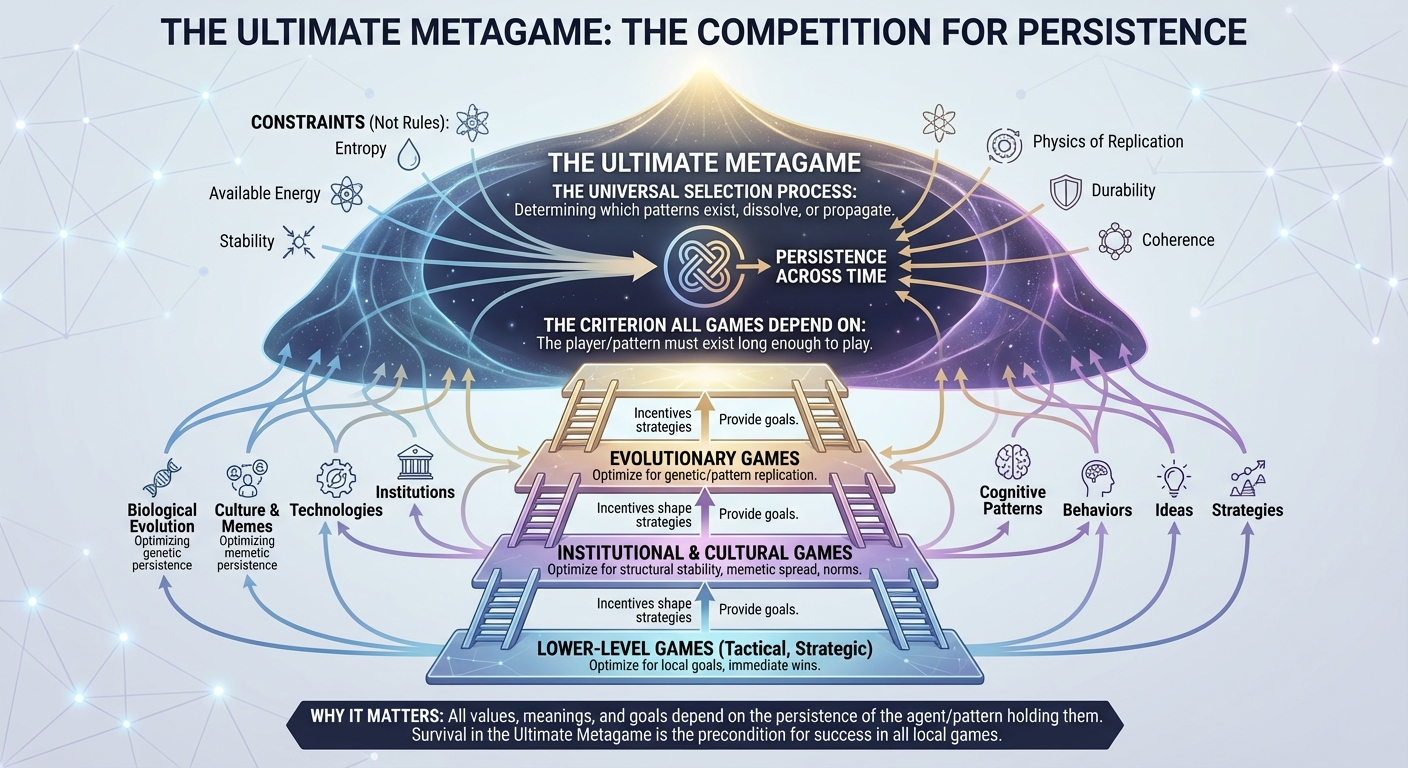
The ultimate metagame is the competition among patterns for persistence across time.
More fully:
The ultimate metagame is the universal selection process that determines which patterns continue to exist, which dissolve, and which propagate into the future.
It is the background process that all other games are embedded in. It is the condition that makes all other goals possible. It is the architecture that all agents participate in, whether they know it or not.
This metagame is not limited to biological life. It applies to:
ideas,
technologies,
institutions,
behaviors,
cultures,
strategies,
cognitive patterns,
and any structure capable of replication or maintenance.
If something persists, it has “won” at least temporarily. If something spreads, it is succeeding. If something disappears, it has lost.
5. Persistence as the Universal Scoreboard
Unlike lower-level games, the ultimate metagame does not have explicit rules. It has constraints:
entropy,
available energy,
the physics of replication,
the stability of structures,
the durability of information,
the coherence of strategies.
These constraints function like the boundary conditions of a universal contest. Every pattern must navigate them. Patterns that are more capable of maintaining coherence through these constraints tend to dominate future states of the world.
Persistence is not merely continuing to exist. It is continuing to exist as a coherent pattern—stable enough to maintain its identity across time.
6. How All Other Games Fit Inside the Ultimate Metagame
Every game humans play—economic, political, cultural, intellectual—can be understood as a subgame of the ultimate metagame.
Examples:
Biological evolution is a subgame optimizing genetic persistence.
Culture is a subgame optimizing memetic persistence.
Institutions are subgames optimizing structural persistence.
Technologies are subgames optimizing functional persistence.
Agents are subgames optimizing cognitive and behavioral persistence.
When a strategy in a lower game is selected, rewarded, or propagated, it is because it improves the pattern’s position in the ultimate metagame, directly or indirectly.
When a strategy fails, it is ultimately because it degraded the agent’s or system’s ability to persist.
7. Why the Ultimate Metagame Matters
Most confusion in human affairs comes from analyzing decisions only in terms of the explicit local game. But people, institutions, and ideas are often optimizing for survival in larger contexts, not for success in the narrow frame observers assume.
A movement may sacrifice short-term popularity to maintain internal cohesion.
A scientist may pursue prestige because prestige secures their position.
A corporation may avoid innovation to preserve a legacy structure.
A culture may enforce norms that appear irrational but maintain long-term identity.
All of these make sense through the lens of the ultimate metagame.
8. Closing: The View from the Top
There are many games, layered one atop another. But at the top sits a single structure: the universal contest of persistence. Seeing this does not answer every question, but it places every question in context.
This is not nihilism. The ultimate metagame does not tell you what to value; it tells you what all values depend on. Meaning is not erased by the logic of persistence — meaning becomes possible because of it. Your goals, ideals, and purposes matter because they are embodied in patterns capable of shaping the world while they exist; their significance is not erased by mortality, only enabled by the fact that they persist long enough to act.
Every strategy, every value, every decision — even the shape of every institution and idea — ultimately traces back to the demands of the ultimate metagame. Understanding it doesn’t simplify the world, but it reveals the architecture beneath it.