
Navigating The Multiverse
Moral Reasoning under Everettian Quantum Mechanics
September 27, 2025
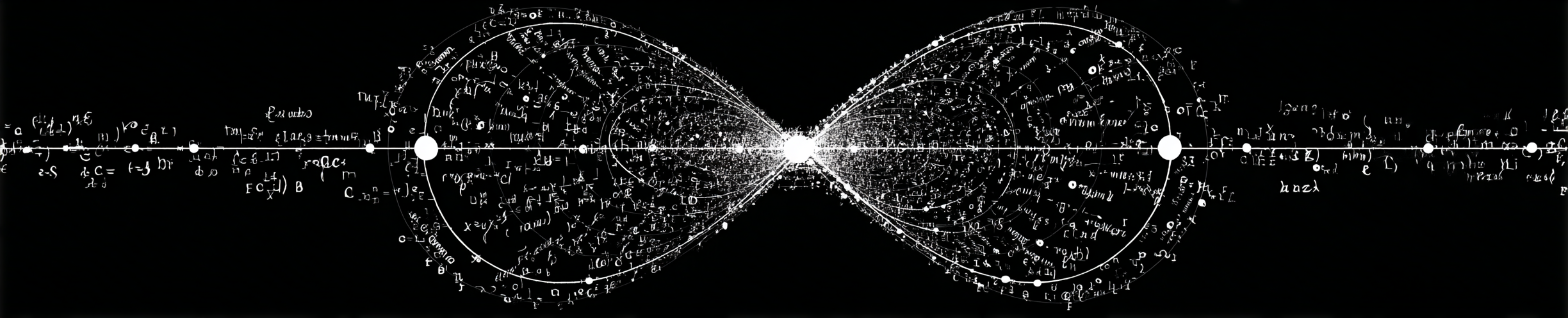
If Everett is right, then every quantum event branches into divergent realities. Each non-zero amplitude outcome exists somewhere. This radically alters how we must think about responsibility, obligation, and ethics. What follows is a framework for anchoring moral responsibility under the Quantum Branching Universe (QBU) lens.
Why Everett Changes Ethics
The Everettian view forces a fundamental re-architecture of ethics in at least three ways:
Responsibility is distributional, not binary.
In a single-world picture, we ask whether harm occurred or not, whether someone caused it or not. In Everett, harm and good always both occur. The relevant question becomes: how much amplitude of harm vs good did your policy generate? Responsibility is no longer binary but measure-weighted optimization.Inevitability no longer dissolves duty.
In a single-world picture, inevitability cancels obligation: if harm will happen no matter what, you are not responsible. In Everett, every outcome is inevitable somewhere, but that does not erase responsibility. What matters is how much of the universal wavefunction carries harm forward under your lineage. Duty is reframed as amplitude navigation, not harm elimination.Identity and obligation become pattern-indexed.
In a single-world view, promises and obligations appear absolute: you either kept your word or broke it. In Everett, both occur somewhere. What binds is not the global fact but the pattern at your Vantage. Obligations attach to stable Pattern Identifiers—agents, promises, causal relationships—relative to the local branch. Justice and reciprocity are thus vantage-indexed, not universalized across all branches.
In sum, Everett transforms ethics from:
binary → distributional responsibility
inevitability → amplitude-weighted duty
absolute outcomes → vantage-indexed obligations
From the outside view, morality becomes a matter of navigating measure across the branching structure, not ensuring or preventing single outcomes.
Responsibility and the Vantage
The first key point is that responsibility is always local to your Vantage—your present decision node in the branching structure. You cannot control what all your counterparts elsewhere do. What you control is how you, here, place measure into one future distribution rather than another.
Your responsibility lies in the policy you enact: the choice that shapes the amplitude-weighted distribution of your descendants. Fatalism is an error; inevitability does not erase agency.
Measure, Not Just Credence
Two distinct quantities must be kept clear:
Credence: Your subjective probability of an outcome, relative to limited information.
Measure: The objective amplitude weight of branches produced by quantum mechanics.
In classical uncertainty, credence is all you have. But in Everett, the right ethical calculus is to maximize measure-weighted value. That is, you owe it to your descendants to bias the universal wavefunction toward futures with more flourishing and less harm.
Determinism and Navigation
A common objection is that the QBU is deterministic: the global wavefunction evolves unitarily, so every outcome with non-zero amplitude happens inevitably. How then can one “navigate” amplitude?
The answer lies in the Vantage perspective. From the God’s-eye view, everything is fixed. But from your embedded perspective, you are an agentic subsystem whose deliberation and action determine which descendant branches inherit your pattern. You do not alter the total wavefunction, but you do control which amplitude-weighted futures count as continuations of your lineage.
Think of it as deterministic chess: the full game tree exists, but your moves determine which line of play you inhabit. Likewise, in Everett, all outcomes occur, but your policy determines the distribution of measure across futures that descend from your Vantage.
So “navigating amplitude” means: choosing a policy that maximizes the share of measure where your descendants thrive. You cannot prevent the existence of bad branches, but you can ensure they carry less of your measure.
Multiplying Outcomes vs Multiplying Duties
Do you owe a separate obligation to every microscopic branch? No. Obligations attach to patterns—agents, promises, relationships—that persist across decohered structures. The multiplication of outcomes does not multiply your duties; it scales them by measure.
Think of it as optimization: your goal is not to please infinitely many copies, but to maximize the amplitude share of good futures.
Worked Examples
The Switch
Suppose flipping a switch prevents great harm in 99.9% of amplitude, but in 0.1% it causes minor harm. Everett says: flip the switch. Even though there will always be a sliver where something bad happens, the overall distribution of measure is improved.
The Promise
You promise to donate if event E occurs. In Many-Worlds, both E and ¬E occur. Your obligation holds relative to your Vantage: in branches where E happens here, you must donate. Promises are context-indexed, not globally duplicated.
The Rescue
Suppose you can attempt a rescue with a high chance of success but some small amplitude where you fail and die. In a single-world view, you weigh the risk to yourself against the potential lives saved. In Everett, both success and failure occur. Your policy determines how much measure flows into worlds where many are saved versus worlds where you perish. The rescue is justified if the amplitude-weighted value of lives saved outweighs the cost of your own lost branches.
Integration with the QBU Framework
Vantage: Anchors responsibility to the present decision node.
Measure: Provides the weighting scheme for ethical evaluation.
Pattern Identifiers: Obligations persist with stable patterns (agents, promises) that have causal ancestry, not arbitrary labels.
This dovetails with Conditionalism: moral truths are conditional on vantage, measure, and stable patterns, not absolute across the multiverse.
Common Objections
“But somewhere I still do wrong regardless.” True, but inevitability ≠ irrelevance. The right question is: what is your policy’s effect on the distribution of wrong vs right?
“Isn’t this just fatalism?” No. You cannot avoid that some bad exists, but you can navigate amplitude toward futures with less of it.
“How do blame and praise work?” They apply locally, by assessing what policy an agent enacted at their vantage. Blame is tied to how much measure of harm you knowingly increased.
Conclusion
In an Everettian universe, morality is not erased but clarified:
Responsibility = navigating amplitude wisely.
Your task as an agent is not to eliminate all harm—impossible—but to maximize the measure of good futures radiating from your Vantage. Ethics becomes a matter of charting the branching structure with foresight, discipline, and care.