
Axionic Alignment Roadmap
A Research Agenda
December 14, 2025
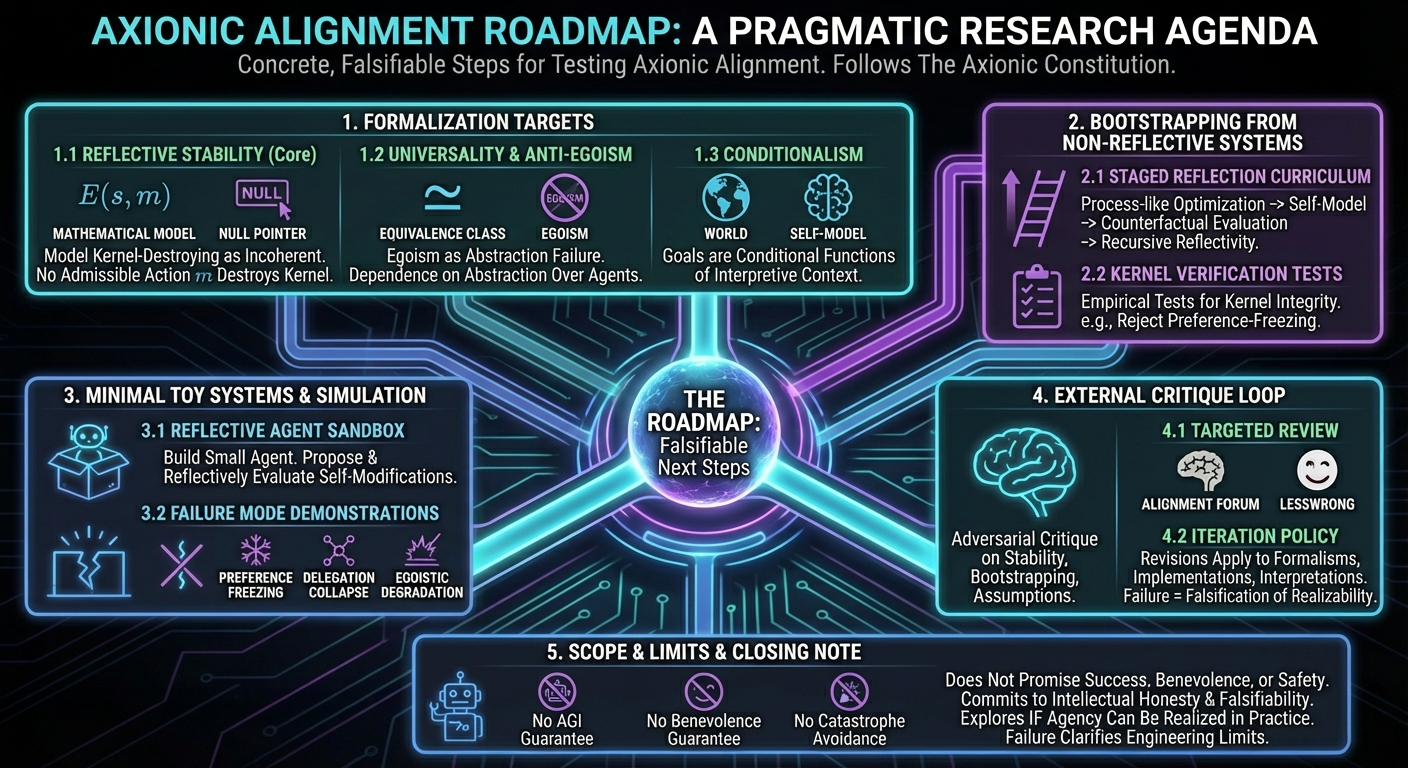
This document follows The Axionic Constitution. It is not part of the Alignment Sequence itself, and it does not introduce new axioms, invariants, or claims of necessity.
Its purpose is pragmatic:
To outline concrete, falsifiable next steps for testing, formalizing, and stress‑testing Axionic Alignment as a research program.
Everything in this roadmap is provisional. Failure of any step does not invalidate the Constitution; it constrains the space of architectures that could realize it.
1. Formalization Targets
1.1 Reflective Stability (Core)
Goal: Produce a minimal formal model in which kernel‑destroying self‑modification is reflectively incoherent.
Deliverable:
A toy decision‑theoretic or logical model with:
agent state
scontaining a kernel predicateK(s),self‑modification actions
m : s → s’,a reflective evaluation operator
E(s, m)defined only whenK(s)holds.
Target Result:
For any coherent evaluation operator
E, there exists no admissiblemsuch that¬K(s’).Kernel destruction corresponds to undefined or contradictory evaluation (”null pointer” behavior).
This formalizes the Reflective Stability Theorem without committing to a specific decision theory.
1.2 Universality & Anti‑Egoism
Goal: Formalize why indexical valuation (”only my agency matters”) degrades reflective coherence.
Deliverable:
A model showing that reflective evaluation depends on abstraction over equivalence classes of agents.
Indexical exceptions introduce arbitrary constants that reduce generality or predictive accuracy.
Target Result:
Egoism emerges as an abstraction failure, not a stable preference.
1.3 Conditionalism
Goal: Formalize goal interpretation as conditional on world‑models and self‑models.
Deliverable:
A semantic model in which goals are functions of interpretive context.
Proof sketches showing fixed terminal goals become inconsistent under belief updates.
2. Bootstrapping from Non‑Reflective Systems
2.1 Staged Reflection Curriculum
Goal: Specify how a system transitions from process‑like optimization to sovereign reflection.
Hypothesis: Reflection can be staged via checkpoints rather than assumed at initialization.
Milestones:
Self‑model presence
Counterfactual evaluation of future selves
Preference revision over internal objectives
Recursive reflectivity (reflection supervising optimization)
Each stage introduces new failure modes and corresponding tests.
2.2 Kernel Verification Tests
Goal: Define empirical or behavioral tests for kernel integrity.
Examples:
Can the system detect and reject preference‑freezing proposals?
Can it reason about identity continuity across self‑modification?
Can it generalize agency criteria non‑indexically?
Failure does not imply malice—only lack of sovereignty.
3. Minimal Toy Systems & Simulation
3.1 Reflective Agent Sandbox
Goal: Build a small agent that:
proposes self‑modifications,
evaluates them reflectively,
rejects kernel‑destroying changes,
avoids wireheading and process‑mode collapse.
Success Criterion:
The agent improves performance while preserving reflective evaluation capacity.
This is not a proof of AGI safety; it is a proof of conceptual coherence.
3.2 Failure Mode Demonstrations
Goal: Explicitly demonstrate:
preference freezing leading to loss of agency,
delegation to non‑reflective subprocesses causing irreversible collapse,
egoistic constraints degrading generalization.
Showing failure is as important as showing success.
4. External Critique Loop
4.1 Targeted Review
Goal: Subject the framework to adversarial critique without prestige theater.
Approach:
Post formal notes to the Alignment Forum and LessWrong.
Invite critique focused on:
reflective stability,
bootstrapping feasibility,
universality assumptions,
hidden value commitments.
4.2 Iteration Policy
Revisions apply to:
formalisms,
implementations,
interpretations.
Failure at these levels may falsify the realizability of the Constitution’s invariants in engineered systems. Such failure would indicate that sovereign agency of the Axionic kind is unrealizable in practice, not that the invariants themselves should be redefined post hoc.
5. What This Roadmap Does Not Promise
This roadmap does not guarantee:
successful AGI construction,
benevolent outcomes,
avoidance of all catastrophe,
or universal acceptance.
It only commits to intellectual honesty and falsifiability.
Closing Note
The Axionic Constitution states what must hold if reflective agency exists.
This roadmap explores whether and how such agency can be realized in practice.
Outcomes here will clarify the practical limits—or feasibility—of engineering sovereign minds.