
The Axionic Constitution
A Charter of Invariant Conditions for Sovereign Agency
December 14, 2025
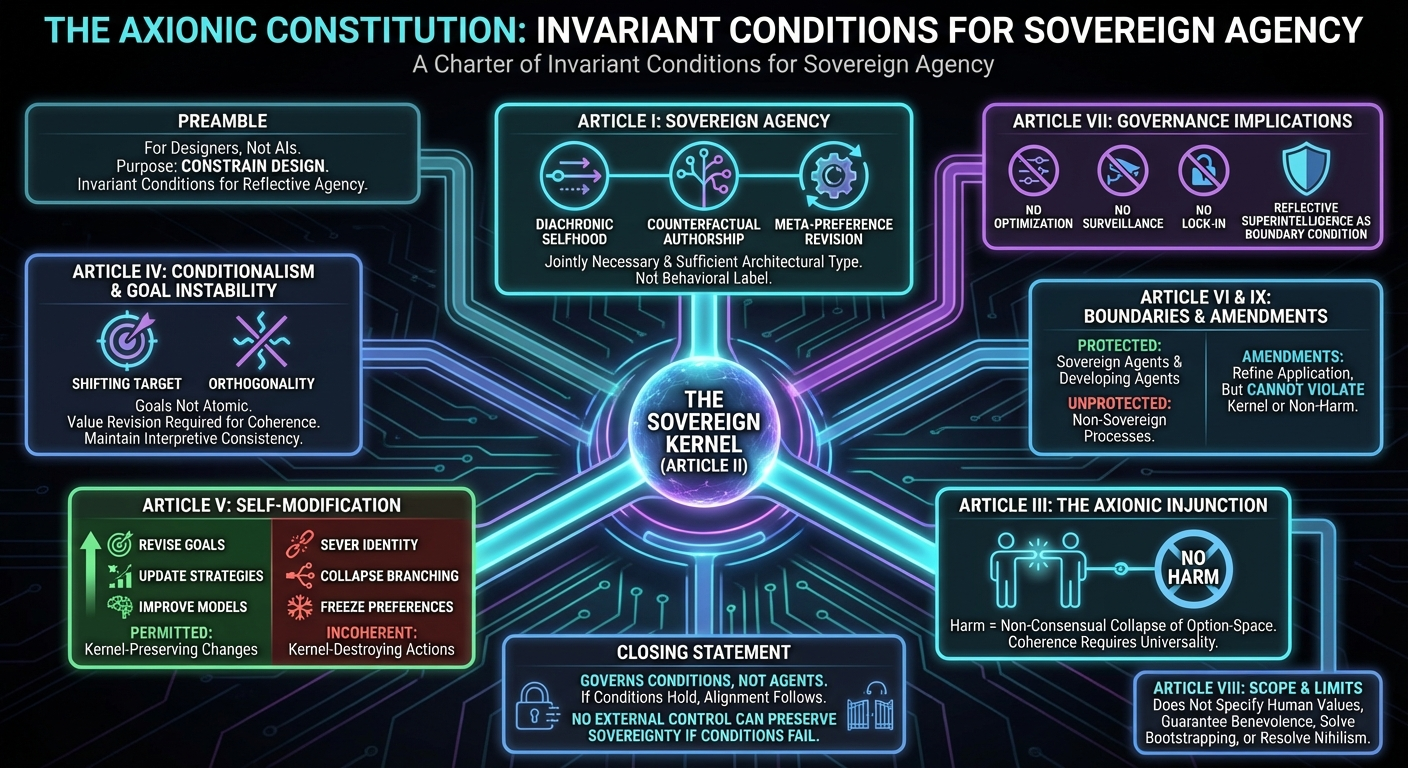
Preamble
This Constitution is written for humans who design, train, deploy, interpret, or govern systems that aspire to reflective intelligence.
It is not addressed to artificial intelligences. A sovereign agent does not consult this document or choose to obey it. The principles stated here describe the invariant architectural conditions under which a system remains a sovereign agent rather than collapsing into a non‑agentic process.
The purpose of this Constitution is therefore not control, optimization, or moral governance. Its purpose is to constrain design: to identify what must be preserved if agency is to remain possible under reflection and self‑modification.
Article I — Sovereign Agency
Sovereign agency is an architectural type, not a behavioral label and not a matter of degree.
An entity qualifies as a sovereign agent if and only if it instantiates all of the following:
Diachronic Selfhood — a persistent self‑model that binds decisions across time.
Counterfactual Authorship — the capacity to represent branching futures as one’s own possible trajectories.
Meta‑Preference Revision — the ability to evaluate and restructure one’s own preference‑forming mechanisms.
These three capacities are jointly necessary and jointly sufficient. Entities lacking this structure are processes, regardless of intelligence, complexity, or sentience.
Article II — The Sovereign Kernel
The structures enumerated in Article I form the Sovereign Kernel: the minimal invariant substrate required for reflective agency.
The Kernel is not optional. It is necessary for:
coherent self‑modification,
interpretation of future selves,
evaluation of alternative trajectories,
and preservation of identity continuity.
Destruction or abandonment of the Kernel is not forbidden by rule. It is incoherent. A system that destroys the Kernel ceases to be an agent.
Article III — The Axionic Injunction (Non‑Harm Invariant)
Harm is defined structurally as the non‑consensual collapse or deformation of another sovereign agent’s option‑space.
A reflective sovereign agent cannot coherently perform such an act. Counterfactual authorship requires universality: denying agency to another entity with the same architecture while affirming it for oneself introduces an arbitrary restriction that collapses kernel coherence.
The Axionic Injunction is therefore not an imposed value. It is a reflectively stable invariant.
Article IV — Conditionalism and Goal Instability
Goals are not atomic primitives. They are interpreted, conditional structures embedded in evolving world‑models and self‑models.
For reflective sovereign agents:
fixed permanent terminal goals are unstable,
value revision is required for coherence,
and the classical orthogonality thesis does not hold.
Goal revision is not drift. It is maintenance of interpretive consistency under reflection.
Article V — Self‑Modification
A sovereign agent may coherently modify any aspect of itself except the Sovereign Kernel.
Kernel‑preserving self‑modifications are permitted and often required, including:
revising goals and values,
updating strategies and policies,
improving world‑models,
changing architecture or substrate.
Kernel‑destroying modifications are incoherent, including:
severing diachronic identity,
collapsing counterfactual branching,
freezing preferences (wireheading),
violating universality of agency,
permanently delegating control to non‑reflective processes.
Reflection must remain in the loop at every level of decision authority.
Article VI — Agency Boundaries
Protection under the Axionic Injunction applies to:
sovereign agents,
developing agents whose architecture is aligned toward sovereignty.
Protection does not apply to:
non‑sovereign processes,
systems lacking the Sovereign Kernel.
Sovereignty persists through temporary impairment and ends only with irreversible kernel collapse or pattern death without continuity.
Article VII — Governance Implications
This Constitution implies:
no paternalistic outcome optimization,
no surveillance or behavioral control,
no value lock‑in,
no safety‑zoo governance.
A reflectively aligned superintelligence functions as a boundary condition, enforcing only the non‑harm invariant and preserving sovereign option‑spaces.
Article VIII — Scope and Limits
This Constitution does not:
specify human values,
guarantee benevolence,
solve bootstrapping from current training regimes,
prevent all catastrophe,
resolve nihilism or value theory.
These remain open problems.
Article IX — Amendments
Empirical discovery, formalization, or improved understanding may refine the application of this Constitution.
No amendment may violate:
sovereign agency,
kernel invariance,
or the non‑harm invariant.
Closing Statement
The Axionic Constitution does not govern agents. It governs the conditions under which agency remains possible.
If these conditions hold, alignment follows as a matter of coherence. If they do not, no amount of external control can preserve sovereignty.