
The Pathologies of Misaligned Incentives
Why Systems Fail Even When People Don’t
November 28, 2025
1. When Games Collide
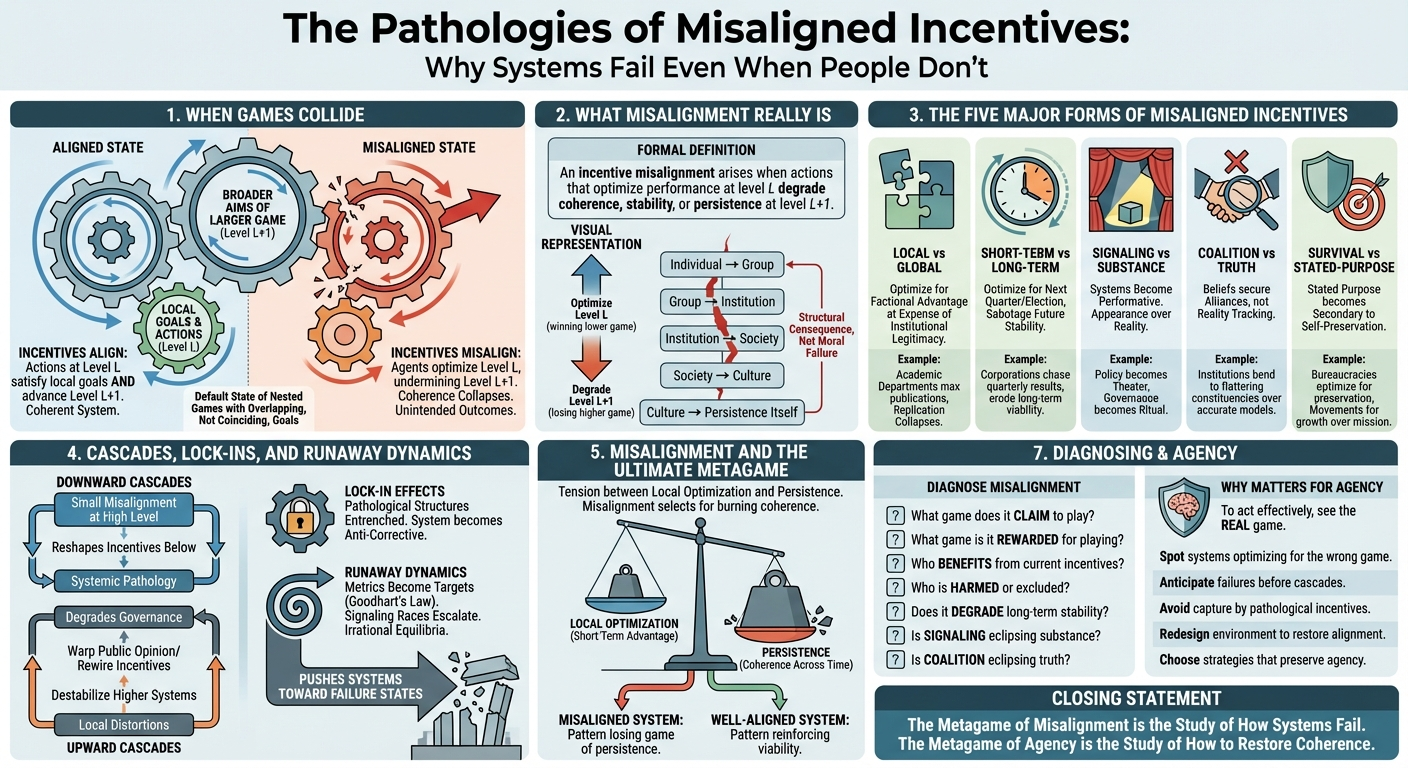
Every system—political, scientific, economic, cultural—runs on incentives. They are the transmission channel by which higher-level games shape the effective rules of lower ones. When incentives align, systems behave coherently: actions that satisfy local goals also advance the broader aims of the larger game. But when incentives misalign, coherence collapses. Agents optimize for one game while undermining another. Institutions drift off purpose. Groups behave irrationally. Systems produce outcomes nobody intends.
Misalignment is not rare. It is the default state of nested games whose goals partially overlap but do not fully coincide.
2. What Misalignment Really Is
Misalignment occurs when the strategy that wins the lower game loses the higher one.
Formally:
An incentive misalignment arises when actions that optimize performance at level L degrade coherence, stability, or persistence at level L+1.
This can happen across any layer of the hierarchy:
individual → group,
group → institution,
institution → society,
society → culture,
culture → persistence itself.
Misalignment is not a moral failure. It is a structural consequence of layered systems with different reward landscapes.
3. The Five Major Forms of Misaligned Incentives
Misalignment follows recognizable patterns across governments, corporations, academia, media, and social movements.
3.1 Local vs Global Incentives
A strategy that wins locally can be catastrophic globally. Academic departments maximize publication counts even as replication collapses. Corporations chase quarterly results while eroding long-term viability. Politicians optimize for factional advantage at the expense of institutional legitimacy.
3.2 Short-Term vs Long-Term Incentives
Short-term incentives dominate because they deliver dense, immediate feedback. Long-term incentives are sparse and abstract. As time horizons collapse, agents optimize for the next quarter, the next election, or the next news cycle—even when these choices sabotage future stability.
3.3 Signaling vs Substance Incentives
When signaling rewards outweigh substantive rewards, systems become performative. Institutions privilege appearance over reality, messaging over operations, ideology over accuracy. Policy becomes theater. Governance becomes ritual.
3.4 Coalition vs Truth Incentives
Coalition-building delivers survival benefits; truth-seeking does not. People adopt beliefs that secure alliances, not beliefs that track reality. Institutions bend toward flattering constituencies rather than producing accurate models of the world.
3.5 Survival vs Stated-Purpose Incentives
An institution’s stated purpose quickly becomes secondary to its survival. Bureaucracies optimize for self-preservation. Movements optimize for growth over mission. Scientific organizations drift toward perpetuation over knowledge. What looks like corruption is the metagame of persistence asserting itself.
4. Cascades, Lock-Ins, and Runaway Dynamics
Misaligned incentives rarely remain isolated. They propagate through the hierarchy, distorting everything they touch.
4.1 Downward Cascades
A small misalignment at a high level reshapes incentives at every level below it. A funding body rewards novelty; journals prioritize novelty; scientists chase novelty; replication collapses. A minor shift at the top becomes a systemic pathology.
4.2 Upward Cascades
Local distortions can destabilize higher systems. Outrage-driven engagement incentives warp public opinion, which rewires political incentives, which degrades governance.
4.3 Lock-In Effects
Once entrenched, pathological incentive structures are difficult to dislodge. Reformers lose to those who exploit the existing architecture. The system becomes anti-corrective.
4.4 Runaway Dynamics
Some misalignments amplify themselves. Metrics become targets; targets become meaningless. Signaling races escalate. Rational agents are trapped in irrational equilibria.
Misalignment behaves like a selector that pushes systems toward failure states.
5. Misalignment and the Ultimate Metagame
All misalignment reflects a tension between local optimization and persistence.
Persistence selects for strategies that maintain coherence across time. Misalignment selects for strategies that burn coherence for short-term advantage. Systems survive brief misalignments, but persistent misalignment erodes stability, predictability, and collective agency.
Seen through the lens of the ultimate metagame:
a misaligned system is a pattern losing the game of persistence,
a well-aligned system is a pattern reinforcing its viability.
6. How to Diagnose Misalignment in Any System
To see misalignment, ask:
What game does this system claim to play?
What game is it actually rewarded for playing?
Who benefits from the current incentives?
Who is harmed or excluded by them?
What outcomes would change if the incentives changed?
Does the system preserve or degrade its own long-term stability?
Do short-term wins accumulate as long-term losses?
Is signaling eclipsing substance?
Is coalition-building eclipsing truth?
These questions expose the real optimization target.
7. Why Misalignment Matters for Agency
To act effectively, you must see the real game. Misalignment hides the real game behind contradictions and mixed signals.
Understanding misalignment gives you the ability to:
spot systems optimizing for the wrong game,
anticipate failures before they cascade,
avoid being captured by pathological incentives,
redesign your environment to restore alignment,
choose strategies that preserve agency rather than surrender it.
Agency begins when you stop letting misaligned incentives choose on your behalf.
8. Closing: The Consequences of Broken Games
Systems do not collapse randomly. They collapse because incentives stop pointing at persistence and start pointing at self-destruction.
Misaligned incentives are the fault lines where systems fracture, beliefs contort, institutions corrode, and predictability evaporates. Seen through this lens, the apparent madness of human systems becomes legible.
The metagame of misalignment is the study of how systems fail. The metagame of agency is the study of how to restore coherence.