
Invisible Chains
Analyzing the State’s Ownership Over Citizens
August 02, 2025

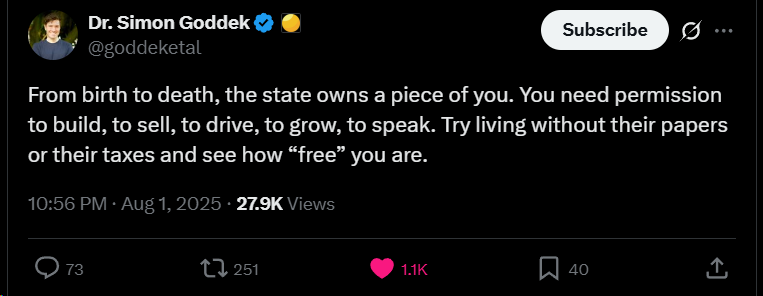
The libertarian argument that the state effectively "owns" a piece of each citizen is often dismissed as exaggerated or metaphorical. However, when subjected to rigorous technical analysis, the claim holds up remarkably well.
Ownership, defined precisely, means having enforceable claims over three distinct rights regarding an entity or resource:
The Right to Use: Ability to engage with, employ, or utilize the resource as you wish.
The Right to Exclude: Authority to control access, thereby preventing others from using or benefiting without permission.
The Right to Dispose: Freedom to transfer, alter, or sell the resource.
The state's relationship with citizens explicitly meets all these criteria, thus satisfying the technical definition of ownership:
1. The Right to Use
The state dictates precisely how you can use your body, property, time, and speech. Consider:
Licensing and Permits: Nearly all significant activities—driving, building homes, operating businesses, even marrying—require explicit state approval.
Regulated Behavior: Laws constrain what you can ingest, which medicines you can access, and how you express yourself. In essence, your basic bodily autonomy is contingent on state permission.
This level of control amounts to the state managing your "use rights" at a fundamental level.
2. The Right to Exclude
Exclusion rights permit control over access to resources or activities. The state holds extensive exclusion rights over citizens:
Occupational Licensing: States regularly prevent citizens from freely participating in various trades or professions without explicit approval. If denied a license, you're excluded from that area of economic activity.
Travel Restrictions: Borders, visas, passports, zoning laws—all explicitly control where you can live, work, or travel.
Thus, the state can—and frequently does—explicitly exclude you from certain aspects of life.
3. The Right to Dispose
Disposal rights involve transferring or altering property at will. The state exerts enormous influence over your right to dispose of your assets or wealth:
Taxation: Mandatory taxation is not voluntary—it is extraction under the credible threat of harm. Your money, property, and assets are partially appropriated, severely limiting your freedom of disposal.
Inheritance and Transfer Restrictions: Estate taxes, inheritance regulations, and complex property laws effectively determine what and how you can dispose of your resources.
The state's actions demonstrate that it directly manages your disposal rights, thereby assuming a share of ownership in your property.
Given the above analysis, dismissing state ownership as hyperbole misunderstands the nature of ownership itself. Ownership isn't solely a function of paper titles or explicit purchase; it is fundamentally about enforceable claims over resources or beings. The state explicitly enforces claims over your body, property, actions, and speech.
If ownership is truly defined by enforceable rights—use, exclusion, and disposal—then undeniably, a substantial part of you is effectively state-owned. Recognizing this technical truth reframes how we must view our relationship to governance, freedom, and autonomy.
Confronting this truth is the first step toward reclaiming your autonomy from those who presume to own you.