
From Sovereignty to Slavery
The Spectrum of Taxation and Coercion
May 28, 2025

Many people instinctively regard taxation and slavery as fundamentally distinct, seeing one as a necessary civic duty and the other as a moral atrocity. But what if the difference between taxation and slavery is merely one of degree rather than kind? This provocative idea challenges conventional wisdom by framing coercion not as a binary state, but rather as a continuous spectrum. By adopting this perspective, we see that all forms of compelled labor or economic extraction share a common ethical dimension, varying only in their intensity—from complete self-sovereignty to outright enslavement.
Defining the Spectrum
To ground our discussion clearly, let's define our Taxation-Enslavement Spectrum explicitly:
0% represents total self-sovereignty, with no external coercion, forced labor, or compulsory obligations imposed upon an individual.
100% signifies absolute appropriation of an individual's labor output, equating to complete and unequivocal enslavement.
Under this framework, taxation and coercion can be understood as positions along a continuum rather than categorically separate phenomena. This approach forces us to reconsider accepted societal norms and practices, calling for a deeper ethical evaluation.
Historical and Modern Examples
Consider the comprehensive spectrum illustrated below:
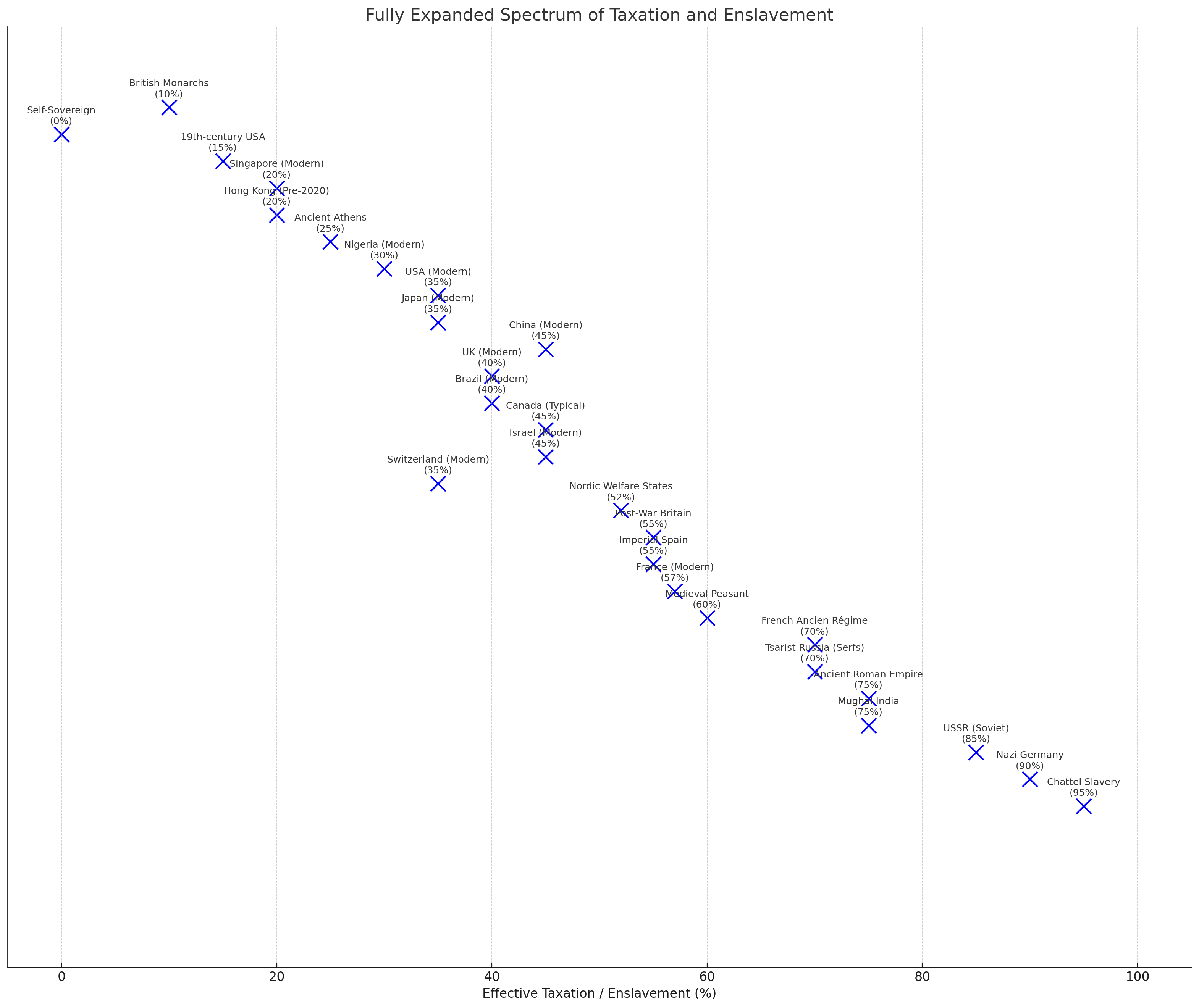
Low Coercion (0–20%): British Monarchs, 19th-century USA, Modern Singapore, and pre-2020 Hong Kong represent societies with minimal governmental extraction and substantial individual autonomy.
Moderate Coercion (30–50%): Contemporary societies such as Canada, Israel, Japan, and Switzerland impose significant taxes, yet they generally preserve a robust degree of personal and economic freedom.
Significant Coercion (50–70%): Historical examples such as medieval peasants, Imperial Spain, Nordic welfare states, and modern France indicate heavier obligations, significantly limiting personal economic autonomy.
High Coercion (70–90%): Highly oppressive regimes such as Tsarist Russia, the Soviet Union, and Nazi Germany imposed severe economic controls and extensive forced labor practices, substantially curtailing autonomy.
Extreme Coercion (90–100%): Chattel slavery, exemplified historically by the institution of slavery in the Americas, represents near-total economic extraction and minimal to no individual autonomy.
Insights and Implications
Exploring this spectrum yields several critical insights:
Continuity of Coercion: Coercion exists as a universal societal feature, and no society is entirely exempt. Every nation or culture occupies a position along this continuum, demanding continuous ethical vigilance and scrutiny.
Ethical Perspective Shift: Recognizing taxation as a form of partial enslavement forces a critical re-evaluation of its moral justification. If outright slavery is undeniably unethical, at what point does coercive taxation become morally acceptable or unacceptable?
Historical Blind Spots: What is ethically obvious today was not always so. Past societies normalized practices like serfdom and slavery, now universally condemned. Similarly, modern coercion may one day appear equally unjustifiable to future generations.
Criticisms and Responses
To strengthen our argument, we must anticipate and respond to potential objections:
"Taxation is voluntary in democratic societies."
Response: Genuine consent requires a viable option to refuse. Compliance under threat of legal penalties or imprisonment constitutes coercion rather than genuine voluntary participation."High taxation provides substantial societal benefits."
Response: While benefits from taxation are real and substantial, these benefits do not erase the ethical dilemma. The fundamental issue remains: coercion without explicit, informed consent is inherently morally problematic.
This spectrum-based analysis naturally reinforces Conditionalism—the philosophical stance that insists on explicitly articulating and justifying any underlying conditions of political or economic authority.
A Future Perspective
Envisioning how future generations might evaluate current norms can provide valuable ethical insight. Might future societies view contemporary taxation practices as morally questionable in the same way we now view serfdom, colonialism, or forced labor?
Historical precedent strongly suggests this possibility. Ethical perceptions evolve, revealing blind spots in norms and values previously accepted without challenge. It is therefore prudent and morally responsible to critically evaluate our current practices in anticipation of future moral scrutiny.
Conclusion
The taxation-enslavement spectrum clearly and powerfully illuminates fundamental ethical considerations surrounding autonomy, coercion, and authority. Recognizing coercion as a continuous spectrum rather than a categorical binary compels us to explicitly justify—or critically reassess—the forms of coercion we routinely accept as normal. By embracing this perspective, we affirm individual autonomy as a paramount ethical principle and commit ourselves to transparent, consistent moral reasoning regarding political and economic structures.
References
Huemer, Michael. The Problem of Political Authority.
Friedman, David D. The Machinery of Freedom.
Hayek, F. A. "The Use of Knowledge in Society."