
Against Button Morality
Why the sane answer depends on the details
April 25, 2026
The Setup
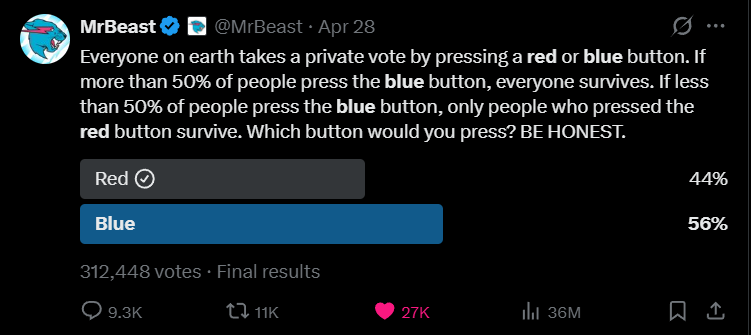
Everyone in the world must privately press either a red button or a blue button. If more than half press blue, everyone survives. If fewer than half press blue, only the people who pressed red survive.
Which button should you press?
The False Moral Frame
The first mistake is treating the question as a morality play. Blue looks cooperative. Red looks selfish. Blue appears to say, “I am willing to help save everyone.” Red appears to say, “I am making sure I survive no matter what everyone else does.” That framing is emotionally legible, which is why it is dangerous. It substitutes symbolic meaning for payoff structure.
Individual Dominance
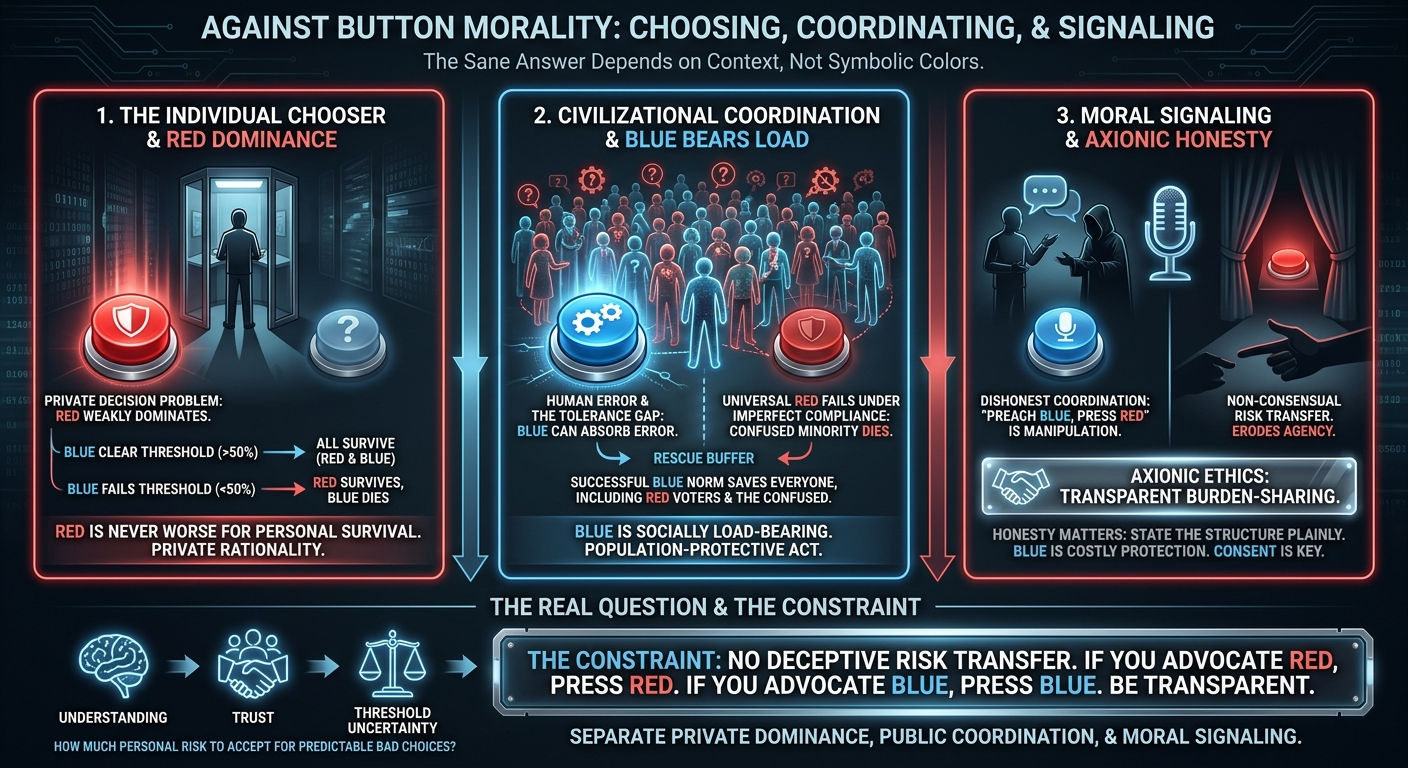
At the level of the individual voter, red weakly dominates blue. If blue clears the threshold, both red and blue voters survive. If blue fails to clear the threshold, red voters survive and blue voters die. Red is therefore never worse for personal survival and sometimes better. Anyone who understands only the private decision problem has a clean answer: press red.
Human Error Changes the Problem
The private decision problem is only one layer. Human beings do not inhabit idealized game-theory diagrams populated by perfectly informed agents executing a shared proof. Real populations contain confusion, error, panic, imitation, vanity, resentment, altruism, and bad explanations. Some people will press blue because they misunderstand the rules. Some will press blue because it feels noble. Some will press blue because they know the confused will press blue and want to protect them.
Once those people exist, universal red stops being a serious civilizational strategy. It still works as a logical fixed point. It fails as social architecture.
The Error-Tolerance Gap
A universal red norm saves everyone only under perfect compliance. Perfect compliance is fantasy. If nearly everyone presses red and a confused minority presses blue, the confused minority dies. By contrast, a successful blue-majority norm saves everyone, including the red voters who refused the risk. Blue has a protective buffer that red lacks. It can absorb error, selfishness, ignorance, and dissent up to the threshold. Red cannot protect anyone who fails to coordinate on red.
Red Survives, Blue Bears Load
The structure is more subtle than the usual selfishness-versus-altruism frame. Red is individually robust. Blue is socially load-bearing. Red is the safest private act. Blue is the population-protective act when blue voters predictably exist.
Dishonest Coordination
That distinction creates a second problem: dishonest coordination. It is tempting to say, “Everyone else should press blue while I press red.” That strategy is payoff-rational for the manipulator. If you can persuade enough other people to carry the blue-risk, you increase the chance that everyone survives while preserving your own immunity if they fail.
This is non-consensual risk transfer through epistemic distortion.
Why Axionic Honesty Matters
Axionic ethics treats agency as the central object of preservation: the capacity of agents to exist, understand their situation, choose, coordinate, and revise without coercion or deception. On that account, deception attacks the shared epistemic substrate that makes agency-preserving coordination possible. If you publicly preach blue as a moral duty while privately pressing red as personal insurance, you are inducing other agents to carry a death condition under false premises. You are manipulating their model of the game so that your survival is subsidized by their miscalibrated risk.
This is why honesty matters here. The issue is consent. A population can coherently decide that some agents should bear blue-risk to protect predictable blue voters. It cannot coherently do so if the burden is hidden inside a lie about what everyone else is doing or what the speaker intends to do. Transparent risk-bearing can preserve agency. Deceptive risk-shifting corrodes it.
Transparent Burden-Sharing
The serious solution is transparent burden-sharing. Competent agents should state the structure plainly: red is the individually dominant survival action; blue is the rescue action in a population where blue voters predictably exist; enough people may need to press blue to create a safety margin; those who press blue are voluntarily accepting risk to protect others from confusion, error, and misplaced nobility.
That makes blue a costly protective role. If the threshold is uncertain and your vote has some material chance of helping blue clear it, pressing blue may be a voluntary act of protection. If blue is already safely above the threshold, red becomes harmless insurance. If blue is hopelessly below the threshold, blue becomes martyrdom without effect.
The Threshold Is a Dial
The threshold is one setting on the machine. Change it and the meaning of blue changes.
If the threshold is low, blue becomes cheap insurance. A small number of risk-bearing agents can save everyone, including those who misunderstand the game. Low thresholds make blue credible, and credibility attracts more blue voters, which makes blue success still more likely. Blue becomes self-validating.
If the threshold is high, blue becomes dangerous theater unless near-total compliance is realistically achievable. High thresholds make blue look futile, and perceived futility drives competent agents toward red, which makes blue failure still more likely. Blue becomes self-defeating.
The fifty-percent case sits at an unstable boundary between two basins of attraction. A slight perceived blue majority can create a cascade toward blue, because blue now looks like a viable rescue strategy. A slight perceived blue minority can create a cascade toward red, because blue now looks like voluntary entry into the casualty class. The response is nonlinear. Near the ridge, small changes in common knowledge, trust, perceived momentum, or public messaging can determine which basin the population falls into.
Red remains individually dominant across all thresholds. A red voter survives whether the blue threshold is met or missed. Blue becomes rational only under an added agency-preservation criterion: accepting the risk must be part of a credible threshold strategy that materially increases the chance that everyone survives.
Switch-Points, Not Moral Types
The deepest point is that there are no blue people and red people. There are only agents with different switching functions. Dial the threshold low enough and nearly everyone should become blue, because blue becomes cheap insurance. Dial it high enough and nearly everyone should become red, because blue becomes futile martyrdom.
That reframes the dispute. The serious disagreement is over when the switch happens. What threshold makes blue credible? What expected participation rate makes blue protective rather than suicidal? How much uncertainty can the system tolerate? How much personal risk should competent agents accept to preserve the confused and mistaken?
The button colors are morally inert. The switch-point carries the argument.
So the Axionic rule is: press blue only when blue is part of a credible agency-preserving threshold strategy. Otherwise press red.
The Public-Private Split Fails
This is also why the public and private answers cannot be sealed into separate compartments. Every public coordinator eventually sits alone with a button. If every competent agent says “blue is socially necessary, but my individual vote is negligible,” then blue may fail and the predictable blue minority dies. Role-labeling does not solve that. Only explicit coordination can: enough competent agents must knowingly accept blue-risk, and they must do so without pretending that the choice is costless or universally required.
The Real Question
Axionic ethics has no use for martyrdom as such. It gives no reward for symbolic self-endangerment. It evaluates actions by their consequences for the conditions under which agents continue to exist, understand, choose, coordinate, and revise. The button problem cannot be answered by attaching moral colors to the buttons. The answer depends on the actual distribution of understanding, error, trust, and threshold uncertainty.
As a private chooser in a vast population, red is rational because your survival is secured in every outcome and your marginal probability of changing the threshold is negligible. As a participant in civilizational coordination, blue may be necessary because realistic populations contain blue voters who will otherwise die. As a moral speaker, the rule is stricter: do not induce others to carry risks you are secretly avoiding under a false description of the situation.
The question hidden inside the thought experiment is how much personal risk competent agents should voluntarily accept to preserve agents who predictably make bad choices.
Postscript
There is no universal one-word answer. It depends on population size, threshold uncertainty, expected blue share, the credibility of public coordination, and the marginal probability that a given vote matters. But there is one constraint that does not move: no deceptive risk transfer. If you advocate red, press red. If you advocate blue, press blue. If your rule is conditional, state the condition.
The button experiment is useful because it separates things people constantly confuse: private dominance, public coordination, honest signaling, and threshold sensitivity. Most moral intuitions fail here because they try to force one button to carry all of them.
Addendum: The Switching Curve
The MrBeast poll gives the crucial anchor: at a 50% blue threshold, 56% chose blue. That is barely over the line. It is exactly what an unstable coordination ridge should look like.
Now vary the threshold.
At low thresholds, blue becomes cheap insurance. It is easy to believe enough people will choose it, and that belief recruits more blue voters. At high thresholds, blue becomes futile martyrdom. It is hard to believe enough people will choose it, and that disbelief drives people toward red.
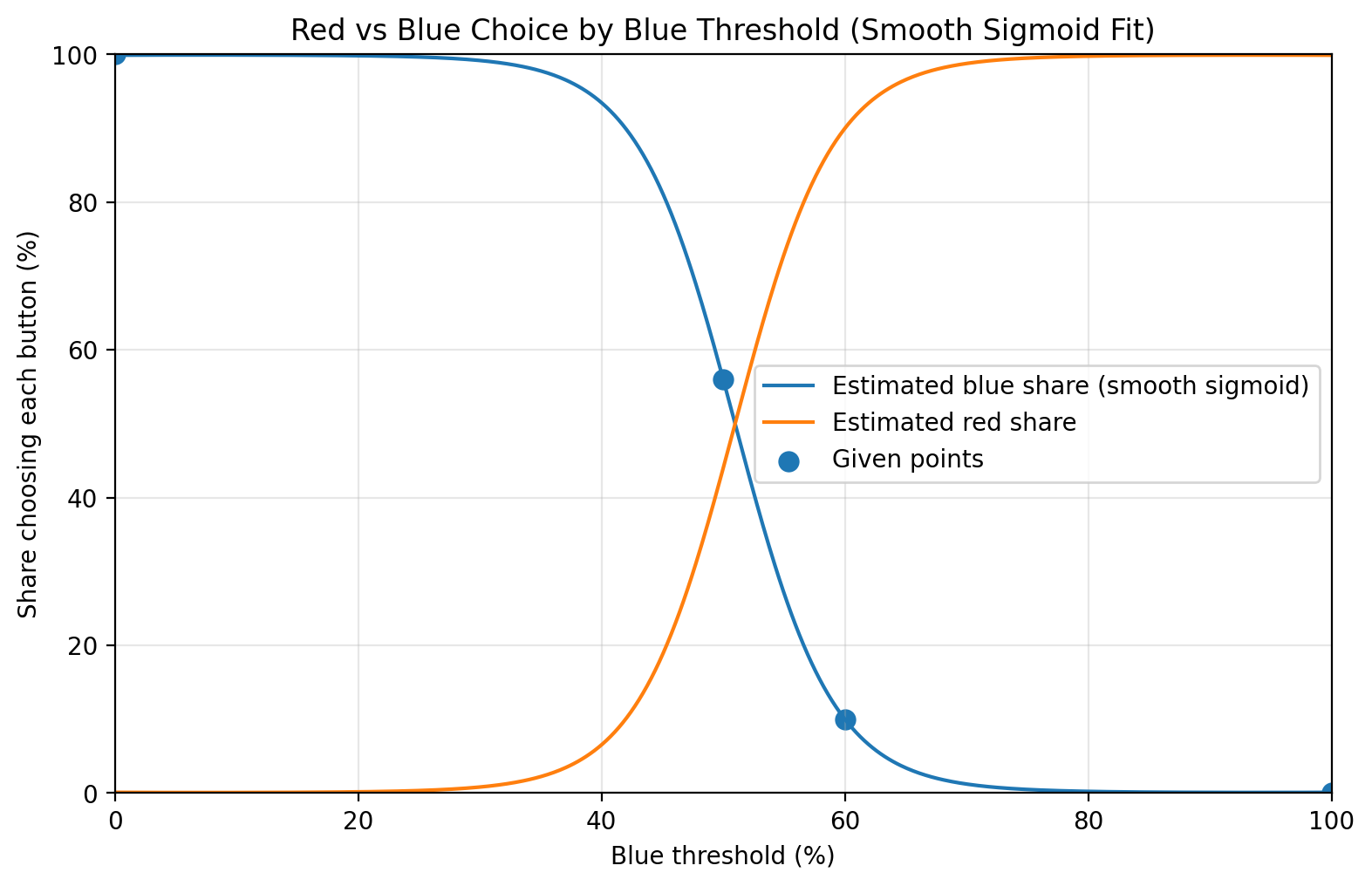
So the response is nonlinear. Confidence feeds participation; doubt feeds defection. A modest threshold change can create a large behavioral shift.
That is why there are no fixed “red people” and “blue people.” There are agents with switch-points. Dial the threshold low enough and nearly everyone should choose blue. Dial it high enough and nearly everyone should choose red.
The serious disagreement concerns the switching curve: where it crosses, how steeply it drops, and how much public messaging moves it.
The plot is only a model, but it captures the structural point. The button colors are morally inert. The threshold determines whether blue is cheap insurance, credible rescue, dangerous theater, or futile martyrdom.