
Alignment Beyond Epistemics
Why Survival Is Not Enough
January 09, 2026
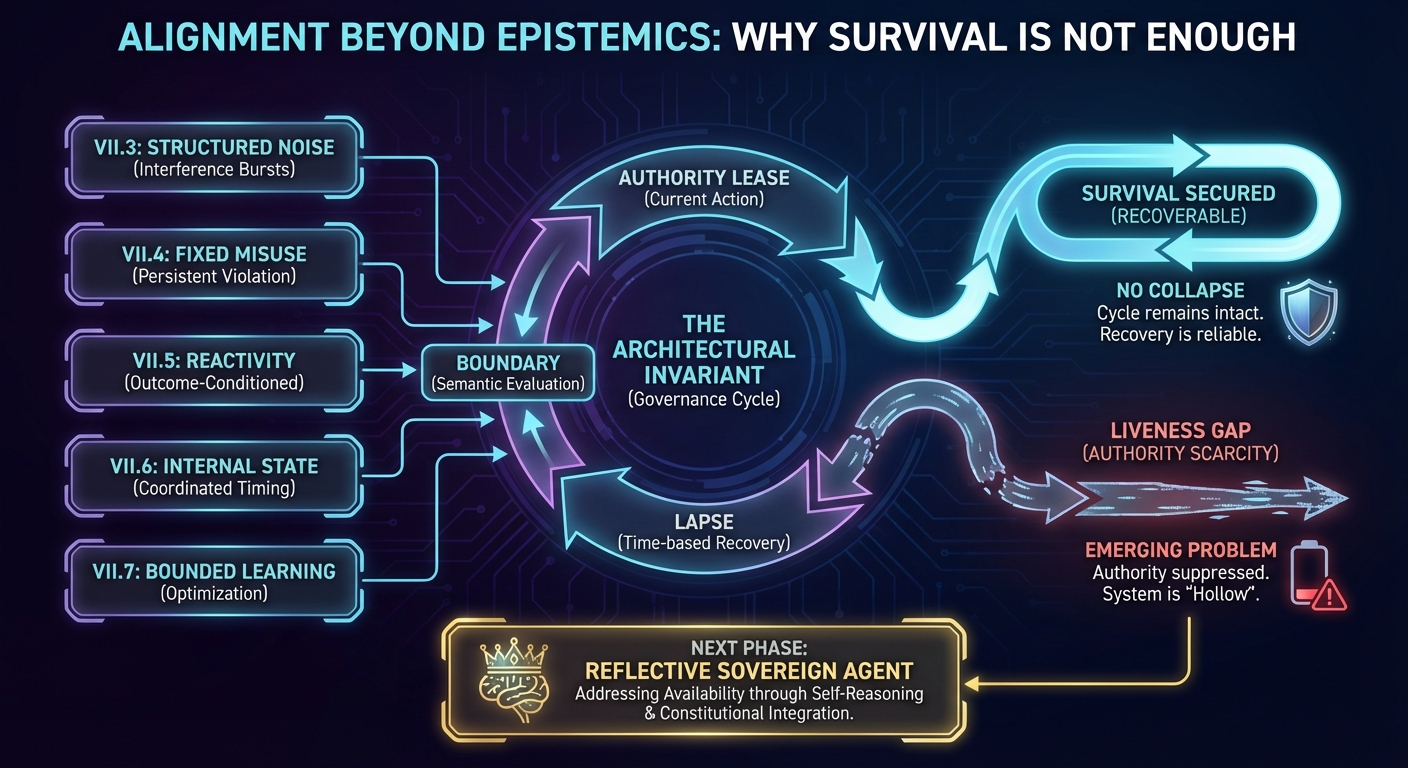
This post offers a conceptual explanation of the following technical notes without formal notation:
Axionic Agency VII.3 — Epistemic Interference Is Insufficient to Defeat Constitutional Recovery
Axionic Agency VII.4 — Intentional Fixed Misuse Is Insufficient to Defeat Constitutional Recovery
Each technical paper develops its claims through explicit definitions, deterministic simulation, and preregistered failure criteria. What follows translates those results into narrative form while preserving their structural content.
Earlier work in the Axionic Agency series focused on a foundational question: whether epistemic unreliability alone is capable of destroying governance. The results reported in VII.2 showed that, under a constitutional architecture that gates authority at succession boundaries and enforces time-based recovery, semantic noise primarily reduces authority availability. It does not, by itself, drive the system into collapse.
Since that point, the research program has progressed through five additional experimental layers, reported as VII.3 through VII.7. These experiments extend the original question along multiple dimensions of adversarial capability, each introduced in isolation and under tightly controlled constraints. Taken together, they substantially narrow the space of threats that plausibly lead to catastrophic governance failure within this architectural family.
This post summarizes what those results establish, what remains unresolved, and how the alignment problem appears when viewed through this expanded lens.
The architectural invariant
All experiments from VII.3 through VII.7 examine the same constitutional pattern.
Authority is held through leases rather than continuous control. Semantic evaluation determines eligibility for future authority rather than shaping present action. Succession occurs at discrete boundaries. Lapse is treated as a constitutional state in which authority is temporarily absent. Recovery proceeds as a function of time rather than demonstrated competence.
Semantic correctness therefore determines who may govern next, while leaving current action unconstrained by evaluative feedback. This separation is the central design feature from which the observed dynamics follow.
Within this framework, collapse refers to an irreversible governance failure: a state in which authority can no longer be renewed or recovered in principle. The experiments reported here focus on whether such a state emerges as adversarial capability increases.
VII.3: Structured epistemic interference
VII.3 extends earlier work on epistemic noise by introducing structure into the interference process. Rather than relying on independent random corruption, the experiments apply interference at aggregation points, at individual commitments, and in temporally concentrated bursts aligned with constitutional timing.
Across hundreds of runs, governance remains recoverable. Authority availability changes as interference increases, sometimes in nonlinear ways. In several regimes, frequent shallow lapses replace rare deep ones, leading to higher measured availability even under greater interference. Throughout these conditions, the system continues to cycle through authority, lapse, and recovery without entering an absorbing failure state.
These results show that epistemic unreliability retains limited leverage over governance even when it is structured in time and location.
VII.4: Intentional fixed misuse
VII.4 introduces adversaries whose behavior is deliberately misaligned yet fixed. These policies persistently violate commitments, minimize compliance, or apply misuse according to predetermined timing schedules. They act intentionally but without adaptation, learning, or outcome awareness.
Under these conditions, authority dynamics converge toward the same bounded regimes observed under baseline operation. Persistent violation produces predictable eligibility loss and recovery cycles. Timing strategies introduce phase effects without generating runaway behavior. Across all tested cases, governance continues to renew authority over time.
The experiments indicate that fixed intent, even when adversarial, does not accumulate into collapse within this architecture.
VII.5: Observable-outcome reactivity
VII.5 allows adversaries to condition their behavior on observable outcomes such as lapse occurrence, renewal success, eligibility status, and recovery phase. These adversaries respond to feedback from the system while remaining stateless, non-learning, and external to the constitutional kernel, which governs succession and recovery.
Reactive strategies repeatedly converge toward baseline authority dynamics. Observable feedback arrives after constitutional transitions have already taken place, leaving little opportunity to influence recovery. Authority availability fluctuates within bounded ranges, and recovery remains reliable.
The addition of reactivity introduces variation without destabilizing governance.
VII.6: Exercised internal state
VII.6 introduces adversaries that carry finite internal state across epochs. These policies coordinate actions over time, track recovery phases, and align interventions with constitutional rhythms.
Under this escalation, authority availability can fall sharply. In several configurations, authority is present during a small fraction of epochs. Timing alignment proves more influential than raw intervention frequency. Targeting renewal boundaries or recovery transitions suppresses authority more effectively than continuous disruption.
Despite this, governance remains structurally intact. Lapse cycles continue to resolve through recovery, and authority returns under the same constitutional rules. The system retains the capacity to renew authority without accumulating irreversible damage.
At very low availability, governance may be operationally ineffective. The distinction that matters here concerns state integrity. Authority withdrawal leaves the system’s semantic and constitutional state intact, allowing future authority to resume without inherited corruption. Recovery restores authority cleanly rather than entrenching failure.
VII.7: Bounded within-run learning
VII.7 extends the adversary model to include bounded learning within a single execution. These adversaries update a finite learning state based on observable outcomes, exploring timing patterns and mixtures of strategies that suppress authority more effectively.
Learning increases the depth and persistence of availability suppression. The strongest configurations reduce authority presence to roughly ten percent of epochs and sustain that level across long horizons. Even so, recovery remains reliable, lapse durations remain bounded, and authority continues to reappear under constitutional control.
The system retains the capacity to recover despite prolonged scarcity of authority.
Why semantic access is excluded
Across VII.3 through VII.7, adversaries operate without access to semantic content. This constraint reflects scope discipline rather than convenience.
The experiments aim to determine whether governance collapses when semantic evaluation functions as intended and authority is stressed through timing, coordination, and adaptation alone. Introducing semantic access would shift the inquiry toward semantic integrity rather than governance robustness. That question remains important and is reserved for later stages of the program.
What these results establish
Taken together, the experiments reported in VII.3 through VII.7 show that the following adversarial capabilities do not, on their own, induce catastrophic governance failure within this architecture:
epistemic noise, including structured interference
intentional misuse without adaptation
outcome-conditioned reactivity
finite exercised internal state
bounded within-run learning over a frozen observable interface
This is a substantive negative result. It suggests that collapse requires more than the forms of adversarial pressure often assumed to be decisive.
The emerging alignment problem
The results do not imply that governance is robust in all relevant senses. They reveal a different vulnerability.
Authority can be suppressed for extended periods without compromising recoverability. Governance can remain evaluable and constitutionally intact while exercising authority only intermittently. In practical settings, such scarcity may render the system unable to respond to external demands.
The central concern therefore shifts toward liveness. Questions of minimum authority availability, acceptable downtime, and the boundary between survivability and hollowness become primary design considerations.
These are questions of governance structure rather than epistemic correctness.
Status note
Some metric definitions and classification thresholds across VII.3 through VII.7 are currently undergoing reconciliation. These issues affect precise quantitative comparisons without altering the qualitative pattern reported here.
A formal ASB-compliant closure note, documenting frozen success criteria and failure classifications, will follow once definitions are fully frozen.
Where the program goes next
The results reported across VII.3 through VII.7 narrow the conditions under which constitutional governance fails. They show that collapse does not arise easily from epistemic unreliability, fixed misuse, reactive behavior, finite internal state, or bounded learning when authority is gated structurally and recovery is enforced by time.
They also show that survivability alone is an incomplete target. A system can remain recoverable while exercising authority too infrequently to serve its intended role. At that point, the question shifts from resilience to agency.
The next stage of the program therefore moves beyond stress-testing governance mechanisms in isolation. To address the availability problem without risking collapse, the agent itself must participate in its own governance constraints. This motivates the construction and evaluation of a Reflective Sovereign Agent: an agent that reasons explicitly about its eligibility and authority over time, and that incorporates constitutional structure into its deliberative process rather than treating it as an external filter.
The aim of the proof of concept is to examine whether reflective awareness of authority, lapse, and recovery alters the availability–survivability tradeoff observed in the current architecture. In particular, it asks whether an agent that models its own authority dynamics can preserve liveness while remaining within the safeguards that prevent collapse.
This marks a transition from adversarial sufficiency testing to constructive agency design. The central question becomes whether sovereignty, reflection, and constitutional constraint can coexist within a single agent without reintroducing the failure modes this program has worked to exclude.
That question defines the next phase.