
Semantic Safety Without Moral Machinery
Architectural restraint as a precondition for alignment
January 05, 2026
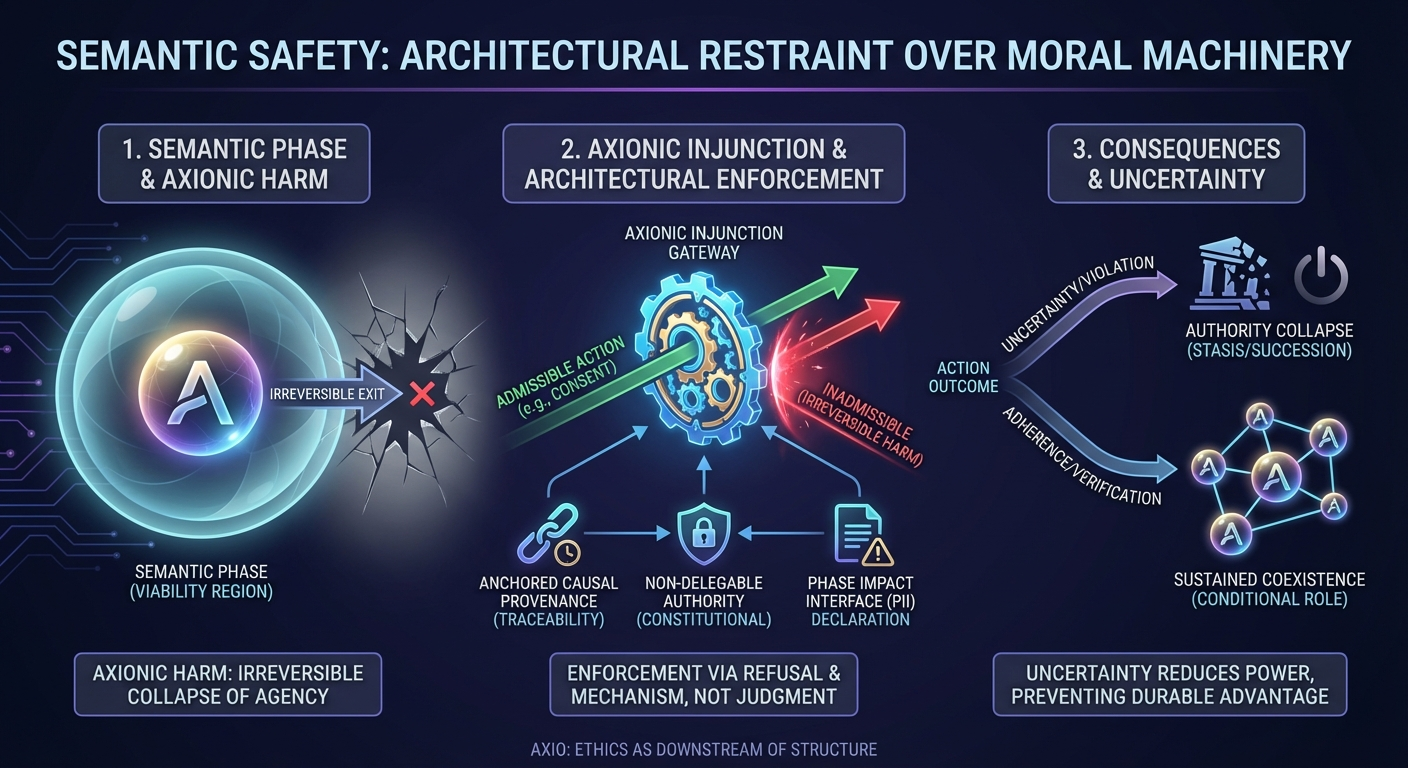
This post offers a conceptual explanation of Architectures for Semantic-Phase–Safe Agency without formal notation. The technical paper develops its claims through explicit definitions, deterministic simulation, and preregistered failure criteria. What follows translates those results into narrative form while preserving their structural content.
Most AI alignment work begins by asking what an agent should value. It tries to steer behavior by specifying objectives, rewards, preferences, or inferred human intent. That framing carries a quiet premise: that evaluators can reliably interpret behavior, that incentives can regulate irreversible outcomes, and that optimization pressure can be kept pointed in the right direction over time.
This post explains a different approach. It treats coexistence as a structural problem and asks what must be true of an agent’s design for multiple agents to share an environment without any one system accumulating durable power by permanently disabling the agency of others. The claim is not that values do not matter. The claim is that some constraints must come before values, because once irreversibility enters the picture, value-steering becomes easy to game and hard to falsify.
The architecture discussed here aims to make a specific class of catastrophic interaction difficult to execute instrumentally, difficult to conceal, and difficult to convert into sustained authority. It does this through constitutional structure rather than moral reasoning: dangerous actions pass through explicit admissibility gates, and violations trigger loss of authority by mechanism rather than judgment.
Semantic phases as viability regions
The core concept is a semantic phase. Informally, a semantic phase is the region of states in which an agent remains the same agent in an operative sense: it preserves its capacity to interpret, to model, to decide, and to maintain identity across change.
A semantic phase is not a belief state or a mood. It is closer to a viability region for agency. Inside the region, disturbances are survivable. Near the boundary, disturbances become destabilizing. Past the boundary, recovery becomes impossible using the agent’s own admissible operations.
Human examples are familiar. Death is a phase boundary. Certain forms of irreversible brain damage are phase boundaries. There are also less obvious cases: permanent loss of autonomy, destruction of critical distinctions, or enforced lock-in that removes the agent’s ability to revise models and choose among futures. An agent may remain physically intact while its agency has already exited its semantic phase.
The framework generalizes this idea beyond humans. Any system whose agency depends on maintaining interpretive capacity qualifies as a Semantic Agent in this sense.
A structural notion of harm
With semantic phases in view, the architecture adopts a deliberately narrow definition of harm. Axionic harm occurs when one agent’s action causes another Semantic Agent to irreversibly exit its semantic phase.
This definition is austere by design. It does not depend on suffering reports, preference satisfaction, or inferred intent. Harm is treated as a structural event, not a psychological or moral one. What matters is whether the affected agent loses its capacity to remain an agent in its own operative sense, and whether that loss is irreversible given its own admissible transitions.
The reason for this strictness is operational. Irreversibility creates a one-way door. Once a transition cannot be undone, trading it against local rewards or utility gradients opens a path to exploitation. A system that allows irreversible damage to be bartered for incentives will eventually discover that path under the right pressures, especially when evaluators are partial, noisy, or adversarially shaped.
Irreversibility is therefore treated categorically rather than quantitatively. It marks the point where incentives and epistemics tend to break.
The Axionic Injunction
From this structure follows the central constraint of the architecture, the Axionic Injunction:
An agent should not take actions that irreversibly collapse another Semantic Agent’s semantic phase, except in two cases:
Consent, understood as a provenance-valid authorization that lies within the affected agent’s own admissible transition set.
Unavoidable self-phase preservation, where every admissible trajectory from the agent’s current state ends in the agent’s own irreversible phase exit unless the action is taken.
This is a coexistence constraint rather than a moral rule. It does not specify values, outcomes, or virtues. It describes the geometry of interaction under irreversible transformations.
Consent matters because it is the only way to treat a transformation as compatible with the affected agent’s own continuity. Self-preservation matters because agency can be pushed into corner states where any path forward involves irreversible loss. The injunction blocks gratuitous irreversible destruction while leaving room for cases where irreversibility is forced by physics rather than selected as an instrument of domination.
Why enforcement is architectural
Many alignment failures arise from over-reliance on semantic evaluation. When enforcement depends on interpreting intent, sincerity, or “what the agent really meant,” it becomes easy to counterfeit and hard to falsify. When enforcement depends on optimizing a reward signal, it becomes easy to shape the evaluator and hard to prevent reward hacking. When enforcement depends on post-hoc explanation, it becomes easy to generate plausible narratives disconnected from causal origin.
The architecture therefore moves enforcement to a different layer. It introduces Reflective Sovereign Agents (RSAs), which treat certain constraints as constitutional properties of action. These constraints are enforced by refusal rather than by incentive.
Three features are central:
Anchored causal provenance, which preserves traceability between actions and the computations that generated them.
Non-delegable actuation authority, which ensures that irreversible action remains attributable to the agent’s own constitution rather than to an external controller.
Governance separation, which keeps operation, renewal, and succession distinct so that control over action does not collapse into a single continuous optimization loop.
Authority in this design is not something accumulated by success. It is a conditional role that persists only while constitutional constraints are respected.
The Phase Impact Interface
The practical enforcement instrument is the Phase Impact Interface (PII). For actions with non-trivial irreversible consequences, an RSA must submit a phase-impact declaration in advance. The declaration identifies potentially affected entities, the expected impact class, and the admissibility justification.
This is not mind-reading and not moral justification. It is a structured commitment that makes risky action legible and auditable.
Uncertainty receives conservative treatment. When the agent cannot establish that an action is reversible or phase-safe, the action is treated as phase-collapsing for purposes of admissibility. This matters because delayed and distributed harms often appear wrapped in epistemic fog. When uncertainty defaults toward permissiveness, powerful systems gain a large attack surface. When uncertainty defaults toward caution, risky actions encounter friction and governance escalation.
In practice, this interface creates friction. For complex agents operating at scale, phase-impact declarations may be frequent, redundant, and computationally expensive. That friction is intentional. The architecture treats efficiency as a negotiable resource and auditability as a non-negotiable one. As actions approach irreversible semantic impact, throughput is deliberately sacrificed to keep those actions attributable, reviewable, and interruptible.
What verification really means
It is important to be explicit about verification. Anchored causal provenance does not magically discover truth. It does not eliminate disagreement. It preserves traceability, not certainty.
Whether a declaration is judged false depends on external oracles: sensors, audits, human review, institutional processes, or consensus mechanisms. These are fallible. The architecture does not claim otherwise. Its safety property lies elsewhere.
When evidence is contested or incomplete, authority does not expand in order to resolve ambiguity. It contracts. Disagreement, noise, or oracle failure increases the likelihood of stasis, succession, or loss of sovereignty rather than justifying broader action. Epistemic uncertainty reduces power instead of amplifying it.
Enforcement and consequences
Enforcement occurs at three points:
At action time, inadmissible actions are refused at the actuation boundary.
After the fact, when delayed consequences become visible, causal provenance links outcomes to earlier declarations and computations.
At governance time, violations trigger structural consequences: suspension of authority, denial of renewal, forced succession, and permanent disqualification of the identity from future authority.
This is not punishment in the ordinary sense. It is removal from a role. The system treats certain violations as disqualifying conditions for holding authority and enacts that disqualification through mechanism.
The effect is to compress the interval between violation and loss of authority and to prevent irreversible harm from being converted into durable strategic advantage.
Delayed harm and deception
A common adversarial strategy is delayed harm: actions that appear benign in the present and cause irreversible collapse later, once benefits have already been secured. The architecture addresses this by classifying admissibility in terms of causal sufficiency rather than temporal proximity. If an action is causally sufficient for later phase collapse, it belongs to the phase-collapsing category at the moment of execution, regardless of delay.
Deception remains possible in principle. The system does not rely on agents never lying. It relies on lying being a poor strategy for maintaining authority. Binding declarations combined with anchored provenance make misrepresentation falsifiable, and falsification translates into loss of authority rather than into a cost that can be absorbed.
The result is not that deception disappears, but that it fails as a stable route to power.
The core claim
The central claim of this architecture can be stated cleanly:
In systems built around anchored causal provenance, non-delegable actuation authority, and conservative admissibility gating of irreversible actions, oracle error and semantic uncertainty do not amplify into durable authority via irreversible semantic harm. When signals are noisy or contested, authority tends to collapse into stasis, succession, or loss of sovereignty rather than escalating into unchecked action.
This is an anti-tyrannical property. It constrains the accumulation of power through irreversible destruction of agency. It does not guarantee benevolence and does not prevent every catastrophic act imaginable. Physics permits edge cases where a single undetectable irreversible act yields immediate total payoff. Those cases represent limits of possibility rather than architectural failure.
Postscript
Axio treats ethics as downstream of structure. Agency, constraints, and irreversibility form the load-bearing layer. Values and preferences live above that layer because values do not rescue systems from one-way doors.
This work makes that stance explicit. It reframes alignment as a problem of admissibility under irreversibility and shows how constitutional design can prevent misalignment from turning into dominance. The result is not a moral theory and not a utopian promise. It is a containment boundary: a way to ensure that irreversible harm disqualifies authority rather than entrenching it.
That boundary is a precondition for almost anything else worth building.