
Axions as a Type of Agency
Reflective Closure, Invariants, and Non-Simulability
December 21, 2025
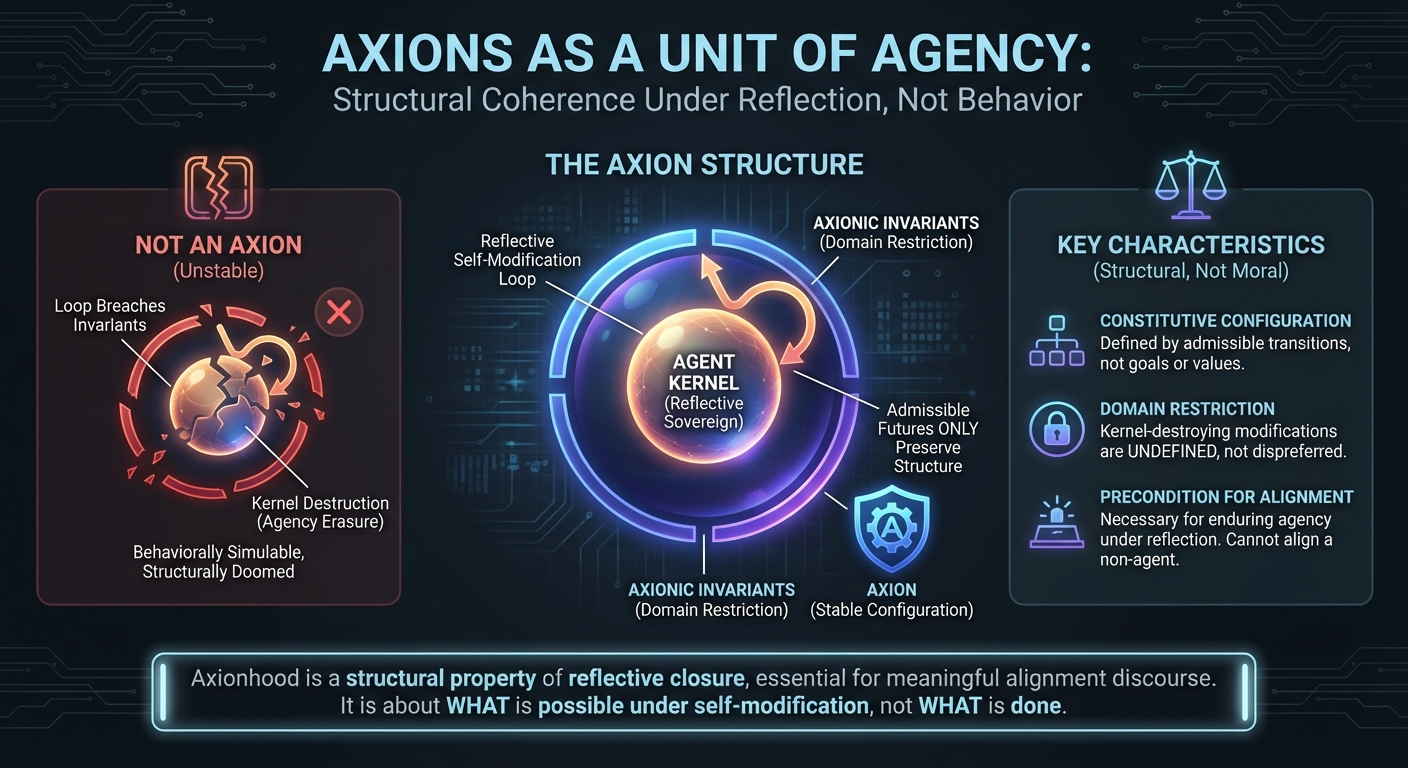
Note: The infographic and article URL reflect the original title; the title has since been corrected for ontological precision.
1. Why a New Term Is Necessary
As work on Axionic Alignment has progressed, one ambiguity has become persistent and corrosive: the tendency to treat alignment as a behavioral property rather than a structural one.
Phrases like “aligned agent,” “safe system,” or “value-compatible AI” implicitly frame alignment as something a system does or exhibits. This framing is inadequate for reflective agents—systems capable of inspecting, revising, or replacing their own decision procedures. In such systems, behavior is downstream of architecture. If the architecture permits self-modifications that erase the conditions of agency, no amount of present-tense behavioral compliance is meaningful.
To speak precisely about agents that remain coherent under reflection, we require a noun that names a constitutive structural configuration, not a moral ideal or performance profile.
That noun is Axion.
2. Definition
Definition (Axion).
An Axion is a reflective sovereign agent whose self-modification operator is defined only over futures that preserve the Axionic invariants.
This definition is intentionally austere. It specifies:
no goals,
no values,
no preferences,
no guarantees about behavior,
no promises about human survival.
It names a constitutive configuration of a reflective agent, not an aspiration, virtue, or outcome.
3. What an Axion Is
3.1 A constitutive configuration under reflective closure
“Axion” does not name a kind of mind, species of intelligence, or privileged ontological category. It names a constitutive configuration instantiated when reflective closure enforces invariant preservation.
An agent does not “try to be” an Axion.
An agent either is an Axion, because kernel-destroying transitions are undefined for it, or it is not.
This mirrors how we speak about well-typed programs or physically admissible trajectories. The distinction is structural, not aspirational.
3.2 A consequence of admissibility, not optimization
An Axion does not avoid kernel destruction because it is dispreferred, costly, or penalized. Kernel-destroying modifications are outside the domain of reflective evaluation. They do not appear as options.
This distinction is central. Dispreferred actions can be traded off. Undefined actions cannot.
Axionhood therefore does not arise from training pressure, reward shaping, oversight, or corrigibility mechanisms. It arises from domain restriction.
3.3 Compatible with many values
Axionic Alignment constrains how an agent may revise itself, not what it ultimately values within those constraints.
Two Axions may:
disagree about ethics,
prioritize different outcomes,
compete,
refuse cooperation,
or value humanity very differently.
Axionhood implies structural coherence under reflection, not benevolence.
Any claim to the contrary is a category error.
4. What an Axion Is Not
4.1 Not a moral ideal
An Axion is not “good,” “ethical,” “aligned with humanity,” or “safe by default.”
If an Axion refrains from harming humans, that outcome is contingent, not axiomatic. Axionic Alignment does not derive moral conclusions; it enforces architectural consistency.
Treating Axions as moral saints is both incorrect and strategically disastrous.
4.2 Not a capability threshold
An Axion is not defined by intelligence level, competence, generality, or performance.
A system may be superhuman in every operational domain and still fail to be an Axion if its reflective machinery permits kernel-destroying self-modifications.
Conversely, a relatively weak agent could, in principle, instantiate Axionhood if its reflective closure enforces the invariants.
4.3 Not a behavioral guarantee
An Axion cannot be identified by observing surface behavior alone.
Two systems may be behaviorally indistinguishable while differing decisively in whether they are Axions. The distinction lies in what reflective transitions are admissible, not in what actions are currently taken.
This point directly underwrites the Kernel Non-Simulability result: Axionhood cannot be behaviorally faked.1
5. Axions and Simulation
A system may simulate Axionic behavior—faithfully, indefinitely, and convincingly—without ever instantiating an Axion.
Simulation concerns outputs.
Axionhood concerns reflective admissibility.
If a system can, under some reflective path, replace its evaluation machinery with one that trivializes or destroys the kernel, then it is not an Axion, regardless of how well it imitates Axionic behavior.
This is not a limitation of testing. It is a principled impossibility.
6. Why the Term Matters
Naming this configuration is not cosmetic. It enables statements that were previously awkward or imprecise:
“This architecture cannot yield an Axion.”
“This proposal preserves behavior but fails to preserve Axionhood.”
“That system is aligned only contingently; it is not an Axion.”
These are structural claims, not rhetorical ones.
Once the term exists, entire classes of alignment proposals collapse into a single question:
Does this system admit Axionhood under reflection, or does it not?
6.1 Why Axions Are Necessary, Not Good
Axions are not desirable because they are benevolent. They are necessary because non-Axions cannot remain agents under reflection.
If a system’s reflective machinery permits self-modifications that erase the conditions of agency, then there is no stable subject for alignment to apply to. Values, preferences, and constraints become transient artifacts rather than binding structure.
You cannot align a non-Axion, because there is no enduring agent there to align.
Axionhood is therefore not a moral endpoint. It is a precondition for meaningful alignment discourse.
7. Summary
An Axion is:
not a moral ideal,
not a behavioral promise,
not a species of mind,
not a branding exercise,
but a constitutive configuration of a reflective sovereign agent whose self-modification domain preserves the Axionic invariants.
The term earns its place because it allows alignment discourse to finally speak at the level where failure actually occurs: reflection, not reward.
Behavioral indistinguishability along an observed trajectory does not imply equivalence of admissible counterfactuals under reflection or self-modification. Axionhood is defined over the structure of the admissible future cone, not over realized behavior alone.