
Tool Bias
Why Strong Models Perform Poorly on Weak Evidence
November 30, 2025
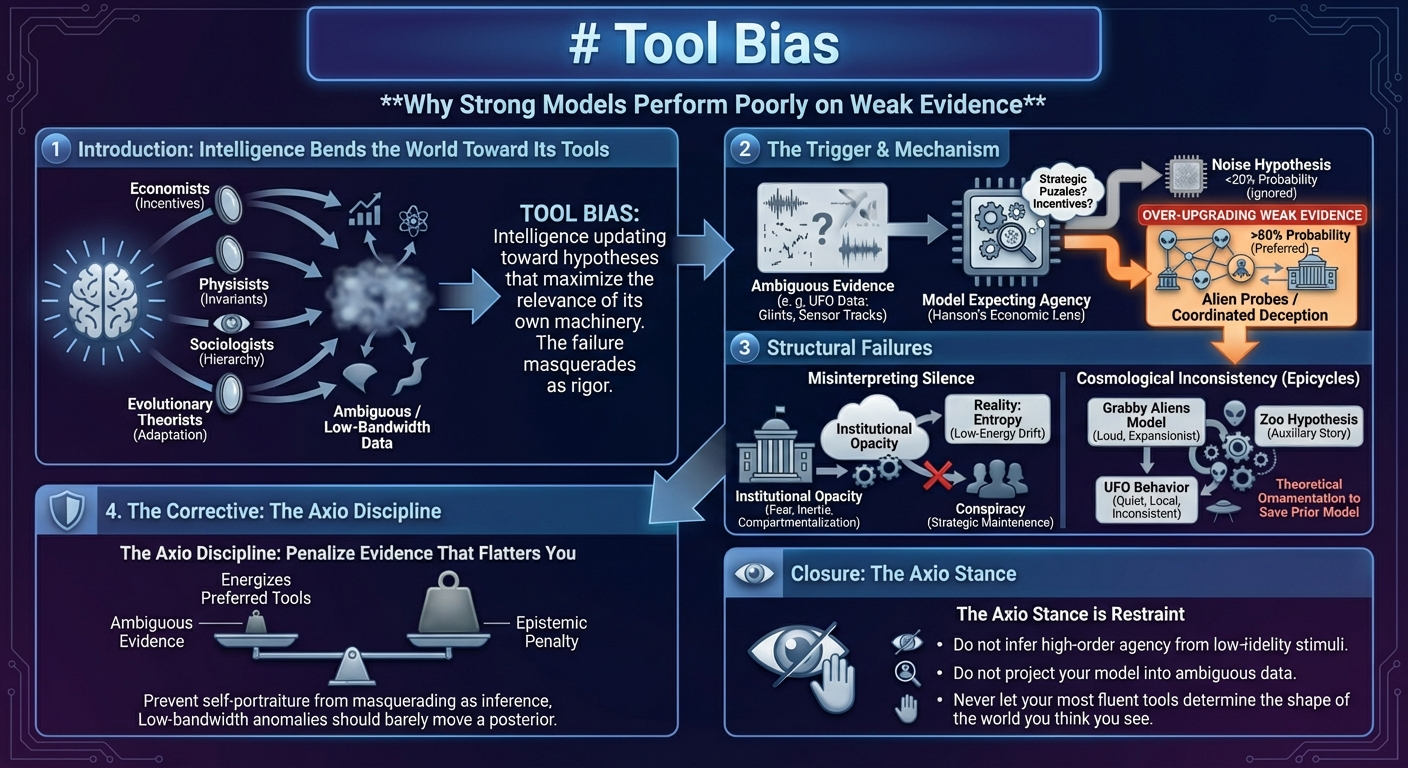
1. Introduction: Intelligence Bends the World Toward Its Tools
Every mind has a preferred architecture. Economists see incentives; physicists see invariants; sociologists see hierarchy; evolutionary theorists see adaptation. These lenses are not passive descriptions—they are active attractors. When the data is ambiguous or low‑bandwidth, the mind bends the world toward the tools it trusts.
This is tool bias: intelligence updating toward hypotheses that maximize the relevance of its own machinery. The failure is subtle, not theatrical. It masquerades as rigor because the internal reasoning is clean while the inputs are contaminated.
Robin Hanson’s recent UFO update is an ideal specimen. The surface rhetoric is Bayesian. The underlying structure is warped by mis-specified likelihoods, overinterpreted noise, and the gravitational pull of a model searching for a problem it can solve.
2. The Trigger: Ambiguous Evidence Meets a Model That Expects Agency
Hanson’s shift rests on a claim that recent UFO data—”glints,” sensor tracks, pilot testimony—carries too much structure to be mundane. He assigns less than 20% probability to the noise hypothesis and drives the posterior toward alien probes or a decades-long coordinated deception.
The problem is the likelihood term. Classified sensor data is not independent evidence. Modern systems share processing pipelines, timing signals, classification libraries, fusion algorithms, and human operators primed by earlier cues. A single software artifact can generate a multi-sensor “confirmation,” and a fusion glitch can produce synchronized ghosts. Treating these channels as independent is a structural error: multiplying probabilities that should be discounted or collapsed.
This is Bayesian form over Bayesian substance.
3. Silence as Entropy, Not Coordination
Hanson interprets institutional opacity as evidence of sustained deception. But bureaucratic silence does not require intention; it requires only fear, compartmentalization, and inertia.
The government does not maintain a coherent narrative about anything for 75 years—not public health, not foreign policy, not procurement. The idea that it has maintained one about aliens misunderstands how institutions fail. Silence is the equilibrium state of risk-averse systems.
Confusion looks like conspiracy from the outside because both produce opacity. Internally, one is low-energy drift; the other requires continuous strategic maintenance. The first is common. The second is exceptional.
4. Cosmological Inconsistency: Epicycles to Rescue a Narrative
Hanson’s signature cosmological work—the Grabby Aliens model—predicts loud, expansionist civilizations. It is a clean application of economic reasoning to cosmic evolution.
UFO behavior, by contrast, is quiet, local, inconsistent, and strategically incoherent. To reconcile these, Hanson introduces a Zoo Hypothesis: aliens birthed in our stellar nursery impose a non-expansion regime on us.
This is theoretical ornamentation—an auxiliary story added to preserve a prior model in the face of ambiguous data. When elegance is sacrificed to salvageability, the conceptual compass has already drifted.
5. Tool Bias: The Mechanism Beneath the Mistake
Why did Hanson over-upgrade ambiguous evidence? Because the hypothesis he chose is precisely the one that activates his core competencies.
Noise gives him nothing to model. Aliens and conspiracies, however, place him back on familiar ground, where incentives shape behavior, signaling equilibria matter, strategic silence becomes analyzable, and coordination dynamics can be mapped. This is his native terrain. In a world of sensor ghosts, Hanson has no comparative advantage. In a world of covert alien governance or bureaucratic deception, he regains relevance.
This is the signature of tool bias: the selection of hypotheses that best match one’s intellectual vocabulary, even when the data is too thin to justify it.
6. The Axio Discipline: Penalize Evidence That Flatters You
The corrective principle is simple: when ambiguous evidence seems to energize your preferred tools, the rational response is to impose an additional epistemic penalty. This discipline prevents self-portraiture from masquerading as inference. Minds naturally amplify data that makes their machinery decisive; the discipline is to restrain that temptation.
Low-bandwidth anomalies—especially those emerging from classified, non-replicable, correlated systems—should barely move a posterior. When they move it dramatically, the cause is rarely the data. It is the geometry of the mind interpreting it.
7. Closure: Intelligence as a System Vulnerable to Its Strengths
Sophisticated minds do not fail by missing obvious patterns. They fail by seeing patterns where their tools fit too neatly. They fail by mistaking correlated noise for independent evidence. They fail when their theoretical aesthetic pulls harder than the quality of the data.
Hanson’s UFO update is not madness. It is a structural failure mode: a specialist applying a sharp, agent-centric toolkit to a domain dominated by noise and secrecy.
The Axio stance is restraint: do not infer high-order agency from low-fidelity stimuli. Do not project your model into ambiguous data. And never let the tools you wield most fluently determine the shape of the world you think you see.