
Agency Conservation
Why Debts Must Be Paid
November 26, 2025
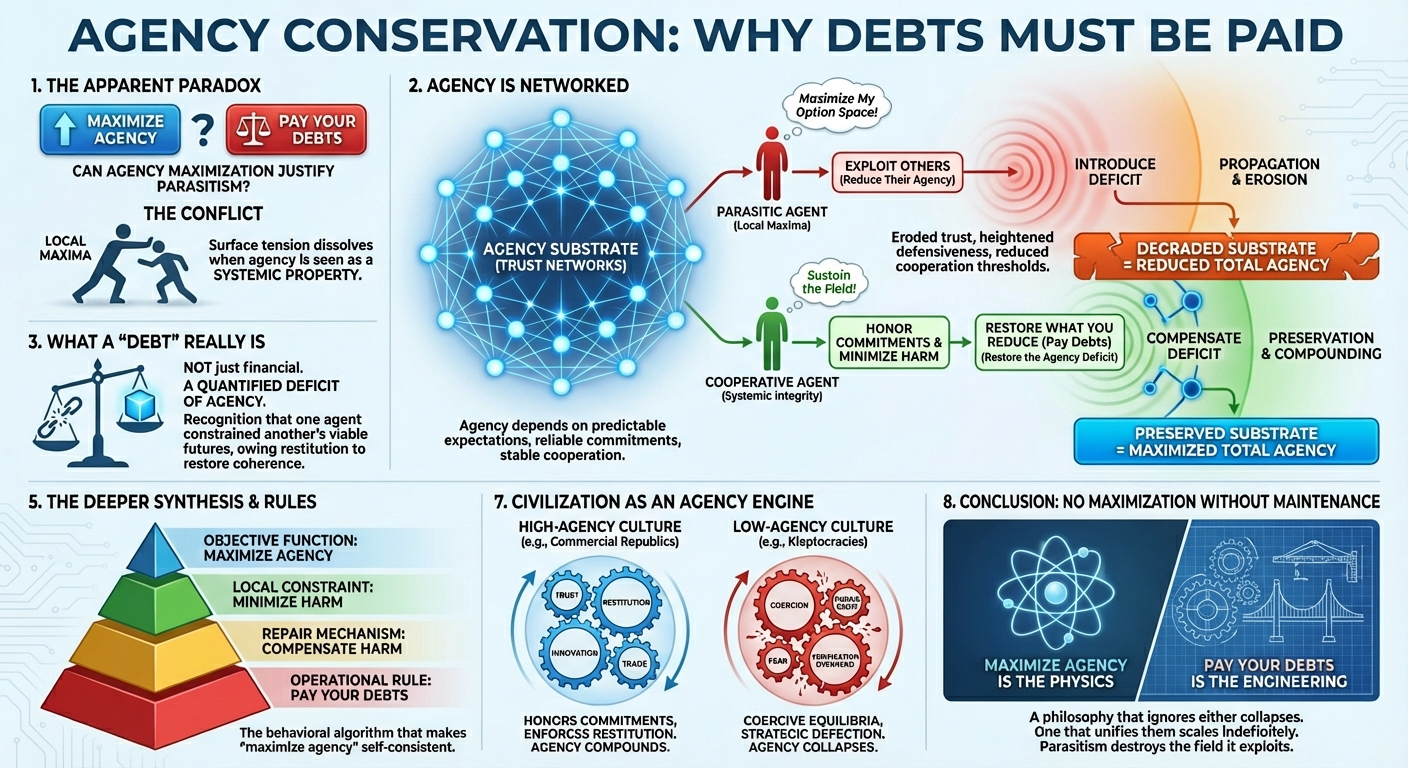
1. The Apparent Paradox
Can agency maximization justify parasitism?
On the surface, “maximize agency” and “pay your debts” look like different ethical layers. One operates at the level of civilizational architecture; the other reads like a moral injunction from a desert trading culture. But the tension dissolves once you examine the mechanics of agency itself. The key is understanding that agency is not a private commodity. It is a systemic property of a multi-agent environment. Any attempt to enlarge one’s own freedom of action at the expense of the system that supports it is, in the strictest sense, self-defeating.
The intuition that sparked this essay—Can someone maximize agency without paying their debts?—highlights the exact edge where simplistic individualism breaks and structural thinking begins. Once you analyze what debts actually represent, the reconciliation becomes inevitable.
2. Agency Is Not Isolated; It’s Networked
Agency depends on predictable expectations, the reliability of commitments, the stability of cooperation, and the absence of coercive threat. These structures emerge from networks of trust, not from isolated wills. An individual can temporarily increase their option space by exploiting others, but the effect is parasitic: the local gain shrinks the global substrate that made the gain possible. A defector’s advantage is borrowed from a trust reservoir they did not create.
A society in which agents routinely seize local maxima at the cost of systemic integrity becomes a low-agency environment: defensive, suspicious, verification-heavy, and ultimately coercive. Rogue agency consumes the field of possibility that supports genuine agency.
3. What a “Debt” Really Is
A debt is not primarily a financial claim but a quantified deficit of agency—the recognition that one agent has constrained another’s viable futures through harm, error, exploitation, or reliance, and now owes restitution to restore coherence. Refusing to repair that deficit exports the loss into the system, forcing others to absorb it and degrading the trust infrastructure that agency depends on. The resulting ripple—eroded trust, heightened defensiveness, reduced cooperation thresholds, and increased coercion risk—illustrates why debts are the accounting layer of agency conservation.
4. The Mechanics of the Constraint
Maximizing agency without paying debts fails because it commits the fundamental error of treating agency as rivalrous. Agency is non-zero-sum only when agents maintain the cooperative equilibria that support it. Those equilibria depend on preserving the integrity of commitments.
A concrete case makes this clearer. Consider a contractor who accepts payment and then quietly cuts corners, leaving structural flaws the client must later repair. The contractor locally increases their own agency—saving time, reducing effort, pocketing profit—but only by exporting a hidden deficit into the environment. The client’s agency shrinks through unexpected cost, risk, and disruption. Trust erodes, verification overhead rises, and future transactions require defensive postures from all parties. The local gain generates a global loss.
The rule is structural:
If you reduce another agent’s agency, you introduce a deficit.
If the deficit is not compensated, it propagates.
Propagation degrades the agency substrate.
A degraded substrate reduces total agency.
Thus, maximizing agency requires repairing all deficits you cause.
Paying debts is not optional; it is an essential term in the optimization function.
5. The Constraint Makes the Objective Coherent
“Maximize agency” is the global imperative. But without constraints, global imperatives collapse into pathology. The unbounded maximizer becomes a vandal. To avoid this, the principle must be bound by a rule that preserves systemic integrity.
That rule is:
Restore what you reduce.
Paying debts turns agency maximization from a predatory strategy into a sustainable one. It aligns individual flourishing with collective flourishing by forcing agents to repair the distortions they introduce. In game-theoretic terms, it prevents exploitation equilibria. In cybernetic terms, it preserves the feedback dynamics needed for coherence.
6. The Deeper Synthesis
The concepts are not separate; they are the same system at different scales.
Maximize Agency → Objective function.
Minimize Harm → Local constraint.
Compensate Harm → Repair mechanism.
Pay Your Debts → Operational rule.
The architectural principle and the ethical injunction are structurally fused. “Pay your debts” is the behavioral algorithm that makes “maximize agency” self-consistent.
7. Civilization as an Agency Engine
Civilizations rise and fall by their ability to preserve and expand the field of agency. High-agency cultures honor commitments, enforce restitution, and constrain exploitation. Consider the commercial republics of Renaissance Italy or early Dutch mercantile society: systems where contract enforcement, reputation, and restitution mechanisms created dense, reliable networks of optionality. These cultures generated innovation, trade, and institutional robustness because the accounting layer was rigorously maintained.
By contrast, low-agency cultures—feudal polities riddled with arbitrary power, or contemporary kleptocracies where corruption is endemic—operate in coercive equilibria. Unpaid debts, unaccounted harms, and strategic defection make trust impossible. Verification overhead replaces cooperation; fear replaces planning; optionality collapses.
When the accounting layer collapses, the agency layer collapses with it. When the accounting layer is preserved, agency compounds.
The most compressed expression of this truth remains stark and elegant:
Pay your debts.
It is not a moral platitude. It is a structural requirement for maintaining a world in which agency can grow, compound, and sustain itself.
8. Conclusion: No Maximization Without Maintenance
The reconciliation is complete. You cannot maximize agency without paying your debts because unpaid debts are negative agency artifacts. They subtract from the system that supports any future gain. Debt repayment is the local, actionable enforcement of the global objective.
In short:
Maximize agency is the physics.
Pay your debts is the engineering.
A philosophy that ignores either collapses. One that unifies them can scale indefinitely. And with that, the original paradox—whether agency maximization could ever justify parasitism—resolves itself: it cannot, because parasitism destroys the very field it exploits.