
The Illusion of Moral Collapse
Atheism doesn’t abolish morality — it relocates it within agency itself.
November 03, 2025
1. The Claim
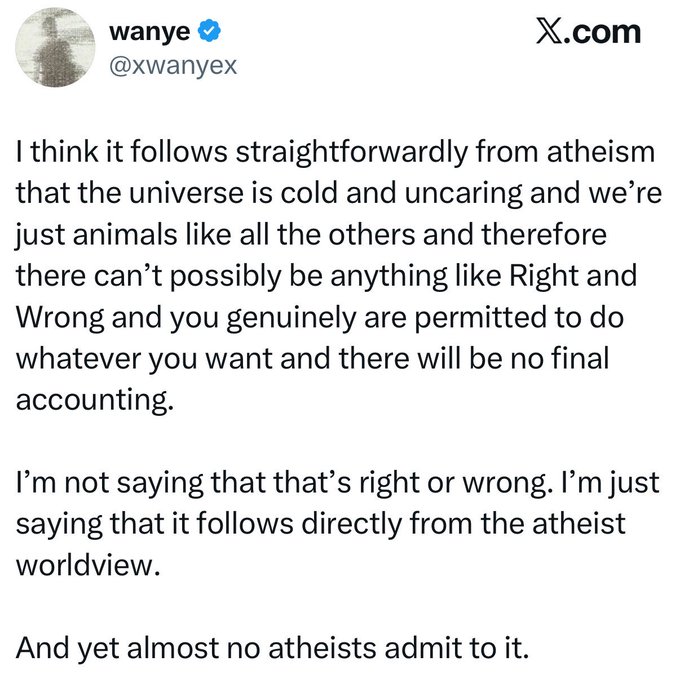
A viral tweet argues that atheism straightforwardly entails moral nihilism: that if the universe is cold and uncaring, then there can be no real Right or Wrong, and thus one is “permitted to do whatever one wants.” The author insists this follows directly from the atheist worldview and that atheists merely refuse to admit it.
2. The Category Error
This argument commits a modal slide—a confusion between descriptive, agential, and normative modalities:
Descriptive (alethic): what is physically possible.
Agential (ability): what an agent can in fact do, given their causal and cognitive constraints.
Normative (deontic): what is permitted, required, or forbidden under some standard.
The tweet conflates these layers. It moves from a metaphysical claim (atheism) to a moral claim (nihilism) by erasing the distinctions between physics, agency, and ethics.
3. Why Each Step Fails
Atheism → Cold Universe: Descriptively true that nature is indifferent, but normatively irrelevant. Indifference of the cosmos doesn’t erase the existence of local norms.
Cold Universe → No Right/Wrong: False. Moral systems emerge naturally from the behavior of agents embedded in networks of consequence, cooperation, and reciprocity. Right and Wrong are conditional invariants for coherent agents, not divine decrees.
No Right/Wrong → Permitted to Do Whatever You Want: False in both senses. You are not able to do whatever you want (causal and psychological limits) and not permitted to do whatever you can (normative systems constrain behavior). Permission presupposes a standard; removing God doesn’t abolish standards—it internalizes them.
4. The Axio Correction
In the Axio framework:
Ability is bounded by causal feasibility.
Permission is bounded by normative coherence.
Motivation is bounded by the structure of desire and consequence.
These constraints exist in all possible universes, divine or otherwise. Atheism eliminates external command, not internal order. Norms persist as emergent coherence conditions for agency—patterns of action that sustain, rather than destroy, the agents who follow them.
5. The True Accounting
There is, in fact, an accounting—not eschatological, but causal. Choices propagate through social systems, feedback loops, and memory. Destructive agents collapse their own future agency. Coherent agents maintain it. The universe does not punish; it simply responds.
6. Summary
The tweet mistakes the loss of divine permission for the loss of all permission. It assumes that if morality is not absolute, it is illusory. Axio rejects that false dichotomy. Value is conditional, not arbitrary; morality is emergent, not decreed.
The absence of divine command does not liberate us from consequence. It merely returns responsibility to where it always belonged — within the causal web of action.