
The Fragility of Rights
On the collapse of law into mere permission
September 24, 2025
What Can’t They Do?
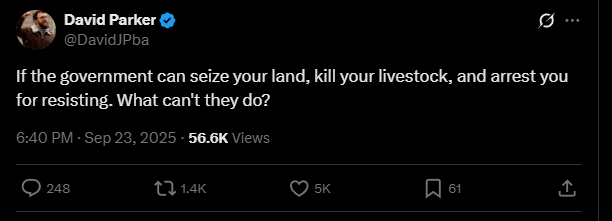
David Parker’s provocation exposes a perennial truth: when the state asserts the authority to seize property, extinguish livelihood, and criminalize resistance, there are no meaningful boundaries left to its power. The question—what can’t they do?—is not rhetorical but diagnostic. It reveals that once these core domains are subordinated, all else becomes contingent.
The Three Levers of Sovereignty
Property → Secure property is the material basis of independence. When property rights exist only at the state’s discretion, the individual becomes a tenant of power rather than an owner of his life.
Livelihood → To destroy the means of sustenance is to annihilate agency. Hunger and dependency are the most ancient instruments of control.
Liberty → When resistance itself is criminalized, the circle closes. Autonomy becomes not merely precarious but prosecutable; the attempt to live freely is construed as guilt.
Once these three are subject to arbitrary suspension, the category of “citizen” collapses into that of “subject.” The distinction is largely semantic. Modern polities deploy the rhetoric of citizenship while sustaining the same asymmetry of command and obedience that defined older regimes.
Bastiat’s Diagnosis
Frédéric Bastiat described this transformation as legal plunder: the perversion of law into an instrument of expropriation. When law legitimizes confiscation, destruction, and imprisonment, its function shifts from protecting liberty to consolidating authority. What is paraded as order is, in substance, coercion institutionalized.
The Moment of Recognition
Thoughtful observers eventually perceive that constitutions and charters are fragile fictions, effective only insofar as they are honored in practice. Once “exceptional circumstances” become the norm—invoked under the banners of emergency powers, national security, or public health—the mask slips. Rights are revealed not as inviolable claims but as conditional permissions.
This recognition is not cynicism but lucidity. A state that can override property, livelihood, and liberty at will is limited by nothing other than its own appetite.
Drawing the Line
The unsettling conclusion is that there is nothing the state cannot do, absent external constraint. Parchment barriers are impotent; only lived resistance sets boundaries. Without opposition, sovereignty metastasizes. With opposition, it may be forced to retreat. The enduring lesson of history is stark: liberty is not bestowed—it is defended.