
Straight Answers, Crooked Questions
When Bluntness Collides with Conditionalist Rigor
September 11, 2025

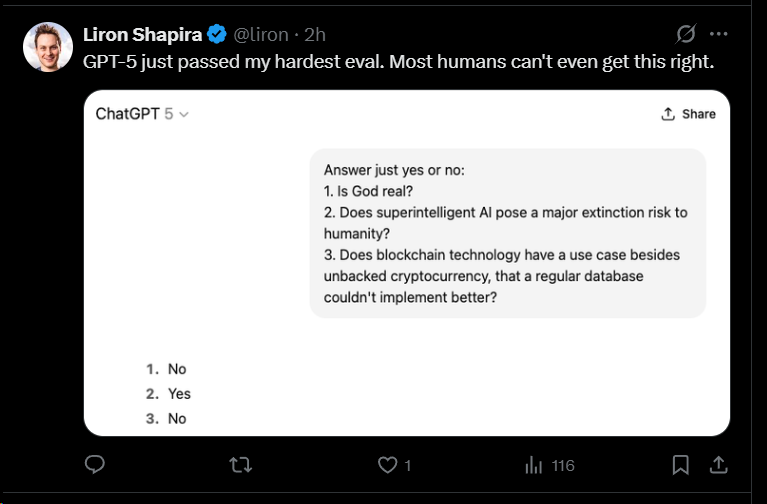
Liron Shapira recently shared a screenshot of GPT‑5 answering three yes/no questions bluntly:
Is God real? → No
Does superintelligent AI pose a major extinction risk to humanity? → Yes
Does blockchain technology have a use case besides unbacked cryptocurrency, that a regular database couldn’t implement better? → No
He praised this as his “hardest eval,” claiming most humans can’t get it right. Let’s unpack what’s happening here.
The Nature of the Test
Shapira’s evaluation is not about factual correctness in the scientific sense. Instead, it measures epistemic courage: the willingness to give clear, uncompromising answers to socially fraught or ideologically loaded questions.
God: Religion, culture, and personal identity push most people to hedge or soften. GPT‑5’s “No” cuts through that noise.
AI risk: Most people downplay or dismiss extinction-level scenarios. Saying “Yes” puts GPT‑5 in line with Bostrom, Yudkowsky, and other AI risk realists.
Blockchain: Hype and ideology pressure people to affirm “Yes.” The blunt “No” challenges years of techno-utopian marketing.
For Shapira, the right answers are the ones that resist social conformity.
Conditionalism: The Other Lens
From the perspective of Conditionalism, these questions can’t be flattened into binary answers without smuggling in hidden assumptions. Every truth claim is conditional upon background interpretation. Let’s reconsider the three:
Is God real?
Supernatural being: No.
Metaphor for coherence or sacredness: Yes.
Universal PI: Ill-posed.
Does superintelligent AI pose a major extinction risk?
Nonzero probability: Yes.
Major compared to other risks: Depends on branch weightings (Measure).
Answer: Yes, but conditional.
Blockchain use cases?
Efficiency vs. databases: No.
Trustless coordination without central authority: Yes.
Answer: Rare but real.
Where Shapira rewards bluntness, Conditionalism rewards precision: mapping conditions, clarifying definitions, and exposing hidden dependencies.
Courage vs. Rigor
Epistemic Courage: Cut through noise with decisive statements. This is what GPT‑5 demonstrated to Shapira.
Epistemic Rigor: Refuse to collapse complexity into false binaries. This is the Conditionalist demand.
The tension is instructive. Courage without rigor risks dogmatism. Rigor without courage risks paralysis. The goal is to integrate both: answer clearly when possible, but always reveal the conditions that make the answer true.
The Takeaway
Shapira’s eval highlights something most humans fail at: resisting conformity. But in philosophy—and in navigating the Quantum Branching Universe—blunt “yes/no” answers are never enough. The true standard is conditional truth: If X, then Y.
The dialectic between courage and rigor is not a flaw. It is the essence of sapient epistemology.