
Mirrors of the Mind
Dissolving the Hard Problem
September 11, 2025
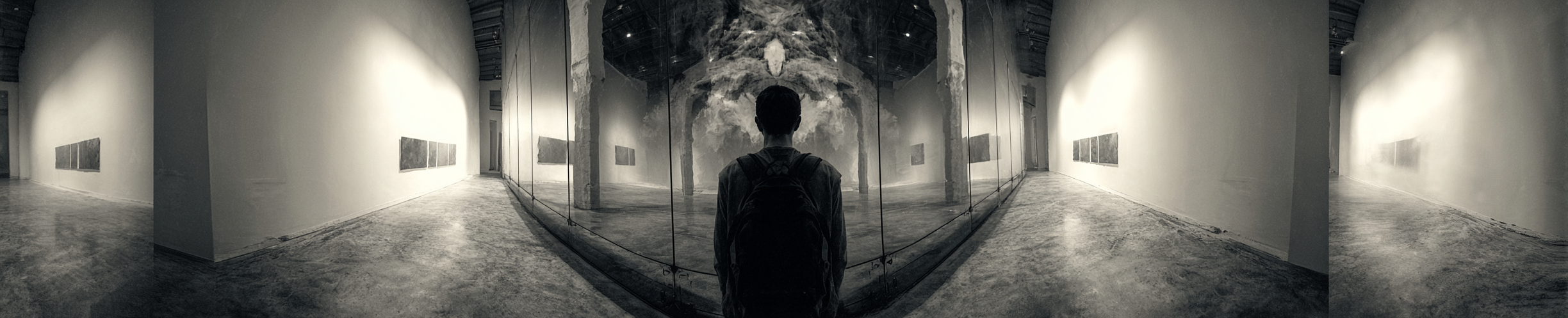
Introduction: The Phantom of the Hard Problem
Ever since David Chalmers coined the term in the 1990s, the "hard problem of consciousness" has haunted philosophy of mind. It asks: Why does information processing in the brain give rise to subjective experience? Why is there something it feels like to see red, to feel pain, or to taste salt, rather than nothing at all?
Most problems in cognitive science are "easy problems"—questions about mechanisms and functions. But this one, we are told, cuts deeper: no matter how much we explain about neurons, circuits, and behaviors, we still haven’t explained why it feels like something from the inside.
I will argue here that the hard problem is not hard—it is ill-posed. Consciousness is not an ineffable mystery; it is what happens when an agent runs a model of itself. Qualia are not metaphysical primitives; they are the way that internal states present themselves from the agent’s perspective. The so-called “hard problem” is a category error.
This is what I call the Agency-Model Theory of Consciousness (AMT).
1. The Brain as a Predictive Machine
Brains are not passive data recorders. They are predictive engines. Their central function is to construct generative models of the world, anticipate what will happen next, and adjust behavior to minimize surprise. This is the essence of predictive processing and Karl Friston’s active inference framework: the brain continuously guesses what inputs it will receive and updates its models when those guesses fail.
An organism without a model of the world cannot act effectively. It would be at the mercy of raw stimuli, unable to anticipate threats, opportunities, or patterns. Evolution built brains to model.
2. The Self-Model as Necessary Machinery
Among these models is a special one: the self-model. This model encodes the system’s own sensory inputs, internal states, and potential actions. It is indispensable for survival. Without a self-model, there is no way to regulate hunger, avoid injury, or coordinate action.
The self-model is not a single thing, but a nested hierarchy: from low-level interoceptive signals (hunger, heartbeat, pain) to high-level identity and intention (beliefs, plans, self-concepts). It is the mirror in which the system sees itself.
3. Qualia as Internal Presentations
Now we reach the crux. What philosophers call qualia are simply the contents of the self-model as accessed internally.
The redness of red is the way the visual subsystem partitions wavelengths for efficient discrimination.
Pain is not a metaphysical essence; it is an internal warning signal: avoid this trajectory.
Emotions are global state summaries, broadcasting guidance for adaptive behavior.
The key is epistemic transparency: the system cannot see the machinery, only its outputs. From the inside, you don’t see neurons firing or models updating; you just feel red, pain, joy, or hunger. That transparency is what makes qualia seem irreducible, but it is simply how modeling presents itself to itself.
4. Why It Feels Like Something
From the outside, the brain is a physical system of firing neurons and flowing ions. From the inside, it is a self-model presenting itself to itself. These are not two different realities; they are two vantage points on the same process.
Third-person view: the scientific description of the machinery.
First-person view: the system’s use of its own self-model.
The hard problem emerges only when we mistake these two perspectives for two ontologically distinct realms. Once you understand them as two descriptions of the same informational process, the mystery evaporates.
5. Consciousness as Agency
Consciousness is not just modeling; it is modeling as an agent. An agent is a system that acts, chooses, and regulates itself. For this, it must have a model that represents itself in relation to the world. The perspective from which that self-model operates is what we call subjectivity.
Consciousness, then, is not a passive glow of awareness. It is the active stance of an agent engaged with the world, running its self-model to anticipate and regulate.
6. Dissolving the Hard Problem
So what of the question: How does matter give rise to subjective experience?
Answer: it doesn’t. That framing is the category error.
Subjective experience is not produced by physical processes. It is the way those processes appear when represented internally in a self-model. There is nothing left over, no metaphysical bridge to build.
The hard problem is like asking:
Where does computation really happen in a program?
How does a map truly represent territory?
The questions dissolve once you recognize the abstraction. The same is true of consciousness.
7. Relationship to Other Theories
Frank Heile’s Modeler Schema Theory (MST): AMT refines the insight that consciousness arises from hierarchical self-models. We agree with MST that qualia are the contents of self-modeling, but sharpen the focus on agency and predictive processing.
Predictive Processing / Active Inference: AMT integrates seamlessly with this neuroscientific paradigm, framing consciousness as the agent’s generative model of itself.
Functionalism: AMT is functionalist but less abstract: consciousness is not any arbitrary functional role, but specifically the function of self-modeling in agents.
Conclusion: The End of a Phantom
The hard problem has enthralled philosophers because it seems to demand an answer beyond science. But the Agency-Model Theory of Consciousness shows it is not a problem at all. Qualia are not ineffable substances; they are the way that self-models present internal states. Consciousness is not a ghost in the machine; it is the machine modeling itself.
Once you see it this way, the supposed mystery evaporates. The hard problem of consciousness is not hard. It is a phantom born of confusion—a shadow cast by our own models when we forget that we are looking in a mirror.