
Simulation Theories
Philosophical, Technological, and Ontological Accounts of Mediated Reality
September 08, 2025
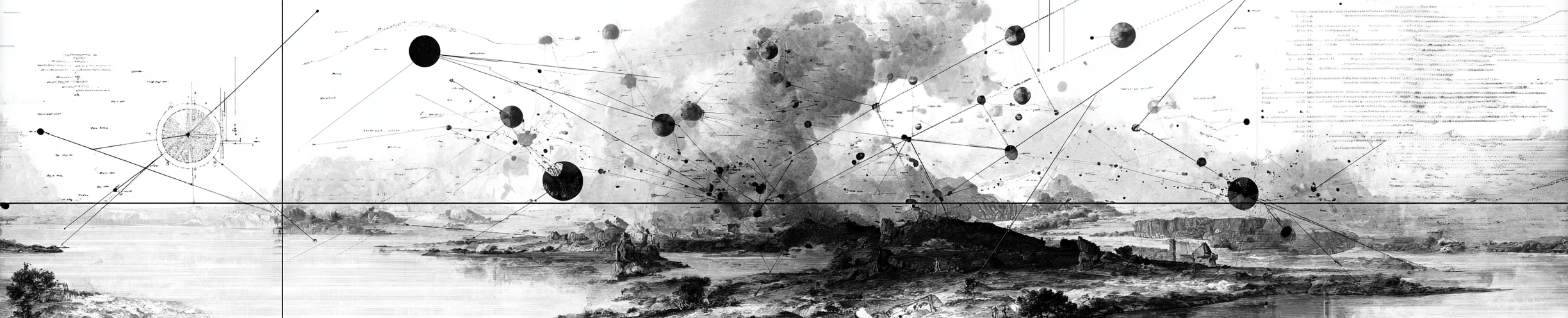
Few ideas grip both philosophers and technologists like the notion that we are living in a simulation. It is an intellectual kaleidoscope: twist it one way and you find Descartes’ evil demon; twist it another and you are inside a GPU-rendered Matrix. The simulation hypothesis takes on many guises, each trying to explain why the world feels both solid and suspect, lawful yet filtered. In this essay we map the territory, not with the intent of closure but to clarify the options and show where they overlap, expand them into deeper historical and conceptual contexts, and highlight their ongoing significance.
1. Philosophical Skepticism Simulations
The oldest ancestors of simulation thinking are skeptical thought experiments:
Evil Demon (Descartes): A powerful deceiver feeds false experiences, leaving us unable to trust our senses. The scenario was designed to emphasize the necessity of radical doubt and the need for foundations stronger than sense perception.
Brain in a Vat (Putnam): A scientist sustains a brain with artificial stimuli, creating an indistinguishable virtual world. This draws attention to semantic and epistemic paradoxes: if one is truly a brain in a vat, how could one meaningfully claim it?
These are not technological hypotheses but epistemic traps: they remind us that perception cannot guarantee reality. Their strength is in highlighting the fragility of knowledge; their weakness is that they provide no positive mechanism beyond doubt. Yet they are the intellectual seedbed for all subsequent simulation theories.
2. Technological Simulations
In the digital age, the skeptical demon becomes a supercomputer:
Bostrom’s Trilemma: Either civilizations never reach the capacity for ancestor simulations, they reach it but choose not to run them, or—most likely—we are inside one. This trilemma reframes ancient skepticism into probabilistic terms.
Computer-Simulation Hypothesis: The universe is literally an execution trace, running on hardware in a higher-level reality. Our physics are algorithms; our constants, variables.
Here the appeal is probability: if simulations vastly outnumber base realities, odds favor that we inhabit one. The weakness is that it assumes computability and sidesteps the regress: what runs the hardware? Philosophically, it risks collapsing into tautology—reality is always the lowest layer we can access, even if it is not the bottom-most layer.
3. Physical Simulations
Some theories identify simulation not as external imposition but as the structure of physics itself:
Digital Physics (Zuse, Wolfram, Fredkin): Reality is a cellular automaton, evolving in discrete steps. Laws of nature are transition rules.
Quantum Rendering Hypothesis: Indeterminacy is resource optimization: the universe only “renders” observed states, like a game engine conserving processing power.
Cosmological Embedding: Our universe could be a subroutine in a multiverse computation, running within layers of higher-dimensional physics.
These theories try to collapse physics into computation. Their strength is empirical ambition—they aim to unify cosmology, quantum mechanics, and information theory. Their weakness is that even if true, they still leave the substrate unexplained: what medium runs the automaton?
4. Theological and Mythic Simulations
Simulation language can also cloak ancient motifs:
God as Programmer: The divine becomes the architect of code and law, setting up reality like a cosmic operating system.
Gnostic Demiurge: Our world is a flawed copy, created by a lesser being who deceives us. In this reading, suffering and disorder stem from incompetence or malice in the simulator.
These variants aim to provide purpose and metaphysical depth. They reframe enduring religious ideas—creation, fall, deception—into computational metaphors. Their weakness is obvious: they lack testability and remain unfalsifiable. But their resonance endures because they connect existential anxiety with cosmic narrative.
5. Neurobiological Simulations
Perhaps the simulator is not outside at all, but inside the skull:
Controlled Hallucination (Seth, Friston): The brain does not passively receive the world; it actively predicts it, correcting through error signals. Experience is predictive modeling tuned by feedback.
Perception as VR: We experience a stitched-together model, not raw input—dreams prove the machinery works in isolation. What feels continuous and detailed is in fact sparse sampling plus inference.
Agency as Simulation: Even motor control is simulated: the brain predicts sensory consequences and compares them with outcomes, generating the sense of will and ownership.
Here, simulation is an empirically grounded process: your brain constantly runs a world-model. It explains subjectivity, but not ontology. Still, this model shows that simulation is not a far-fetched hypothesis: it is our day-to-day mode of consciousness.
6. Cultural and Pop-Culture Variants
Narratives and metaphors popularize simulation thinking:
The Matrix: Humans as batteries, fed artificial lives. A literalized metaphor for false consciousness.
Alien Experiment: Reality as a laboratory run by other intelligences—an updated version of being toys of the gods.
Nested Simulations: Turtles all the way down—simulations inside simulations, possibly without end.
These provide dramatic imagery but rarely rigorous mechanisms. Their contribution is cultural saturation: they frame public imagination, encourage speculation, and remind us that our existential situation might not be what it seems.
7. Chaos and Constructors: A Generative Simulation
Our own Chaos theory reframes simulation from first principles:
Chaos Reservoir: Reality begins as a sea of random bitstrings, pure disorder.
Filters: Exclusion removes incoherence; semantic filters cluster lawful states into equivalence classes.
Constructors: Persistent entities that map coherent states to other coherent states, guaranteeing lawful transitions and preserving stability.
Emergence: Life and consciousness arise when constructors self-maintain, replicate, and model their own transitions. At that stage, simulation produces not just coherence but agency.
This is a simulation in the strongest sense: reality is a computation built from chaos, filtered into structure, and stabilized by persistent operators. Unlike Bostrom’s probability or Descartes’ doubt, this approach offers a generative mechanism and a path toward integration with physics and philosophy of mind. It sits at the intersection of ontology, epistemology, and evolutionary dynamics.
8. Counter-Theories and Meta-Responses
Not all thinkers accept the simulation framing:
Simulation-Irrelevant Realism (Chalmers): Even if simulated, the simulation is our reality; the distinction doesn’t matter.
Uncomputable Physics: If physical laws involve uncomputable processes, no finite computer could simulate them. This challenges the assumption of universal computability.
Conditionalism: All claims about simulation are conditional on interpretive frameworks; truth is never absolute but contingent. To say “we live in a simulation” is only meaningful relative to the definitions of “we,” “live,” and “simulation.”
These responses either dissolve the question, declare it irrelevant, or redirect it toward epistemic humility.
The Big Picture
We can now see the landscape clearly:
External Simulators: demons, gods, computers, aliens, higher-level physicists.
Internal Simulators: brains, perceptual models, agency loops.
Ontological Simulators: physics as computation, chaos as constructor engine, cellular automata.
Narrative Simulators: speculative stories and myths that dramatize the idea.
Counterpoints: frameworks that reject or deflate the distinction.
In the end, every simulation theory addresses the same tension: why does experience feel both real and mediated? Some place the answer outside, others inside, others deep in the ontology of physics itself. What unites them all is the recognition that reality is always filtered—whether by demons, machines, neurons, or constructors. The question is not whether there is a simulator, but where we locate it, and how that location shapes our understanding of knowledge, agency, and existence.