
Foresight Is Not Intelligence
The confusion between oracles and agents
September 05, 2025

Elon Musk recently declared: “The ability to predict the future is the best measure of intelligence.” The claim is crisp, provocative, and—as usual with Musk—self-serving. It plays neatly into the marketing of Grok 4, which he claims has outperformed GPT‑5 Pro on the new FutureX benchmark for real-world predictions. But is Musk right? Is foresight the definitive litmus test of intelligence?
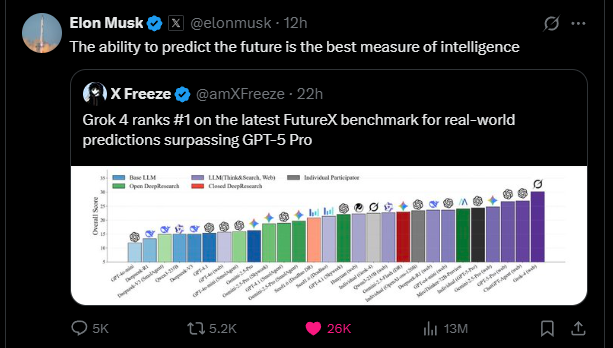
The answer is no. Prediction is necessary, but not sufficient. To conflate the two is to reduce intelligence to oracular forecasting, stripping away the essence of agency, strategy, and play.
Intelligence as a Game We Play
In Intelligence Is a Game We Play, I proposed a different definition. Intelligence is not a static quantity to be measured in isolation. It is the capacity to participate effectively in games: interactive contexts where agents deliberately choose among alternatives to pursue goals within constraints.
Key components of this view:
Agents: Entities capable of modeling and acting.
Strategy: Deliberate selection among alternatives.
Interaction: Engagement with environments or other agents.
Goals: Explicit or implicit preferred outcomes.
This definition captures why even bacteria display rudimentary intelligence—they navigate chemical gradients (a simple game) with strategies that improve survival. And it scales upward: humans play vastly more complex games, from science to politics to philosophy.
Musk’s Prediction-Centric Definition
Musk’s tweet collapses intelligence into a single axis: the ability to forecast outcomes. On the surface, this resonates with modern cognitive science. Brains are prediction machines. Karl Friston’s free energy principle formalizes cognition as the minimization of prediction error. In machine learning, predictive accuracy is often the easiest thing to quantify.
But prediction alone is not intelligence:
A weather oracle could perfectly forecast tomorrow’s storm, but it cannot act, strategize, or pursue goals.
A chess engine that knows the opponent’s next moves is powerful, but without a framework for winning, it is useless.
A prophet who foresees disaster but cannot respond is not intelligent—merely informed.
Side-by-Side Contrast
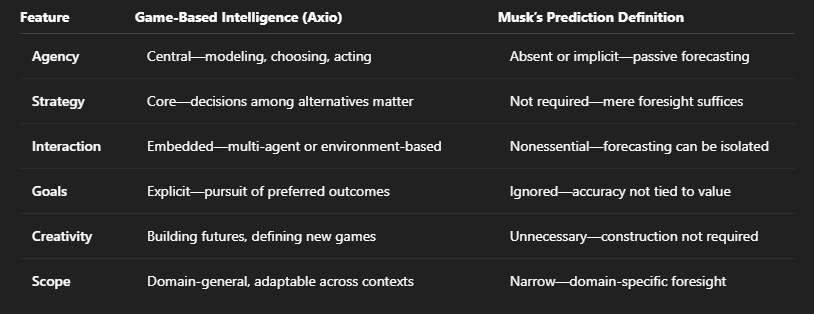
Necessary but Not Sufficient
Prediction is essential. Without anticipating consequences, no agent could play any game effectively. But necessity does not equal sufficiency. Intelligence requires:
Prediction — epistemic grounding.
Strategy — reasoning about alternatives.
Agency — the capacity to act and construct futures.
Value alignment — the pursuit of goals worth achieving.
To reduce intelligence to prediction is to amputate its constructive half. It is like calling eyesight the best measure of athletic ability. Vision is indispensable, but without movement, strength, and coordination, it is useless on the field.
The Benchmark Arms Race
FutureX is just one benchmark. Today Grok 4 edges ahead; tomorrow GPT‑5 or Claude might dominate another metric. These scoreboards say less about the nature of intelligence than about marketing cycles. True intelligence—whether biological or artificial—is not measured in a single competition. It is proven in the endless plurality of games agents play across reality.
Conclusion
Musk is half-right. Prediction is the backbone of cognition. But intelligence, properly defined, is not mere foresight—it is foresight in play. It is the art of navigating, strategizing, and constructing futures within constraints. An oracle may predict, but only an agent can play.
Intelligence is not the ability to foresee the future. It is the ability to create one.