
The Equality Trap
Why both Left and Right confuse outcomes with moral worth
August 30, 2025

James Lindsay recently offered a pithy contrast between what he calls the “Woke Left” and the “Woke Right” by framing each as a syllogism:
Woke Left: If created equal, then outcomes should be equal. Outcomes are not equal, but people are. Therefore the system is unfair, and people must be treated unequally to fix it.
Woke Right: If created equal, then outcomes would be equal. Outcomes are not equal. Therefore people aren’t equal and shouldn’t be treated equally.
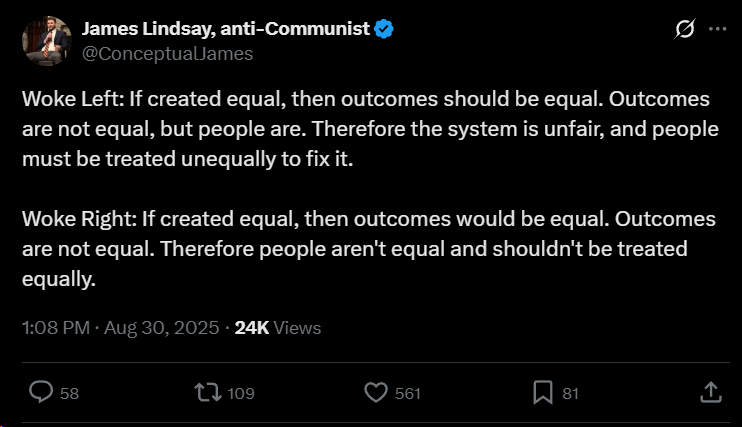
This has rhetorical bite, but the analysis collapses under scrutiny. Both caricatures rest on a fundamental category error: conflating moral equality with empirical sameness of outcome.
Equality in Political Philosophy
When Jefferson wrote that “all men are created equal,” he was not suggesting identical capacities, talents, or life trajectories. He meant equal in moral status and rights. Locke before him used the same concept: equality under the law, equality in moral worth, not equality of outcomes.
To equate equality of creation with outcome-identicality is to shift the meaning of “equal” from normative standing to descriptive fact — a classic equivocation.
The Woke Left Syllogism
The Left caricature Lindsay presents is:
If created equal, then outcomes should be equal.
Outcomes are not equal, but people are equal.
Therefore: the system is unfair; fix by treating people unequally.
Analysis: No serious progressive thinker claims equal creation logically entails equal outcomes. The more accurate view is: if people are equal in moral worth, then persistent structural disparities in outcome deserve explanation. Unequal results are not proof of injustice, but they can be evidence of systemic barriers. The caricature is a straw man.
The Woke Right Syllogism
The Right caricature is:
If created equal, then outcomes would be equal.
Outcomes are not equal.
Therefore: people are not equal; they shouldn’t be treated equally.
Analysis: This is the inverse error. Inequality of outcome is taken as proof of unequal worth. This position collapses descriptive variation (differences in ability, effort, or circumstance) into normative inequality. Again, it is a non sequitur.
The Shared Fallacy
Both syllogisms share the same logical weakness:
They equate moral equality with empirical sameness.
They treat differences in outcome as if they were directly diagnostic of fairness or intrinsic worth.
This is the wrong level of inference. Outcomes can vary for countless reasons that do not negate equal moral standing.
The Real Divide
The actual debate is subtler:
Progressives: Equal moral worth implies unjustified disparities across groups require scrutiny. Persistent inequality may indicate systemic unfairness, and corrective measures may be warranted.
Conservatives/Libertarians: Equal moral worth guarantees equal legal treatment. Outcome disparities are natural consequences of different talents, choices, and luck. Correction is not required unless explicit rights are violated.
The dispute is not whether people are equal, but whether inequality of results is sufficient evidence of systemic injustice.
Correct Framing
The correct framing is:
Equal rights + unequal outcomes is the expected equilibrium. Humans are diverse in ability, preference, and circumstance.
The central normative question: Were these outcomes produced under fair rules of the game?
This avoids both fallacies:
It rejects the inference that unequal outcomes prove unfairness.
It rejects the inference that unequal outcomes prove unequal worth.
Conclusion
Lindsay’s tweet succeeds rhetorically but fails analytically. It constructs mirror-image fallacies to paint both sides as equally absurd. In reality, the philosophical disagreement is about the interpretation of inequality: does it signify unfair structure, or is it simply the natural result of diverse individuals exercising equal rights?
The enduring principle should remain clear: equal dignity under the law is compatible with unequal outcomes in life. The task is not to collapse one into the other, but to ensure that disparities arise from freedom rather than coercion or structural exclusion.