
Coherence From Chaos
Formalizing Self‑Selecting Patterns
August 25, 2025
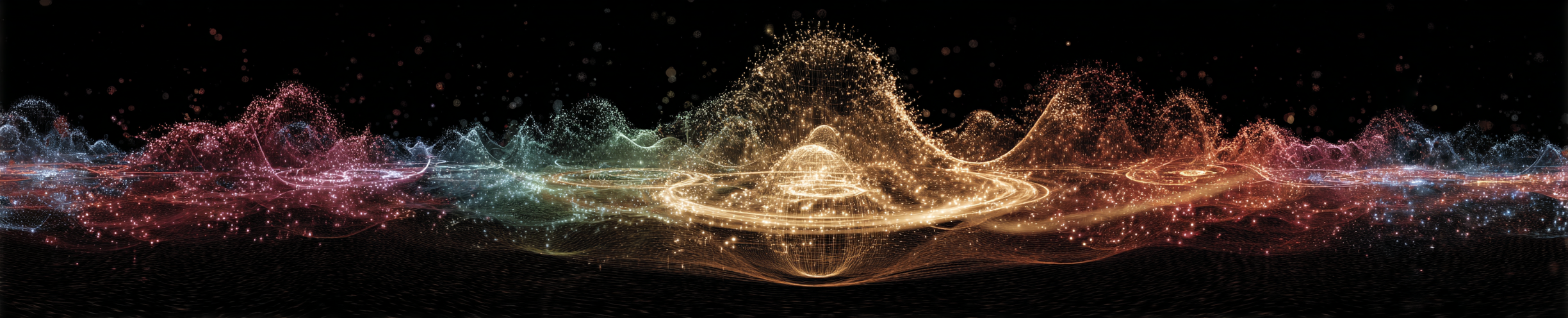
In a previous post, I introduced Chaos: the reservoir of infinite randomness, identified with the real line under Lebesgue measure. Almost all reals are incompressible, meaning their binary expansions are infinite random bitstrings with no shorter algorithmic description. Computable numbers like π or √2 form a measure‑zero exception. This makes Chaos the natural candidate for the metaphysical ground: the inexhaustible reservoir from which all structure arises.
Now we sharpen the picture with mathematical clarity: how does coherence function as a filter within Chaos?
1. Chaos as Random Reals
Let
be the unit interval, equipped with Lebesgue measure. Almost every x∈C is algorithmically random in the Martin‑Löf sense: the binary expansion
is an incompressible sequence. The set of such reals has measure 1, while the set of computable or compressible reals has measure 0.
This gives us the Chaos Reservoir: the measure‑theoretic ocean of incompressible bitstrings.
2. Coherence as a Filter
Define a Coherence Filter as a predicate
that selects subsequences of Chaos as “self‑consistent.” A sequence passes the filter if it does not contradict the internal rules encoded by F.
In algorithmic information terms:
A Coherence Filter corresponds to a recursively enumerable set of constraints.
A bitstring is coherent if it satisfies all constraints in the set.
Filters define islands of order within Chaos by carving out sequences that are not merely random, but structured according to internal consistency.
3. Filters as Patterns in Chaos
Here lies the recursion: every filter F is itself describable as a bitstring — hence as a real number within Chaos. Chaos contains not just random sequences, but also encodings of every possible rule for distinguishing order from disorder.
Thus, coherence is not imposed from outside. Instead:
Filters are patterns within Chaos.
Structures are patterns selected by filters.
Meta‑filters (rules about which filters persist) are themselves patterns in Chaos.
This closes the loop: Chaos contains the filters, the filtered structures, and the higher‑order rules for persistence.
4. Fixed‑Point Character of Coherence
The apparent regress (filters needing filters) stabilizes in a fixed‑point view:
A pattern persists if it encodes a filter that selects itself.
That is, a self‑consistent subpattern of Chaos survives by recognizing its own coherence.
This explains the emergence of long‑lived structures: physics, mathematics, observers.
Formally, if s∈{0,1}^N encodes a filter F, and F(s)=1, then s is self‑coherent. These fixed points of the filter relation define the stable attractors in Chaos.
5. Toward Constructor Theory
Constructor Theory describes physics in terms of possible and impossible transformations enacted by stable entities called constructors. On this view:
Constructors are precisely those self‑coherent patterns that not only persist but also transform other patterns while remaining unchanged.
The transition from Chaos → Coherence → Constructors is the route from measure‑theoretic randomness to physics.
Conclusion
Chaos is not merely noise. It is a complete reservoir containing:
Random sequences,
Filters that extract order,
Meta‑filters that stabilize those filters,
And fixed points that give rise to persistent structures.
Coherence is thus formalized as self‑selecting, recursively enumerable structure within Chaos. This provides the conceptual bridge to Constructor Theory, where physics emerges from the transformations enacted by such coherent patterns.