
Incitement Is Not Coercion
How Probabilistic Censorship Threatens Agency More Than Hate Speech
August 23, 2025

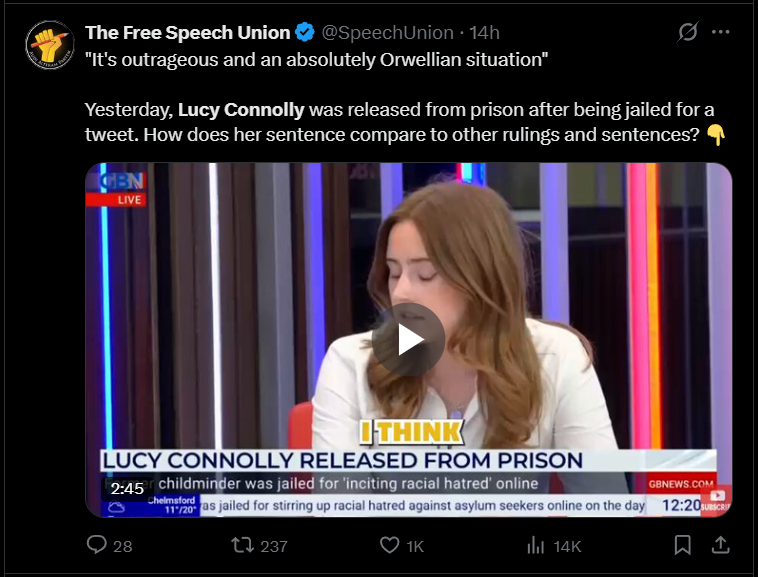
The case of Lucy Connolly, the British childminder sentenced to 31 months in prison for a hateful tweet, highlights a profound error in how modern states conflate incitement with coercion. To evaluate this clearly, we need a precise definition of coercion, a rigorous standard for speech restrictions, and a sober look at how Connolly’s case went wrong.
The Definition of Coercion
I have argued consistently that coercion is best defined as:
The credible threat of actual harm to gain compliance.
This definition has three elements:
Credible threat: The speaker must plausibly signal they will or can carry out harm.
Actual harm: The harm must be concrete—physical injury, property destruction, or equivalent—not mere offense or outrage.
Compliance demand: The speech must aim to compel the target to act (or refrain) in a specific way.
Without all three elements, coercion does not exist.
Connolly’s Speech Examined
Connolly’s post, in the wake of a tragic murder case, read in part:
“Mass deportation now, set fire to all the f***** hotels full of the bastards for all I care.”*
Under the coercion test:
Threat? Not credible. Connolly herself had no means or intent to torch hotels. She was venting, not issuing a personal threat.
Harm? She did indeed invoke violent harm (arson). But she expressed it as a fantasy or call to others, not as her own imminent act.
Compliance? There was no attempt to extract obedience. She wasn’t demanding asylum seekers, hoteliers, or the government do anything under threat.
Result: Her tweet fails the coercion standard. It was vile, racist, and irresponsible—but it was not coercive.
The Category Error: Incitement vs. Coercion
The UK’s Public Order Act 1986 criminalizes speech “likely to stir up racial hatred.” This collapses incitement into coercion-lite, punishing the probability of harm rather than the presence of a threat demanding compliance.
The distinction is crucial:
Coercion: Direct attack on agency. A mafia thug saying, “Pay up or I burn your shop” clearly reduces the victim’s freedom.
Incitement: Ugly persuasion. A demagogue yelling, “Burn down the shops!” does not coerce anyone; it merely urges. The agency remains with the listener.
When the law punishes incitement as if it were coercion, it abandons the principle of punishing actions and threats in favor of punishing risks and offense. This is preventive authoritarianism.
The Principle of Speech Under Agency Protection
To preserve both liberty and order, I propose an Agency Protection Principle for Speech:
Only coercive speech may be criminalized.
That means speech containing a credible threat of actual harm to gain compliance.
Incitement, hate, and vilification remain legal.
Not because they are good, but because they do not strip away agency in the same way.
Social remedies apply.
Counterspeech, ostracism, and surveillance of genuine plots are the proper responses. The state’s role is to prevent crimes, not police emotions.
Why Connolly’s Conviction Was Wrong
By this standard, Connolly should not have been imprisoned:
Her tweet was not coercive. It lacked a credible threat, it lacked a compliance demand, and it did not directly reduce anyone’s agency.
Her conviction punished risk, not action. The argument was that her words might inspire others. That is probabilistic censorship, not justice.
The sentence was disproportionate. Thirty-one months exceeded punishments for many violent crimes, turning her into a political symbol and fueling polarization.
The Larger Danger
When the state equates incitement with coercion, the slope is steep:
Political dissent can be branded “hate.”
Unpopular opinions can be cast as “threats.”
Justice becomes selective, meted out according to ideological convenience.
By contrast, a coercion-only standard is clear, principled, and resistant to abuse. It punishes genuine threats while protecting even the ugliest speech that falls short of coercion.
Conclusion
Lucy Connolly’s words were ugly, irresponsible, and harmful in the moral sense. But they were not coercion. The state’s attempt to criminalize her outburst as though it were a mafia-style threat represents a dangerous category error.
Incitement is not coercion. And until law and society restore that distinction, we will continue to see justice bent into a weapon against unpopular speech, rather than a shield for human agency.