
The Industrial Revolution Starter Kit
How To Bootstrap Ancient Rome
August 10, 2025
Premise
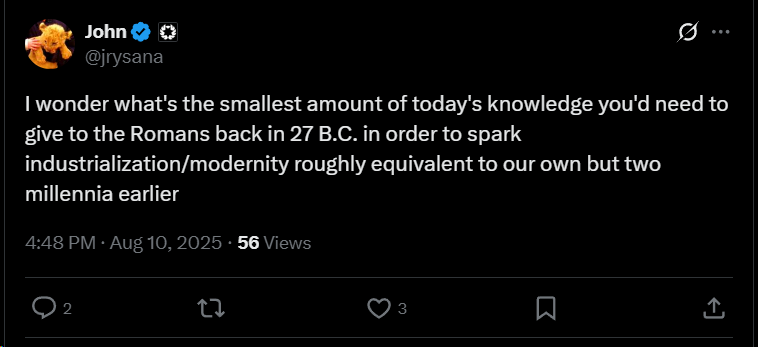
What is the smallest, most catalytic subset of modern knowledge that could be given to the Roman Empire in 27 B.C. to trigger an Industrial Revolution nearly 2000 years early? This is not a fanciful "drop a smartphone" fantasy, but a realistic, resource-conscious blueprint optimized for Roman capabilities, materials, and social structures. The goal is not to overwhelm with trivia but to seed a self-amplifying technological cascade.
1. The Meta-Tool: Scientific Method
Without a reliable method of generating and testing ideas, any single invention is brittle. The scientific method—hypothesis, controlled test, observation, refinement, repeat—is the keystone.
Key points for Romans:
Truth comes from repeated, controlled observation, not authority or tradition.
Experiments must be documented and reproducible.
Predictions that fail are discarded, no matter who proposed them.
The Romans already had literate elites and engineering aptitude. This would formalize their tinkering into a systematic discovery engine.
2. Metallurgical Upgrade Path
To industrialize, Rome needs steel strong enough for pressure vessels, tools, and machinery.
Coke from coal: Heat coal without oxygen to produce a hotter-burning, cleaner fuel.
Blast furnace: Use bellows and preheated air for higher smelting temperatures.
Crucible steel: Controlled carbon content for consistency.
Hardness testing and tempering methods to improve tool reliability.
Better metals enable precision machining, which enables better machines—a feedback loop.
3. Germ Theory and Sanitation
Industrial growth requires a healthy, numerous workforce.
Diseases are spread by invisible organisms.
Boil water, wash hands, keep sewage separate from drinking water.
Antiseptic wound care with boiled cloth, alcohol, or vinegar.
Quarantine contagious individuals.
Immediate effect: lower infant mortality, longer working lives, faster population growth.
4. Practical Machines for Power
The first power multiplier should be achievable with Roman metallurgy: the low-pressure steam engine.
Newcomen-style atmospheric engine: Boiler + piston + beam pumps water from mines.
Flywheel & crank: Convert reciprocating motion to rotary.
Line shaft distribution: Drive multiple machines from one engine.
Uses:
Textile production
Sawmills
Grain milling
Metal lathes for better engine parts
5. Energy Concentration & Scaling
Water turbine improvements for rivers (Romans already had water wheels).
Coal mining methods to feed coke production.
Basic thermodynamics: Heat is particle motion; greater temperature differences produce more work.
6. Information Reproduction & Spread
Printing press blueprint: Adapt a screw press with movable type.
Mass-produce technical manuals, scientific papers, and laws.
Standardize measurements (length, mass, volume) across the empire.
The press accelerates the spread of every other innovation.
7. Simple but Disruptive Chemistry
Soap from lye and fat.
Lime mortar and early Portland cement.
Glass lenses for microscopes and telescopes—feeding back into science.
8. Social and Economic Enablers
Capital formation: Accounting methods, joint-stock companies, early patent systems.
Universal education: Literacy increases skilled labor supply.
Economic structures ensure that innovations are funded, built, and adopted.
Compact Transmission Format
A codex or scroll set (~100 pages) containing:
Step-by-step diagrams for each device/process.
Material lists and tolerances.
Modular sections allowing partial adoption without total dependency.
Why This Works
Self-Amplifying: Each section magnifies the utility of the others.
Resource-Conscious: All designs are possible with Roman-era resources.
Rapid Feedback: Steam power, printing, and germ theory yield visible gains within a generation.
Political Fit: Early success funds expansion and secures elite buy-in.
Given the right leaders, Rome could plausibly progress from water wheels to locomotives and telegraphs in under two centuries, rewriting the trajectory of civilization.