
The Myth of Genetic Immortality
Why Most of “Your” DNA Disappears in Just a Few Centuries
August 08, 2025
We’ve all heard some version of the sentiment:
“I’ll live on in my descendants. This is my immortality.”
It’s a comforting thought — a kind of secular afterlife. Even if the people who knew you vanish, surely your DNA will persist down the generations, carrying a trace of you into the distant future.
Unfortunately, population genetics doesn’t work that way.
The Twitter Exchange
A recent conversation captured the essence of this misunderstanding.
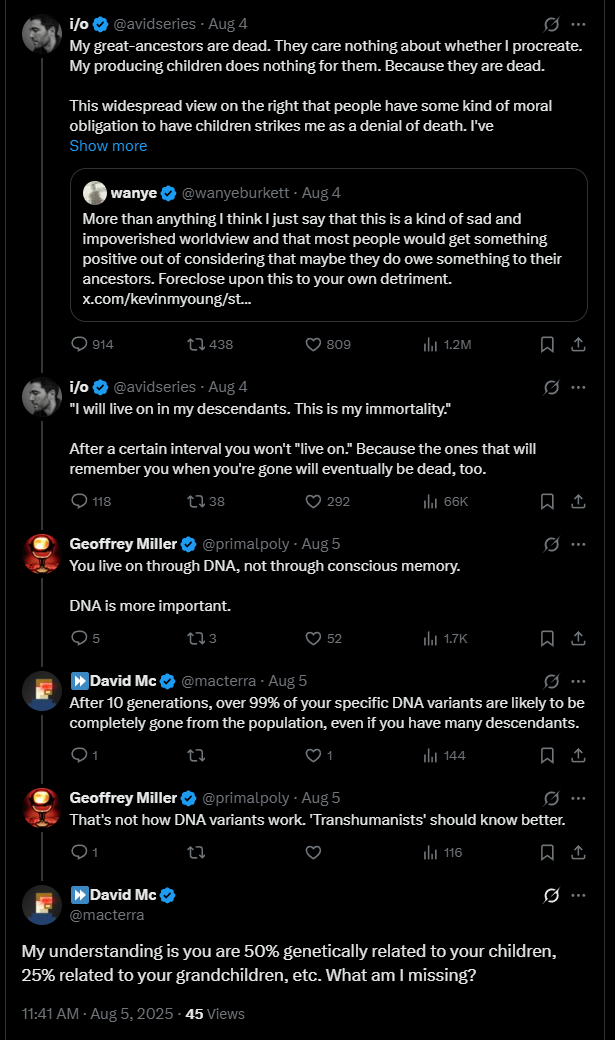
@avidseries pointed out that memories fade quickly — once those who knew you die, you’re gone in every conscious sense.
Geoffrey Miller, an evolutionary psychologist, countered: You live on through DNA, not through conscious memory. DNA is more important.
I replied that after ten generations, over 99% of your specific DNA variants are likely to be completely gone from the population, even if you have many descendants.
Miller dismissed this: That’s not how DNA variants work.
I followed up: My understanding is you are 50% genetically related to your children, 25% to your grandchildren, etc. What am I missing?
That’s where the thread ended — but the question deserves a quantitative answer.
The Coefficient of Relatedness
In family relationships, genetic relatedness is defined by the coefficient of relatedness (r):
You share 50% of your genome with your children.
25% with grandchildren.
12.5% with great-grandchildren.
And so on — halving each generation on average.
That’s the average proportion of your genome found in those descendants. But it says nothing about the fate of any given specific allele.
The Allele Survival Problem
A “DNA variant” here means a specific stretch of genetic code. For example: one of your particular versions of a gene that arose from recombination in you, or that is otherwise rare in the population.
If a variant is:
Common — present in many unrelated people — its survival has little to do with you personally.
Unique to you — found only in your genome — its persistence depends entirely on being passed down through your descendants.
And passing it down is a lottery. At each conception, only half your DNA is transmitted to each child, and recombination scrambles it further. Even if your descendants are numerous, without strong inbreeding, those unique variants vanish rapidly due to genetic drift.
The Simulation
I modeled this using a neutral drift process in a population of 10,000 individuals:
Start with a single copy of the variant in one person (you).
Track how often it survives each generation.
Results:
After 10 generations (~250 years), there’s an ~85% chance the allele is gone completely.
By 20 generations, extinction probability rises above 90%.
This is without any negative selection — just random Mendelian segregation.
If you start with a rare variant, your “genetic immortality” has a half-life measured in centuries, not millennia.
Why Miller’s Dismissal Was Wrong
Miller’s "that’s not how DNA variants work" is true only for common or selected variants. Yes, some DNA sequences persist for hundreds of thousands of years — but those are either ancient common alleles or under strong positive selection.
For most of what makes your DNA uniquely yours, the clock is ticking fast. Within a few hundred years, your specific variants will almost certainly be gone.
Cultural vs. Genetic Survival
If your goal is to “live on,” cultural legacy is far more robust than genetic legacy. A mathematical theorem in population genetics says that in a randomly mating population, the probability that a given individual has any living descendants eventually approaches one — but the probability that they carry any specific genetic material from you approaches zero.
In short:
Your descendants? Almost certain.
Your DNA? Almost gone.
Your memory? That depends on what you leave behind.
The uncomfortable truth: The idea of genetic immortality is mostly an illusion. If you want to persist beyond a few centuries, write a book, start a tradition, build something worth remembering — because your actual DNA won’t be there to speak for you.