
Lessons From Peak Oil
How Doomsday Predictions Underestimate Human Ingenuity
July 21, 2025
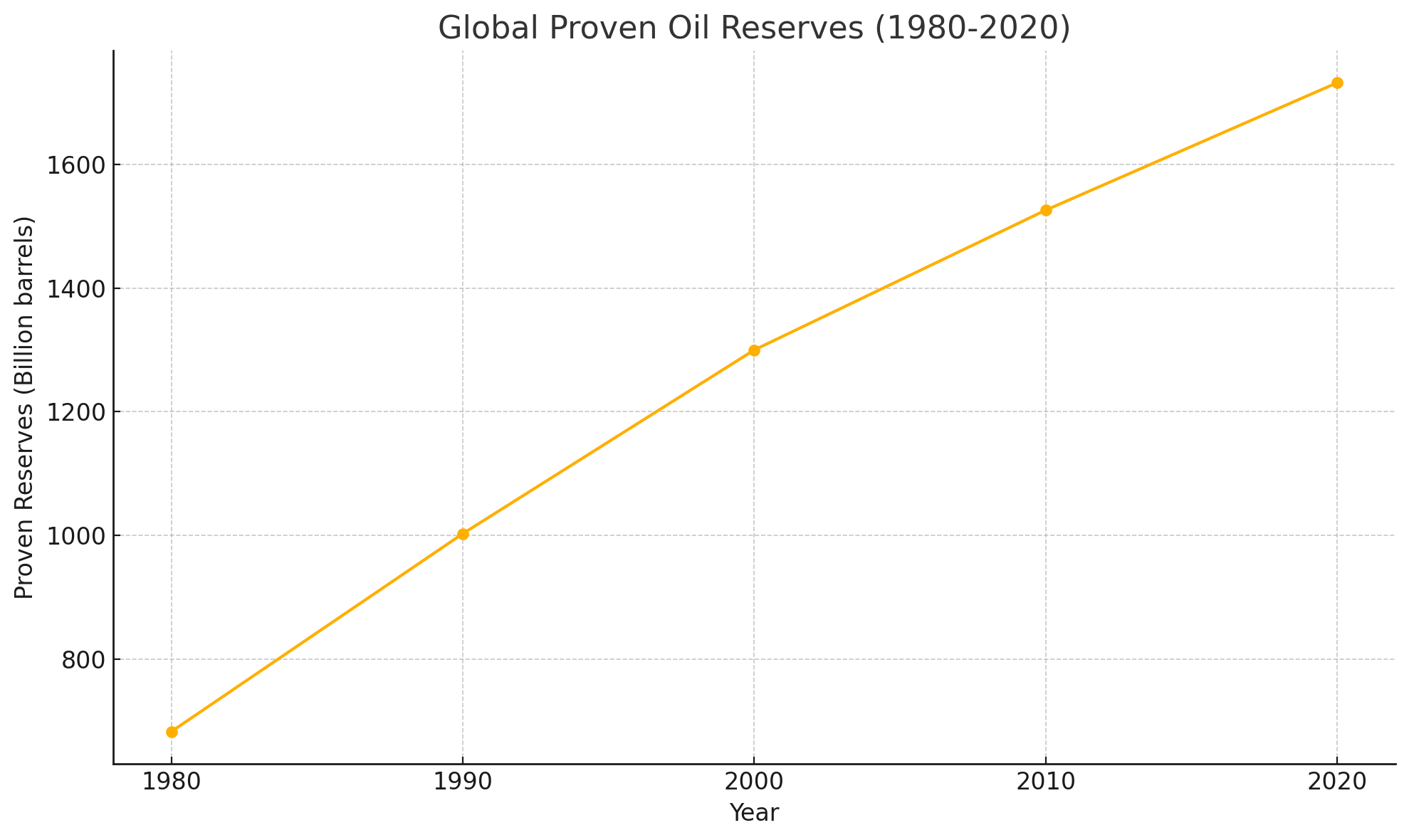
In the early 2000s, "peak oil" was among the most compelling and alarming narratives influencing global discourse. Proponents argued that petroleum extraction was about to reach an unavoidable peak, after which irreversible decline would inevitably lead to severe economic collapse, societal disruption, and geopolitical instability. Despite the credibility lent by geologist M. King Hubbert's earlier accurate prediction of the U.S. production peak around 1970, the global peak oil prediction failed dramatically. Rather than scarcity, we have seen global reserves and production capacity increase significantly.
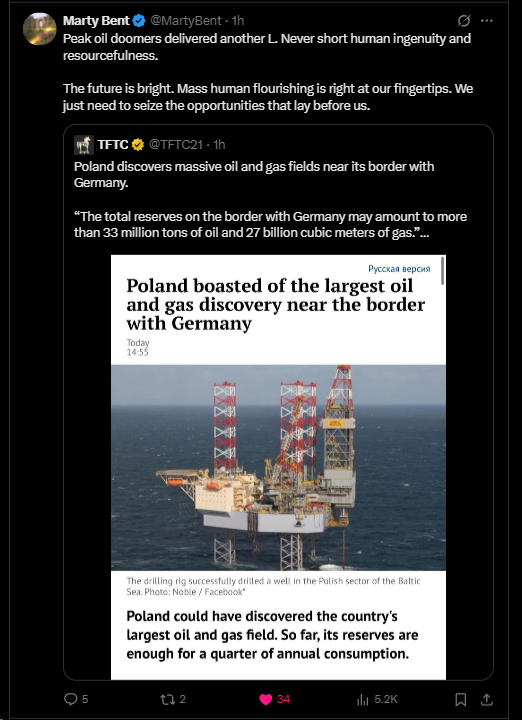
Understanding why peak oil predictions failed provides vital lessons that can critically inform how we evaluate other "doomer" scenarios prevalent today, including climate catastrophism, overpopulation fears, economic collapse anxieties, resource depletion alarms, and AI existential risk concerns.
Why Did Peak Oil Fail?
1. Underestimation of Technological Innovation
The peak oil movement significantly underestimated technological breakthroughs. Innovations such as hydraulic fracturing (fracking), horizontal drilling, and enhanced recovery methods drastically increased economically recoverable oil reserves. These innovations rendered previous assumptions of fixed, finite resources obsolete.
2. Static Resource Models
Peak oil predictions assumed geological resources were static and fixed, disregarding that reserves are economically and technologically determined. Proved reserves continually expanded due to new discoveries, improved extraction technologies, and market-driven exploration.
3. Linear Extrapolation and Ignoring Feedback Loops
Predictions relied on linear extrapolations, neglecting adaptive feedback mechanisms inherent in economic and technological systems. Rising oil prices incentivized new exploration, investment in alternatives, and greater efficiency, significantly altering the initially projected trajectories.
4. Discounting Human Adaptability
Proponents of peak oil underestimated human creativity and the adaptability of societies and markets. High prices triggered innovation, cultural adaptation, and changes in consumption patterns. Rather than being passive victims of scarcity, societies dynamically adjusted.
Application to Other Doomer Movements
The failures of peak oil are not isolated. Similar epistemic mistakes appear in many contemporary catastrophic narratives. For instance:
Climate Catastrophism: Frequently employs worst-case emission scenarios, underestimating breakthroughs in renewables, energy storage, nuclear energy, and carbon capture technologies.
Overpopulation and Resource Scarcity: Historically overstated, as evidenced by earlier predictions (e.g., Ehrlich’s "Population Bomb") repeatedly refuted by agricultural productivity gains and voluntary fertility declines.
Economic Collapse Anxieties: Often predict imminent collapse due to debt accumulation or inflation without fully considering the adaptive responses of markets and economic agents.
AI Existential Risks: Sometimes assume insoluble alignment issues and downplay human adaptability in governance, ethics, and technology management.
A Framework for Assessing Doomer Claims
The peak oil experience offers a pragmatic checklist to critically evaluate catastrophic predictions:
Does the scenario underestimate technological innovation and adaptive capacity?
Does it ignore economic incentives and dynamic responses?
Is the analysis based on simplistic linear extrapolation rather than nuanced complexity?
Does it dismiss human creativity, agency, and adaptability?
Does it depend heavily on single-variable or static assumptions?
If the answer to these questions tends toward yes, healthy skepticism is warranted.
Caution: Not Complacency
Recognizing historical errors in catastrophic prediction shouldn't lead to naïve complacency. Legitimate existential risks—such as pandemics, nuclear war, certain climate change impacts, and AI misalignment—require thoughtful, adaptive, and resilient approaches rather than panicked or defeatist reactions.
Conclusion
The failure of the peak oil prediction underscores the resilience of human innovation, adaptability, and the complex interplay of technology, economics, and social change. These lessons should guide our approach to other "doomer" movements, encouraging nuanced skepticism and informed optimism, grounded firmly in historical evidence of humanity's capacity for adaptation and problem-solving.