
Beyond Left and Right
Understanding the Three Faces of Socialism
July 06, 2025
Socialism is often mistakenly treated as a monolithic political ideology. In truth, socialism encompasses radically distinct philosophies, each with its own ideals, methods, and outcomes. Misunderstanding these differences results in conceptual confusion and undermines political discourse. To engage thoughtfully, we must clearly distinguish between the three primary forms socialism has historically taken: National Socialism, International Socialism, and Liberal Socialism.
1. National Socialism: Ethno-Nationalist Authoritarianism
National Socialism, most infamously embodied by Nazi Germany, is defined by extreme nationalism, racial collectivism, and authoritarian governance. Although it appropriated socialist language—claiming to represent "workers" and oppose capitalism—it had little interest in genuinely redistributing power or wealth democratically. Rather, it subordinated individual freedoms and economic rights to the perceived needs of the nation-state and its racial identity.
Core principles: Ethnic supremacy, nationalism, authoritarian governance, corporatist economic control.
Historical example: Nazi Germany (1933–1945).
Legacy: Universally condemned due to oppressive, violent, and genocidal practices.
2. International Socialism: Class-Based Authoritarian Collectivism
International Socialism, or Marxist-Leninist Communism, championed global working-class solidarity and sought the abolition of private ownership. However, in practice, it resulted in authoritarian regimes where individual rights were heavily suppressed, ostensibly in service of class struggle and collective ownership. Economic decision-making became centralized, resulting in planned economies characterized by inefficiency, oppression, and eventual collapse.
Core principles: Class solidarity, abolition of private property, international revolution.
Historical examples: Soviet Union (1917–1991), Maoist China.
Legacy: Broadly discredited due to authoritarianism, human rights abuses, and economic failures—though paradoxically still admired by some intellectual and political elites in the West.
3. Liberal Socialism: Democratic Welfare Capitalism
Liberal Socialism, more commonly known as social democracy or welfare capitalism, balances democratic governance, individual rights, and market economies with robust social safety nets and regulated industries. Liberal Socialists do not seek to eliminate capitalism or private ownership; instead, they aim to moderate capitalism’s excesses through public investments in health, education, and social welfare. This model has proven economically stable and widely popular.
Core principles: Democracy, individual freedom, regulated markets, strong welfare systems.
Historical examples: Post-war Nordic countries, Canada, much of Western Europe.
Legacy: Positive reputation due to high standards of living, economic stability, and strong democratic institutions.
Comparing the Three Faces
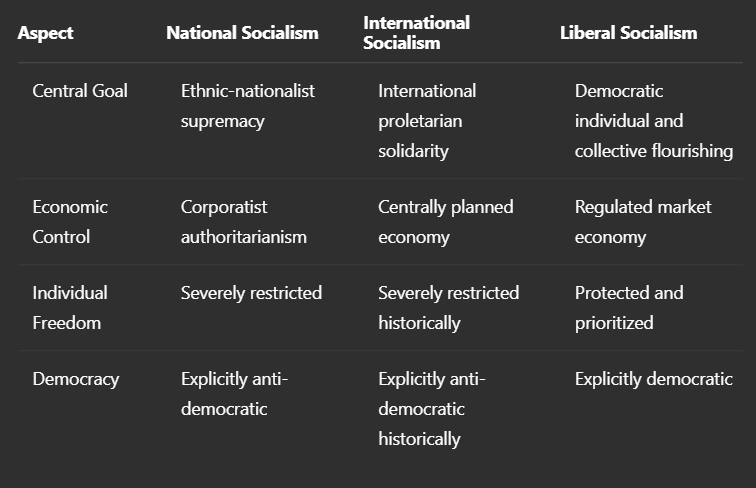
National and International Socialisms, despite ideological rivalry, share crucial characteristics: authoritarian governance, suppression of individual rights, and state control at the expense of personal freedoms. In contrast, Liberal Socialism explicitly prioritizes individual rights and democratic processes, employing socialist-inspired policies pragmatically rather than dogmatically.
Why Precision Matters
Conflating these distinct models has consequences. Labeling welfare policies as "fascist" or "communist" misunderstands political reality and muddies critical debates. By clearly distinguishing between National, International, and Liberal Socialism, we sharpen political understanding, encourage nuanced conversations, and foster more informed democratic choices.
Understanding these three faces of socialism helps us see beyond simplistic left-right binaries, promoting clearer thinking about what kind of social and economic structures we genuinely value.