
The Inner Monologue Fallacy
Separating genuine reasoning from verbal narration
June 29, 2025

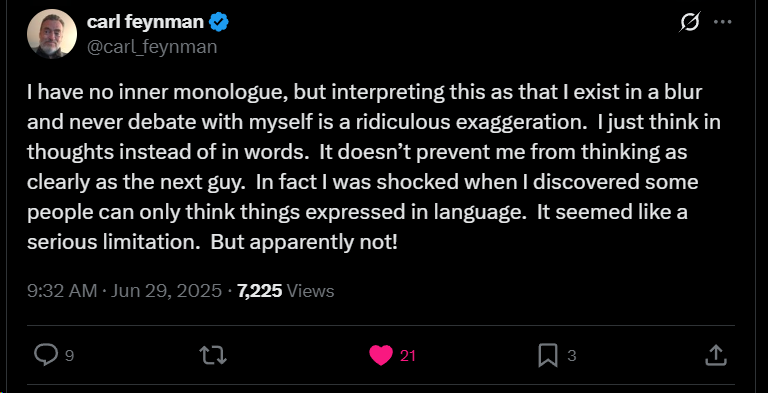
A recent tweet from Carl (son of Richard) Feynman caught my attention:
“I have no inner monologue… I just think in thoughts instead of words… I was shocked when I discovered some people can only think things expressed in language. It seemed like a serious limitation. But apparently not!”
This reveals a basic cognitive error: confusing thinking with talking internally. An inner monologue isn't the same as reasoning—it is simply a narrative layer added over deeper cognitive processes.
Clarifying this distinction:
Everyone has thoughts.
Some people translate these thoughts into internal speech.
Those accustomed to inner monologues often mistake the monologue itself for the act of thinking.
Language: A Tool, Not the Engine
Inner speech acts like a mental check—useful for linguistic rehearsal—but the actual thinking happens beneath, through images, intuitions, patterns, and abstract reasoning.
Mistaking inner speech for thought is like confusing an object's shadow with the object itself. Words are symbolic representations—compressed versions of richer cognitive activities.
The Misconception of Verbal Dominance
This verbal misconception leads to several misunderstandings:
Thinking animals are unintelligent because they don't speak our languages.
Assuming infants or people with language impairments are cognitively limited.
Believing that language models truly understand just because they produce coherent text.
Such errors obscure true intelligence, which can operate independently of language, encoding knowledge in visual, emotional, structural, or intuitive forms beyond words.
Thought is Independent of Language
Just as software engineers understand algorithms are separate from programming language syntax, genuine thinking is separate from the words used to describe it. Inner speech is analogous to logging or debugging output—sometimes useful but rarely essential.
AI and Language
Artificial intelligence demonstrates this clearly. A model like ChatGPT generates fluent text effortlessly, but fluency doesn't imply genuine reasoning. Similarly, humans who don't rely on internal verbalization aren't cognitively disadvantaged; they might even benefit from fewer linguistic constraints.
Conclusion
Inner speech isn't thought; it's just internal narration. Real cognition is broader, richer, and deeper than words alone. Recognizing this helps avoid the mistake of equating linguistic fluency with genuine understanding.