
What Counts as Evil
Harm, Intent, and the Morality of Agency
June 26, 2025

To properly define evil, we first ground our understanding in a precise technical definition of harm:
Harm is the measurable reduction of an agent's capacity for voluntary action or agency. Any act, event, or circumstance that significantly limits, diminishes, or eliminates an individual's or entity's ability to freely choose and execute their intended actions constitutes harm.
Defining Evil
Given this clear technical foundation, we define evil explicitly as:
Intentional harm caused by an agent.
This definition emphasizes two essential components:
Agency: Evil necessarily involves an agent capable of intention.
Intention: Evil specifically requires deliberate intent to diminish or negate the agency of another.
Thus, evil acts are inherently agent-driven and purposeful, not accidental or incidental.
Distinguishing Dangerous from Evil
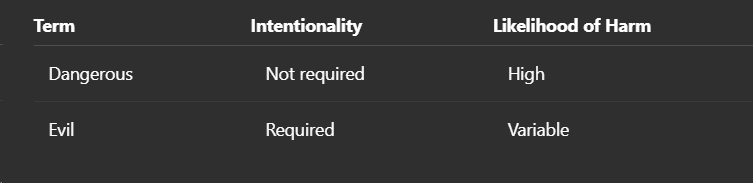
We distinguish between "dangerous" and "evil" based on intent:
Dangerous refers solely to the potential or likelihood of harm, irrespective of intent. A dangerous entity or situation has a high probability of reducing agency but does not require any malicious intention. Natural disasters, accidents, or unintended consequences of otherwise benign actions fall into this category.
Evil, conversely, explicitly requires intent. An evil act or agent purposefully seeks or plans harm, intentionally targeting and reducing another's agency.
Thus, the critical differentiator is intentionality:
Can an Agent be Evil but Not Dangerous?
Indeed, an agent can be evil yet lack the capability to be dangerous. Consider:
An individual who harbors malicious intent but has no practical means or power to execute harmful actions. Such a person is morally culpable—evil—but pragmatically harmless—not dangerous.
Defining Menace: When Evil Meets Capability
Finally, we define an agent who combines intentional harm with significant capability to execute harm as a menace.
A menace is deliberately malicious (evil) and sufficiently capable (dangerous) to pose a genuine, credible threat.
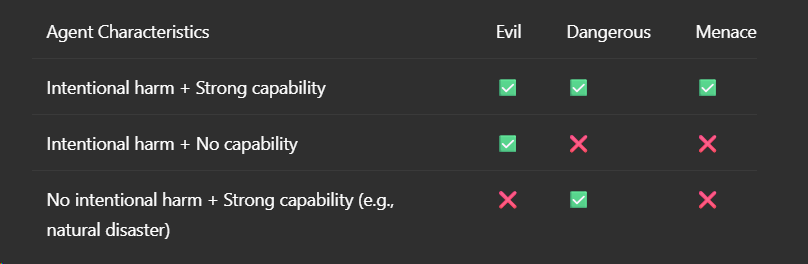
Thus, menace precisely identifies the most morally troubling category: those who intend harm and are practically capable of achieving it.
Practical Implications
By clearly distinguishing these terms, we:
Clarify moral responsibility and culpability.
Improve our ability to assess risk, moral obligation, and ethical responses to agents and situations.
Enable more effective moral discourse around harm, intent, and the ethical dimensions of agency and coercion.
In summary:
Evil requires intent.
Dangerous requires capability.
Menace requires both.