
Culture Hierarchies
Schemas Within Schemas
June 20, 2025
In a previous post, we introduced a clear distinction between Cultural Schemas (abstract sets of beliefs) and Cultural Groups (the individuals who instantiate these schemas). An important and insightful extension of this model is the natural emergence of hierarchical relationships among cultures.
Hierarchical Structures
Cultures don't exist in isolation; they often form hierarchies, where broader cultural schemas encompass multiple narrower schemas. These hierarchical structures result from shared beliefs and values that unite otherwise distinct cultural groups.
Example: Christianity
Consider two distinct cultural schemas:
Catholic schema: S(Catholic)={x,y,z}
Protestant schema: S(Protestant)={x,y,w}
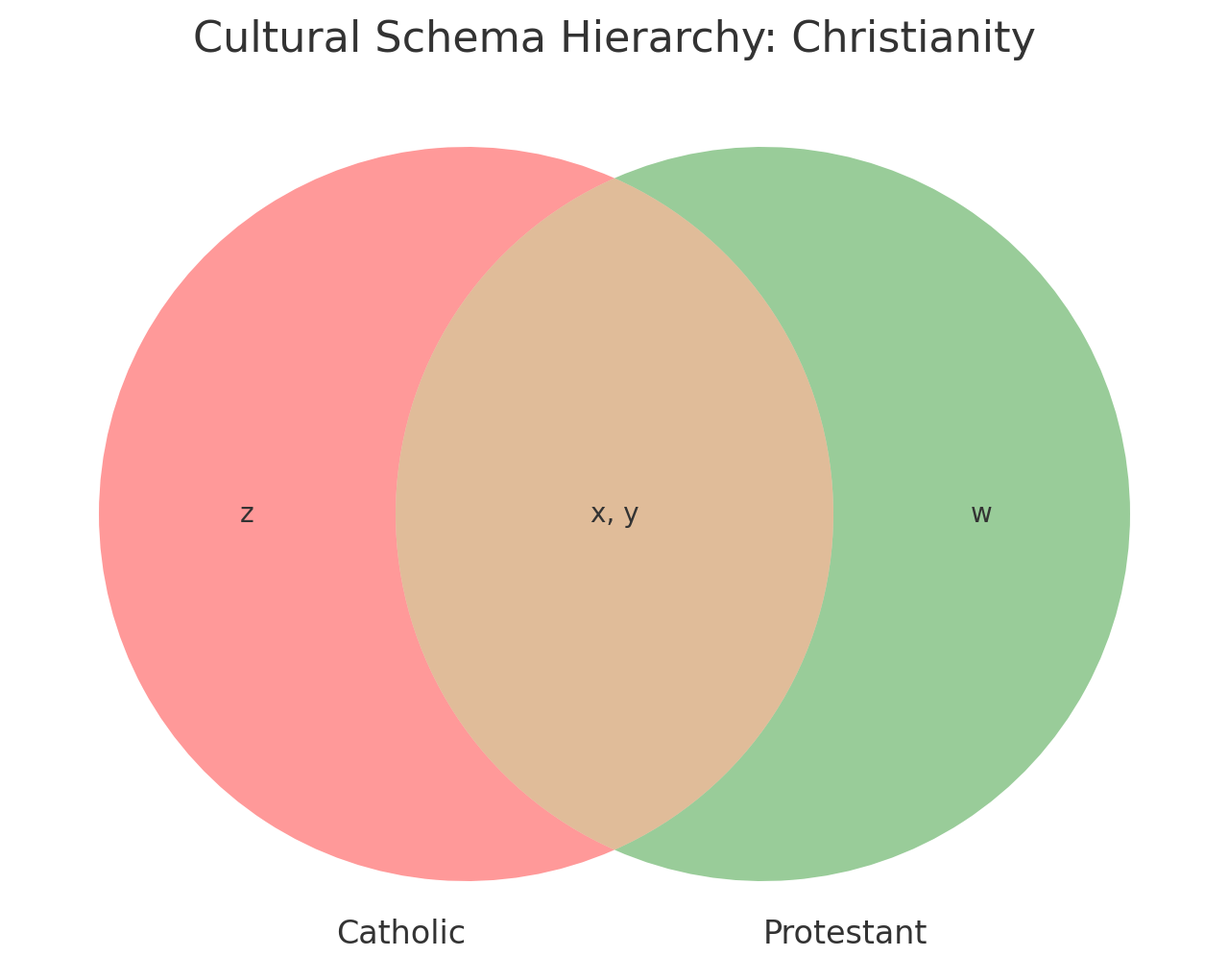
Both schemas share beliefs {x,y}. These common beliefs (the intersection of the sets) define a broader schema, the Christian schema:
This broader schema naturally forms a hierarchy:
The Christian schema S(Christian) is more general and thus includes both Catholic and Protestant groups.
Catholic and Protestant schemas are more specific instantiations within this broader Christian cultural context.
Formally:
Therefore:
Why Hierarchies Matter
Acknowledging cultural hierarchies helps clarify interactions, conflicts, alliances, and the processes of cultural evolution. For instance, when analyzing conflicts between cultural groups, identifying shared higher-level schemas can facilitate understanding and reconciliation.
Hierarchical thinking allows clearer analysis of:
Cultural transmission (beliefs flowing from broader to narrower schemas)
Cultural divergence (schemas splitting off due to differing subsets of beliefs)
Cultural convergence (schemas merging through shared beliefs)
Conclusion
The schema-group framework naturally supports hierarchical structures. Embracing this hierarchical perspective significantly enriches our ability to analyze and understand complex cultural dynamics.