
True Neutral
Navigating the Alignment Grid of Meaningness
June 15, 2025

Philosophies can often be understood metaphorically, and few metaphors are as widely recognized as the alignment grid from Dungeons & Dragons. Typically used to categorize characters by ethics (Lawful, Neutral, Chaotic) and morality (Good, Neutral, Evil), it also provides an insightful lens for exploring philosophical systems.
Reframing the Alignment Axes for Philosophy
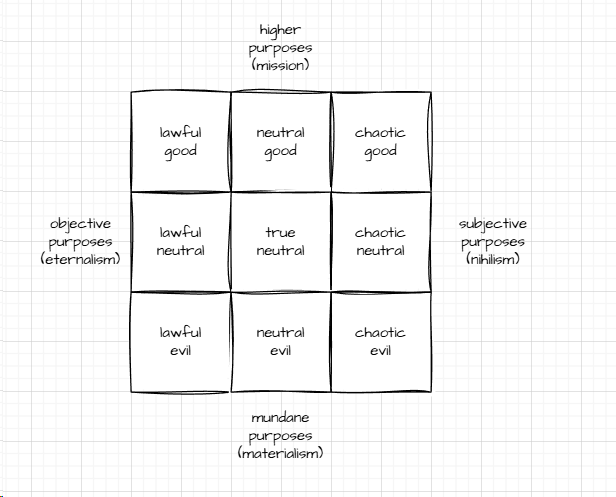
In our philosophical alignment grid, we reinterpret the axes as follows:
Horizontal Axis: Objective Purposes vs. Subjective Purposes
Objective Purposes (Eternalism): Belief that meaning and purpose are inherent in reality, independent of human opinion.
Subjective Purposes (Nihilism): Belief that meaning and purpose are entirely human constructs or illusions.
Vertical Axis: Higher Purposes vs. Mundane Purposes
Higher Purposes (Mission): Pursuit of transcendent, grand, or idealistic goals.
Mundane Purposes (Materialism): Focus on practical, immediate, and worldly goals.
This produces nine distinct philosophical alignments:
Placing Meaningness at True Neutral
David Chapman's Meaningness project explicitly seeks balance, proposing that meaning arises precisely from navigating between extremes:
Eternalism vs. Nihilism: Chapman argues both extremes are incomplete. Eternalism imposes rigid, absolute truths, ignoring fluid human contexts. Nihilism dismisses meaning altogether, ignoring the significance humans inevitably create.
Mission vs. Materialism: Similarly, he rejects an exclusive emphasis on transcendent missions or purely mundane pursuits. True meaningfulness, according to Chapman, involves continuously integrating ideals and practicality.
Hence, placing Meaningness at the "True Neutral" center effectively illustrates Chapman's notion of dynamic equilibrium—a stance that neither negates nor strictly adheres to a singular worldview.
Dynamic Equilibrium in Practice
True Neutral, philosophically understood through Chapman's lens, requires continuous balance and vigilance. It isn't passive neutrality, but an active, agile response to shifting contexts. Meaning arises not from static dogmas, but from skillful navigation.
Chapman's appreciation of this metaphor underscores the accuracy of positioning Meaningness as True Neutral—it's neither detached nor dogmatic, neither nihilistic nor eternalistic, neither overly idealistic nor purely pragmatic.
Conclusion
Using the familiar D&D alignment grid as a metaphor provides a memorable framework to grasp Chapman's sophisticated philosophical stance. Embracing this True Neutral alignment helps clarify how dynamic equilibrium can meaningfully inform both our intellectual pursuits and practical living.