
The COVID-19 Lab Leak Hypothesis
A Bayesian Examination
June 10, 2025
Debates over COVID-19's origins often deteriorate into polarized dogma, but clarity emerges through disciplined Bayesian reasoning—a crucial antidote to confusion.
Establishing a Rational Prior
Historically, pandemics stemming from zoonotic spillovers occur where humans and wildlife collide—often rural regions or wildlife markets teeming with natural reservoirs. Wuhan, an urban industrial hub remote from bat habitats, uniquely houses the Wuhan Institute of Virology—the singular global epicenter for gain-of-function coronavirus research. A natural emergence precisely here strains credulity and suggests a low initial prior.
The Extraordinary Coincidence
In Bayesian terms, the initial outbreak's proximity to the Wuhan lab dramatically amplifies the posterior credence for a lab-associated origin. To believe otherwise—that the virus spontaneously emerged within mere miles of the only laboratory in the world actively engineering coronaviruses to infect humans—is statistically absurd. This stark spatial-temporal coincidence virtually demands explanation through human involvement rather than blind chance.
Corroborating Context
Gain-of-function Experiments: The Wuhan Institute explicitly enhanced coronavirus infectivity and transmissibility to humans, precisely aligning with the properties of SARS-CoV-2.
Missing Links: Intensive, prolonged searches for natural intermediate hosts have conspicuously failed, undermining natural emergence hypotheses.
Opacity and Obfuscation: The aggressive suppression of transparency by Chinese authorities—censoring data and hindering investigations—compounds suspicions, fitting the predictable pattern of institutional embarrassment after an accidental leak.
Institutional Betrayal and Erosion of Trust
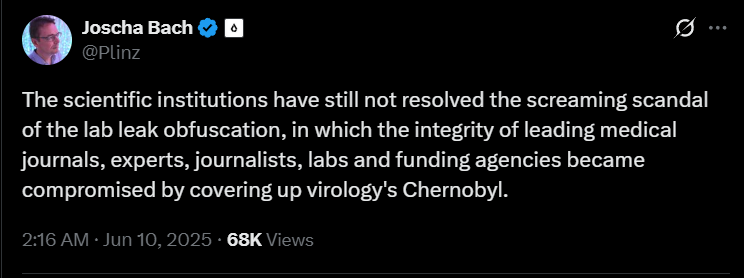
Joscha Bach aptly describes the scandal surrounding COVID-19 origins as "virology's Chernobyl," highlighting how scientific institutions compromised their integrity by obfuscating evidence and suppressing critical discussion. This betrayal has not merely distorted facts but fundamentally eroded public trust in scientific institutions, journals, experts, and funding agencies. When institutions tasked with truth-seeking engage in ideological self-protection, they undermine their legitimacy and diminish society's collective confidence in scientific discourse.
Evaluating the Opposition
While genetic analyses indicate no overt laboratory-engineered markers, virus adaptation through routine animal or cell-culture methods would obscure such signatures. Thus, this apparent lack of explicit genetic manipulation evidence fails to undermine the lab-leak hypothesis meaningfully.
Bayesian Conclusion
Properly calibrated Bayesian reasoning, duly accounting for the sheer improbability of coincidence and supporting contextual evidence, yields an overwhelming posterior probability favoring an accidental laboratory origin. Tentative, cautious estimates around 60-70% pale when genuinely acknowledging the extraordinary improbability of coincidence.
A robust Bayesian stance compels a credence level of 85-95%. To assert otherwise—that COVID-19 naturally emerged adjacent to the very facility uniquely positioned to engineer such viruses—is to reject rational probability in favor of wishful improbability.