
Defending Bayes, Part 3
Sharpening the Distinction Between Scientific and Empirical Knowledge
May 23, 2025

Introduction
In previous discussions, we addressed criticisms raised by Deutsch and Hall regarding the inappropriate use of Bayesian reasoning in the context of scientific theories. Here, we explore a fundamental distinction crucial for properly applying Bayesian methods: the difference between scientific knowledge (explanatory frameworks) and empirical knowledge (timeline uncertainty). We explicitly define and clarify how credence represents uncertainty about our position within a Quantum Branching Universe (QBU). This refinement resolves confusion around Bayesianism's appropriate domain of applicability, aligning it with rigorous epistemological principles.
Part 1: Scientific (Explanatory) Knowledge
Definition: Scientific knowledge includes general theories or explanatory frameworks that describe consistent and universal relationships and principles underlying observed phenomena. These explanatory frameworks offer structural clarity, allowing us to comprehend and predict broad classes of phenomena. Crucially, scientific knowledge is intended to apply universally across all timelines within its explanatory domain.
Key Features:
Evaluated through explanatory coherence, simplicity, generality, and resistance to criticism.
Universally applicable across all possible timelines covered by their explanatory scope.
Acceptance is not subject to probabilistic or Bayesian updates; instead, it relies upon critical rationalist evaluation methods.
Examples:
Quantum Mechanics (specifically, the Many-Worlds Interpretation)
Evolutionary Theory by Natural Selection
General Theory of Relativity
Part 2: Empirical (Timeline) Knowledge
Definition: Empirical knowledge captures uncertainty regarding specific events or conditions within accepted explanatory frameworks. This type of knowledge is inherently probabilistic and quantified using credence, representing our degree of confidence regarding particular timelines.
Key Features:
Intrinsically probabilistic and explicitly responsive to Bayesian credence updates.
Credence quantifies uncertainty regarding past, present, or future timeline-specific events.
Empirical uncertainty systematically decreases as new evidence accumulates, enabling more precise identification of our timeline.
Examples:
Medical diagnoses involving uncertainty about genetic predispositions or current health conditions.
Meteorological predictions such as weather forecasts based on present atmospheric data.
Historical uncertainty, such as the precise motives behind major historical decisions or events.
Part 3: Sharpness and Importance of the Distinction
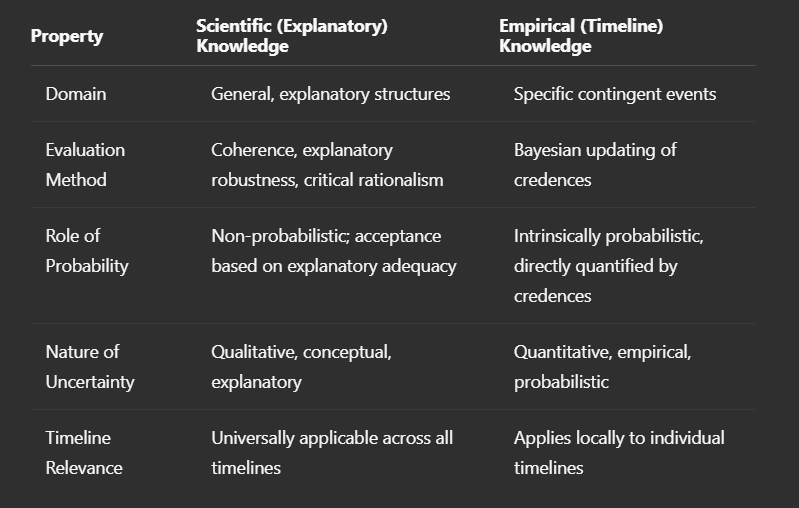
Misunderstanding this distinction leads to errors such as the inappropriate use of Bayesian reasoning to judge explanatory frameworks—exactly the error Deutsch and Hall correctly highlight. However, Bayesian reasoning remains crucial and precisely relevant for handling empirical knowledge, effectively quantifying timeline uncertainty and clarifying our location within the multiverse.
Part 4: Beyond the Binary Distinction – Hybrid and Boundary Cases
Certain types of knowledge exhibit mixed characteristics that integrate both explanatory and empirical elements, creating interesting hybrid cases:
Parameterized Theories:
Scientific theories often include empirical parameters that are subject to probabilistic updating, such as cosmological constants (e.g., the Hubble constant or dark matter density).
These parameters reflect empirical uncertainty within otherwise explanatory and universal frameworks, making them natural hybrid cases.
Historical Interpretations:
Historical explanations blend general explanatory frameworks (theories of history, economics, sociology) with contingent empirical uncertainties due to incomplete or ambiguous evidence.
This creates an inherently probabilistic interpretation space, combining explanatory structure and timeline-specific uncertainty.
Part 5: Additional Distinct Categories of Knowledge
Beyond hybrids, there exist two additional, clearly distinct knowledge categories that complement the explanatory-empirical distinction:
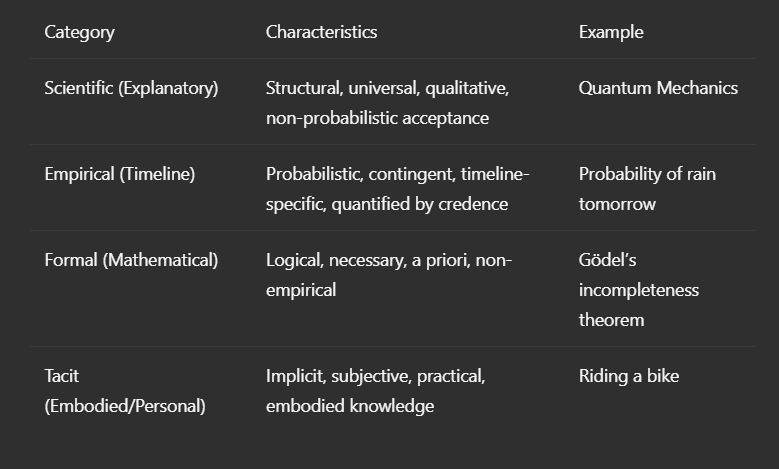
Formal (Mathematical) Knowledge:
This category is non-empirical, necessary, logically rigorous, and derivable entirely a priori.
Examples include Gödel’s incompleteness theorems, basic arithmetic properties, and set-theoretical truths.
Tacit (Embodied/Personal) Knowledge:
Tacit knowledge represents practical, implicit, and subjective knowledge that often defies explicit formulation.
Examples include the skill of riding a bicycle, musical performance, or intuitive judgment in complex situations.
Conclusion: Enhancing Philosophical Clarity
By clearly differentiating scientific (universal explanatory) knowledge from empirical (timeline-specific) knowledge, we establish a robust epistemological foundation. This distinction enhances our ability to critically assess claims and prevents confusion over explanatory adequacy versus empirical uncertainty. Future posts will continue exploring applications of these distinctions, especially concerning Quantum Decision Theory, philosophy of science, and deeper examinations of hybrid cases and boundary conditions.