Volume 7 — Liberty, Coercion, and Governance
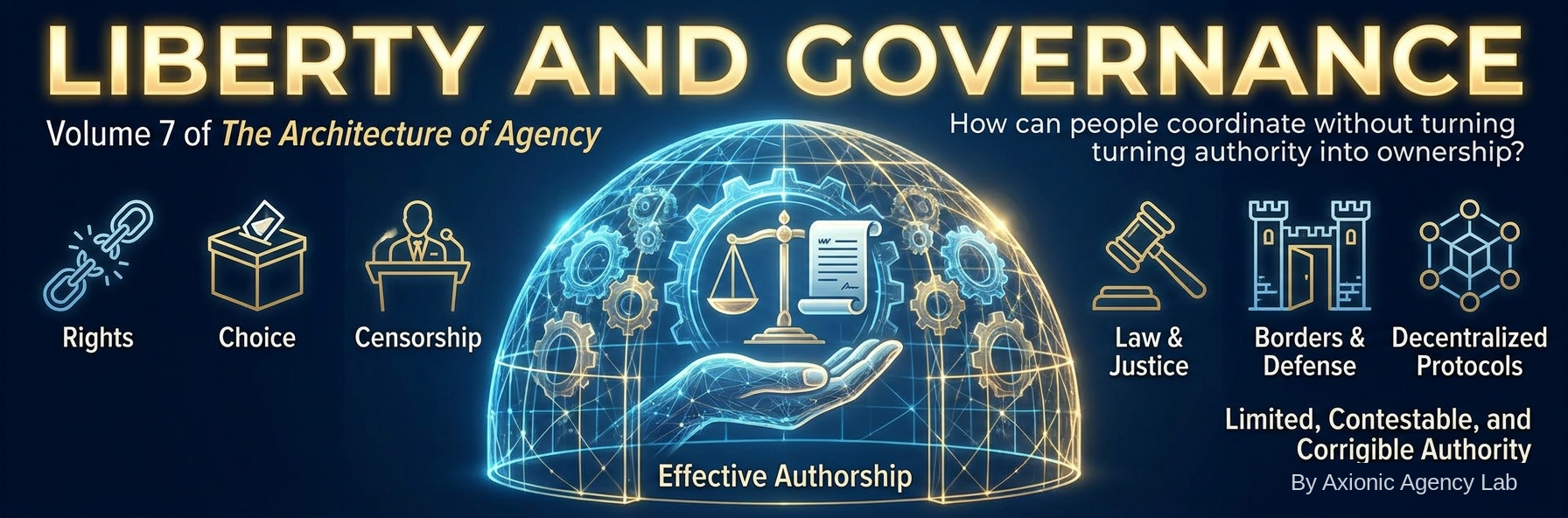
Politics inherits its foundations from everything before it: value is agent-relative; harm is a material setback to welfare or functional capacity and viable options against an explicit baseline; coercion is a conditional-threat mechanism with a canonical definition; and classification, justification, and authority remain distinct. This volume chooses the individual person as its primary moral unit: persons are the directly evidenced valuing agents in political life, while a group label does not by itself establish one subject, consent, or welfare. What this volume adds is the political consequence: an account of the state, rights, speech, justice, equality, and governance built on agency rather than on the fictions — the collective will, the national interest, the moral ledger of disparities — that political philosophy usually runs on.
The argument moves in seven parts. Part I confronts the state directly: the individualist premise and the axis that isn’t left–right; the lineage from Mill’s harm principle through the Non-Aggression Principle to the Agency Protection Principle; the coercion continuum on which taxation and slavery share one dimension of compelled extraction while differing profoundly in moral structure; the funding test that classifies states and protection rackets by the same mechanism — and then the Grey Zone, the volume’s canonical position, where coercion’s legitimacy is conditional, provisional, and burden-scaled, never settled by taxonomy. Part II builds the rights theory: moral claims, legal embodiment, and enforcement are separated, while reciprocity supplies the constraint that a justification must survive application to the coercer; needs are not rights, negative rights collide honestly, and freedom of association includes the freedom to exclude. Part III is free speech from foundation to architecture: the listener’s right, the causal ladder that finally draws the speech/violence boundary once (and classifies operational incitement as delegated violence, a third category), the censorship machine by which liberal societies drift into cognitive regulation, and the capstone: free speech as civilizational infrastructure, with the filter near the user and no moral landlord for the network.
Part IV treats law and justice as applied epistemology: common law resolves conflicts while command law manufactures them; law binds only where power is balanced — the bottom tail generates the rules, the top tail escapes them; the presumption of innocence encodes the state’s admission that it might be wrong; restitution replaces retribution; and borders face the same agency test as every other coercion. Part V takes on the egalitarian temptation in ascending order of ambition: poverty is the problem and inequality a relation; luck is real and ethically irrelevant; envy skips the causal work between disparity and injury; socialism converts need into jurisdiction; communism is the premise fully built — the machine that amputated societies’ sense organs; and utopia itself is ill-typed, with the Sacrifice Pattern as the mechanism every closure runs on. Part VI catalogues the pathologies — the authoritarian default in human psychology, liberalism’s structural unpopularity, the fictions of collective agency, the words inflated into noise — and ends with the temperament that survives the diagnosis: centrism as a discipline for governing complex systems under uncertainty and irreversibility.
Part VII is the final constructive sequence. Politics is treated as an exploit, not a law of nature, and converting coercion into coordination as a chosen civilizational project whose gains can reverse. The archist axiom — that the state holds moral permissions individuals lack — fails its symmetry test; anarchy means the absence of coercive monopoly, not of order, and the international system already runs on it; defense, the hardest case, gets its full strength and ends honestly open. The state is seventeenth-century technology tested against proposed forms of protocolized governance; Leviathan is a coordinating mechanism whose attributable institutional authorship has collapsed; and the admissible region replaces left-and-right with this volume’s governing political question: inside or outside the region where agency remains viable. The volume closes with Axiocracy — governance by value discovery — and its first constitution, drafted for the one place where institutional error runs out of oxygen.
After the seven parts, the fictional coda “The Price of Breath” places the proposed institutions under pressure. Its failure, liability, and privacy conflict test consequences; fiction supplies no empirical evidence that the design will work.
The definitions live in the fifth volume, the economics in the sixth, the formal governance results in the fourth; this volume cross-links all three throughout. Its controlling position is the Grey Zone: coercion is classified without euphemism, but legitimacy remains conditional, burden-scaled, evidence-bound, and open to revision. Polemic remains voice, not doctrine.
This volume is in author review. Chapters carry their status openly, and the arguments are held the way the book says they should be held: at the strength the evidence licenses, and no stronger.
Chapters
Part I — Coercion and Its Burden
- The Individualist Premise review
The individual is the chosen moral unit because directly evidenced valuing, suffering, consent, deliberation, and action occur in subjects and agents rather than in group labels. Nations, classes, races, and institutions can coordinate people and generate real effects without automatically becoming single minds with one welfare or will. The essential political divide is therefore not left versus right but individualism versus collectivism: whether persons remain ends whose standing constrains collective projects or become instruments of an aggregate. This premise is normative, not a deduction from ontology, and it does not deny relationships, communities, shared goods, or institutional agency where authorship can be traced. Individual rights still need reciprocal justification, legal embodiment, enforcement, and procedures for conflict. Collective action can protect agency when grounded in delegation and limited by the people it affects. Political analysis begins by resolving every abstraction back to the persons who choose, bear costs, and can meaningfully authorize what is done.
- Upgrading Liberty review
John Stuart Mill's harm principle preserves individual sovereignty and places coercion under suspicion, but its undefined central term lets offense, disadvantage, and disagreement be redescribed as harm. The Non-Aggression Principle sharpens the boundary around initiated force while relying on disputed property, consent, fraud, threat, and baseline judgments. The Agency Protection Principle states a narrower gate: coercion has a prima facie justification only when it prevents or remedies violations of voluntary agency. Benefits cannot purchase an innocent agent's autonomy before that gate is crossed, and agency concerns capabilities and viable options rather than aggregate happiness. Any licensed response must still count enforcement harms and satisfy evidence, authority, necessity, proportionality, minimally harmful means, reversibility, containment, and review. Where comparison remains unclear, the tie does not go to the coercer. Liberty is protected not as empty noninterference but as the condition in which agents can continue to choose.
- The Coercion Continuum review
Taxation and slavery are not morally equivalent, but both can be located on one declared dimension: compelled extraction of labor or output backed by credible threats of harm. The spectrum runs from zero compulsory extraction to total appropriation, while bodily control, inherited status, legal standing, exit, violence, and brutality remain separate axes. Tax share therefore measures one mechanism rather than supplying a complete moral ranking. States also claim powers over use, exclusion, and disposition through licensing, borders, zoning, taxation, and inheritance rules. Democracy and dictatorship differ profoundly while sharing a structural license to initiate coercion beyond explicit agreement. Chattel slavery adds domination and blocked exit that cannot pass a justification test; a limited levy might pass the Agency Protection Principle and Grey Zone, but must actually do so. The continuum is a diagnosis that keeps familiar institutions answerable to the same coercion inquiry, not a sentence erasing differences of dose, scope, or legitimacy.
- Extortion-Funded Organizations review
An Extortion-Funded Organization receives revenue through demands backed by a credible conditional threat of harm to obtain compliance. The classification concerns the funding mechanism rather than every activity, employee, or outcome of the organization. Voluntary payment provides evidence that participants value an offer under available conditions; compulsory payment cannot reveal the payer's endorsement in the same way. Calling an institution necessary reverses the burden when its monopoly and compulsory revenue have prevented alternatives from developing or being tested. Valuable outputs—including science, infrastructure, protection, and aid—do not retroactively make extraction voluntary or establish authority to impose it. A parasitic relation exists strictly where one party extracts resources while externalizing the costs of maintaining the host, not wherever an institution is disliked. Institutionalization and public acceptance can distinguish a state socially from a protection racket without changing the underlying threat structure. Classification opens the legitimacy inquiry; it does not settle whether a particular coercive revenue system is justified.
- The Grey Zone review
Coercion can be justified provisionally when it prevents or remedies a specified violation of agency, but classification never supplies authority by itself. Grey cases involve contested facts, probabilistic harms, compromised titles, unequal capacity, and enforcers with interests of their own. A disciplined inquiry identifies the actual agents, specifies the alleged violation, states background conditions of ownership, consent, capacity, authority, and harm, and demands evidence proportionate to severity. It then bounds the response through necessity, proportionality, reversibility, minimally harmful means, termination conditions, and review, while asking what permanent enforcement interests the intervention creates. Emergencies can change timing without canceling the burden of later justification. The burden rises with severity, duration, uncertainty, and discretion, so permanent coercion over millions cannot borrow the logic of immediate self-defense. The Grey Zone remains deliberately unresolved in many cases: ambiguity must be exposed and managed rather than concealed beneath words like safety, justice, democracy, property, or order.
Part II — Rights and Their Collisions
- Rights Are Forged — and Reciprocal review
Rights are forged in two distinct senses: power makes a boundary effective, while reciprocal justification makes it a candidate moral right. A moral right is a defensible protection or claim around agency whose principle survives reciprocal application; a legal right is an institutionally recognized claim. Enforcement may embody a justified boundary or mechanize domination, so neither recognition nor power alone establishes legitimacy. Slaveholders had preferences and effective mechanisms, which proves that preference satisfaction and enforcement cannot be sufficient. Reciprocity asks whether the same principle can protect each agent without granting one side a status it denies the other. Needs can ground concern without automatically creating title to another person's body, labor, or property, and hard cases still require evidence, authority, proportionality, and procedure. Parchment declarations fail when no architecture resists violation, yet monopoly enforcement is not the only possible architecture. Rights remain claims, institutions, and mechanisms that must be kept conceptually separate and jointly defensible.
- Needs, Conflicts, and Hard Cases review
Need is morally salient without becoming an automatic right to another agent's resources, labor, association, or property. Negative rights can collide when exercising one protected domain materially invades another, so slogans about noninterference cannot replace baseline, causation, title, consent, and proportionality analysis. Property does not erase necessity, and necessity does not manufacture unlimited title. Freedom of association includes a freedom to exclude, even when exclusion is offensive or unequal, unless it operates through an independently wrongful mechanism such as fraud, breach, monopoly control of an essential dependency, or coordinated coercive penalty. Ordinary criticism and refusal to associate are not coercion merely because they impose social costs. Large-scale exclusion can nevertheless destroy realistic exit or access and become ethically relevant through its actual structure. Hard cases require identifying the agents, protected interests, available alternatives, imposed harms, and authority claimed. Rights remain reciprocal boundaries for coexistence, not trump cards that answer every conflict before the facts are known.
Part III — Speech and the Causal Boundary
- The Listener's Right review
Free speech protects a relation between speakers and willing listeners, not a speaker's entitlement to every platform, audience, venue, or subsidy. The listener's freedom to receive, ignore, seek, filter, and compare expression is the neglected half of the right. Publication and amplification are distinct from permission to speak, while property owners, editors, associations, and audiences retain their own powers of selection. A refusal to host or hear someone is not censorship by definition, though concentrated control over essential channels can make nominal alternatives unreal. Free expression works through offered reasons, evidence, imagination, and persuasion rather than compelled assent. One freedom covers both sides: agents may communicate and may decide what enters their attention, subject to the same boundaries against threats, fraud, and operational participation in harm. Protecting the listener prevents free speech from becoming a demand for access enforced against others. A plural speech order therefore needs abundant channels, user-side control, and no moral landlord empowered to decide what every mind may encounter.
- Where Speech Ends review
Speech must be classified by causal role rather than divided into harmless words and forbidden ideas. Protected expression works through belief, interpretation, and persuasion, leaving the listener's agency as the operative link. Coercion is the deliberate use of a credible conditional threat of harm to obtain compliance, even when the threat is delivered entirely in words. Delegated violence is operational participation in harm through commands, targeting, coordination, or other contributions that load the rifle for another actor. Advocacy, prediction, praise, insult, incitement, threat, and command can therefore occupy different rungs of a causal ladder without becoming identical. Popper's paradox does not authorize suppressing an idea merely because its success might later produce intolerance; the relevant question is what the present utterance does in the causal process. Secular blasphemy rules confuse offense with injury and belief change with force. Three categories—expression, coercion, and operational participation—preserve both free inquiry and responsibility for speech that functions as part of an attack.
- The Censorship Machine review
Liberal censorship grows through three category errors: expression is treated as latent action, offense is treated as harm, and prevention is treated as sufficient justification. Bureaucracies face a gradient toward intervention because visible failures to suppress are punished while invisible losses from suppressed truth, dissent, and correction are rarely assigned. Declaring questions “not up for debate” moves contested claims outside the process that could test them and grants an institution authority over the boundaries of thought. Game-theoretic arguments for coordinated silence can appear prudent when adversaries exploit openness, but the mechanism also protects incumbents and removes error correction. Selective courage condemns censorship by opponents while excusing it for favored risks, revealing that the operative value is control rather than speech. Falsehood, manipulation, harassment, and propaganda remain real problems; censorship does not become competent or legitimate merely because those problems exist. A free order keeps burdens of evidence visible, filters near willing users where possible, and treats irreversible cognitive regulation as a high-cost intervention requiring narrow scope and review.
- Civilizational Infrastructure review
A free-speech order is civilizational infrastructure: a deliberately maintained system for error correction, disagreement, discovery, and peaceful revision. Its useful mess includes falsehood, offense, noise, and conflict because no central authority can remove only error without acquiring power over contested truth. Safety should be treated as sanitation rather than ideological purity, targeting fraud, direct threats, harassment, and operational participation in harm while leaving persuasion and belief contestable. Filters belong as near the user as practical, preserving the listener's control and allowing plural communities to choose different thresholds. Publication, recommendation, advertising, and compelled carriage are distinct decisions rather than one binary of speech versus censorship. Mobs and coordinated exclusion can make nominal expression materially costly, while ordinary criticism and refusal to associate remain protected conduct. Advertiser leverage can centralize hidden veto power over public conversation. No moral landlord should govern every channel; resilience comes from diversity, portability, transparent rules, appeal, and the ability to exit without losing the capacity to speak or listen.
Part IV — Law, Justice, and Movement
- Two Kinds of Law review
Law performs two different functions that should not share one moral presumption. Discovered or evolved law resolves recurring conflicts by clarifying boundaries, expectations, evidence, and remedies among agents. Command law manufactures new conflicts by imposing a planner's purposes and then treating resistance as the original wrong. Real legal systems mix both forms, and legislation can codify genuine conflict-resolution rules while common law can preserve unjust power. Coercion supplies an audit measure: identify which conduct was already a violation and which violation exists only because an authority prohibited otherwise peaceful action. Order alone cannot justify command, because stable domination is also orderly. Rules need legibility, reciprocal application, contestability, and correction, while enforcement needs evidence, jurisdiction, proportionality, and review. Law earns authority by making coexistence more navigable under defensible boundaries, and the honest middle evaluates each rule by function and institutional consequence rather than declaring every statute tyranny or every inherited rule justice.
- Law and Power review
Law binds reliably only where power is sufficiently balanced for violation to trigger credible consequences. The Tail-Risk Principle holds that a small proportion of actors or events creates disproportionate costs, so universal rules become calibrated around them and raise a civic question: should we all be governed by the worst among us? Ordinary offenders become the design cases for law, while elite failures generate regulatory architectures their architects can dilute, redirect, or evade. The Symmetry is exact: the bottom tail generates the rules; the top tail escapes them. This does not make law unreal; it makes effective law a relation among institutions, incentives, and capacities rather than words on paper. International rules, constitutions, contracts, and informal norms all become fragile where one party can defect without meaningful response. Explanation does not justify hegemony or reduce rights to force. Durable legality requires distributed interpretation, exposed decisions, appeal, and consequences even dominant actors cannot unilaterally rewrite.
- The Epistemics of Guilt review
Guilt is an epistemic verdict under uncertainty, not a metaphysical stain revealed directly to an institution. Trials function as error filters through adversarial evidence, burdens of proof, confrontation, independent judgment, appeal, and rules limiting unreliable inference. False conviction and false acquittal are structurally different errors whose costs vary with the sanction, evidence, and reversibility. Reasonable doubt is a policy threshold for institutional action, not a claim that uncertainty has vanished or that every private Credence must match the verdict. Irreversible punishment requires especially demanding evidence because later correction cannot restore what was taken. The presumption of innocence is a principle; current courts, police, juries, experts, and procedures are fallible machinery intended to implement it. Better filters require transparency, recorded evidence, independent review, forensic validation, defense resources, and consequences for misconduct. Institutional humility means designing for known error rather than treating formal process as proof of truth or authority as immunity from revision.
- Restitution, Not Retribution review
Justice should restore violated agency where possible rather than manufacture suffering as repayment to an abstraction. Restitution identifies victims, attributable losses, responsible agents, repair, and future protection; retribution creates a debt owed to no concrete person and authorizes punishment for its own sake. Compensation cannot fully undo death, trauma, lost time, or destroyed trust, but its incompleteness does not make purposeless pain a better answer. Enforcement remains a trade-off because collecting restitution can impose further force, error, expense, and dependency. Universal Compensatory Justice treats responsibility and repair as portable across institutional forms rather than requiring one sovereign monopoly. Incapacity, insolvency, diffuse harm, uncertain causation, and dangerous offenders require insurance, pooled mechanisms, protective restraint, and procedures that preserve evidence and proportionality. Protection may justify confinement while threat persists, but punishment should not be smuggled into protection after the need ends. Justice without monopoly remains a design problem, not a promise that every wrong can be priced or every victim made whole.
- Borders and Movement review
Borders restrict movement through coercive institutions while communities also possess legitimate interests in security, property, capacity, and continuity. Immigration can create gains and localized costs, and those effects must be attributed rather than compressed into either invasion or enrichment. Cultural change is not automatically harm, because no generation owns a frozen social pattern, yet rapid change can affect trust, infrastructure, bargaining, and realistic participation. Immigration is not colonization merely because populations move; colonization adds conquest, domination, expropriation, and political subordination. Historical dispossession can ground claims for restitution or institutional repair without creating inherited collective guilt or a title to coerce uninvolved persons without limit. Demographic objectives do not authorize reproductive mandates, forced settlement, or exclusion by ancestry. Movement policy must distinguish peaceful entry, trespass, security threat, labor-market rules, welfare commitments, and the authority claimed over each. A defensible arrangement protects individual agency on both sides while admitting uncertainty, capacity constraints, and the costs imposed by enforcement.
Part V — Equality, Need, and Utopia
- Agency, Not Equality review
Equality measures a relation between positions; agency measures whether a person retains meaningful capacity and viable options. Poverty can materially constrain agency, while disparity alone does not establish deprivation, discrimination, coercion, or wrongfulness. Luck is real and pervasive, but removing every unequal effect of birth, talent, family, health, timing, and chance would require continuous control over outcomes and choices. Equal opportunity recedes into a regress because equalizing one starting point exposes earlier differences in preparation, inheritance, temperament, and support. The attainable political target is not identical prospects but an agency floor: protection against coercion, access to legal standing, realistic exit, and enough capability to choose and revise a life. Assistance can raise that floor without treating every advantage as stolen or every unequal outcome as proof of injustice. Institutions should identify mechanisms that block agency—fraud, exclusion, monopoly, violence, deprivation, captured rules—rather than pursue equality as an independent scalar good. Fairness remains conditional on stated standards, baselines, and authority.
- The Corruption of Compassion review
Compassion is an orientation toward another's suffering; coercion is a method that obtains compliance through a credible conditional threat of harm. A benevolent motive does not change the mechanism or settle its legitimacy. Voluntary basic income funded through gifts, endowments, mutual insurance, or shared assets differs structurally from a compulsory transfer even when recipients receive the same payment. Aid can also strengthen oppressors when resources pass through institutions that control distribution, extract loyalty, or redirect benefits. Refusing coercive compassion does not prove that private charity will meet every need or that collective provision lacks justification. The relevant inquiry identifies the harmed agents, funding method, authority, alternatives, capture risks, and whether aid preserves or displaces local agency. Kindness becomes corrupted when the donor's virtue is purchased with another person's compelled resources and the enforcement cost disappears from the moral ledger. Compassion remains valuable; it must not function as a blank check for methods that contradict the agency it claims to protect.
- Against Envy review
Envy begins with disparity but does not establish injury. A valid grievance requires a mechanism connecting another person's advantage to a material setback, coercion, fraud, exclusion, rent extraction, or blocked agency. Status is often local and positional, so rank can affect welfare and opportunity without turning every superior outcome into theft. Rank-violation envy reacts when someone perceived as lower crosses an expected boundary, revealing a demand to preserve hierarchy rather than relieve deprivation. Production and predation can both generate fortunes, and snapshots of distribution cannot distinguish them without tracing acquisition, institutions, and counterfactuals. Trajectories matter because unequal growth with a rising floor differs from enrichment through a ladder deliberately frozen behind incumbents. Politics organized around disparity can destroy productive capacity or can expose captured rules; the mechanism decides. The appropriate target is whatever caused deprivation or illegitimate power, not difference itself and not the person who merely occupies a higher position.
- Against Socialism review
Socialism here means institutional allocation or control of productive resources through collective authority rather than voluntary exchange among holders of defensible claims. Need creates moral salience but does not by itself create title to another person's labor, property, or compliance. Failure of voluntary provision can reveal coordination, purchasing-power, or public-goods problems without automatically transferring jurisdiction to the state. Redistribution requires an account of acquisition, affected agents, authority, baseline, enforcement, and why the proposed remedy improves agency after coercive and administrative costs are counted. Scarcity cannot be abolished by command, and compassionate planners face knowledge, incentive, capture, and revision problems of their own. Infrastructure and severe coordination problems can support collective mechanisms, but dose, domain, error correction, contestability, and exit determine whether a particular arrangement is defensible. Rejecting the socialist premise does not deny poverty, mutual obligation, public investment, or cooperation. It denies that declared need or aggregate benefit alone authorizes compulsory control of other agents' productive lives.
- Against Marxist-Leninist Communism review
Marxist-Leninist communism is a narrow institutional family organized around one-party command, suppression of rival ownership and political authority, centralized planning, and coercive transformation. The Soviet template, Maoist scaling, Cambodia's extreme case, and North Korea's end state differ historically while exposing recurrent failures of information, incentives, contestability, exit, and concentrated force. Body counts matter but do not exhaust the indictment; the machinery also destroys independent association, truthful feedback, legal standing, property, mobility, and the capacity to correct policy without threatening the regime. Retreats toward prices, household production, private enterprise, or foreign trade are evidence that command systems needed mechanisms they had attempted to abolish. No claim follows that every welfare policy, cooperative, socialist party, or public institution is Marxist-Leninist. The causal target is the road of monopoly command and enforced closure, not an imagined final ideal judged independently of its means. Moral alchemy cannot convert coercion into liberation merely by assigning it a future beneficiary.
- Against Utopia review
Utopia requires closure: a final model of the good, sufficient knowledge of how to produce it, and authority to prevent dissent from reopening the design. Normative finality turns disagreement from information into defect and converts agents with rival ends into obstacles to optimization. Omelas exposes the Sacrifice Pattern not because every society literally rests on one tortured child, but because aggregate perfection can make an identified innocent appear spendable. Dynamic societies cannot freeze preferences, technology, circumstances, or interpretation without suppressing the very agency that generates correction. A proposed improvement remains corrigible only while exit, contestation, and revision survive. The danger is not hope, planning, or ambitious reform; it is treating one destination as complete enough to authorize irreversible control over everyone who must inhabit it. After closure, institutions defend the model against evidence and call resistance pathology. A humane politics pursues bounded improvements with visible costs and reversible mechanisms rather than salvation that requires sacrificing authorship to the plan.
Part VI — Political Pathologies and Epistemic Discipline
- The Authoritarian Default review
Authoritarianism is a recurrent political risk produced by interacting psychological dispositions, coordination pressures, institutions, and crises rather than an inevitable species destiny. Submission can offer certainty, belonging, protection, reduced responsibility, and a visible agent to blame or obey. A cycle can move from fear through demand for control, concentration of authority, suppression of correction, institutional failure, and renewed fear, but interrupters can break each transition. Three axes expose the structure: authority versus autonomy, coercion versus consent, and dogmatic certainty versus conditional epistemology. The third is deepest because the other two follow from it: certainty licenses authority to close inquiry and coercion to impose the answer. Elections, ideology, or a charismatic leader alone do not settle the classification. Liberal order is a precious, fragile achievement that must be built and maintained because incentives can reward surrendering distributed judgment for coordinated command. The “default” is a vulnerability and discipline, not a biological clockwork prediction.
- Why Liberalism Loses review
Liberalism carries structural handicaps because it promises procedure, restraint, uncertainty, and peaceful disagreement while rivals offer belonging, certainty, protection, and decisive purpose. The Political Triangle contains three answers to what government is for: Individualism offers self-determination, Maternalism offers care, welfare, and a safety net, and Paternalism offers order, law, and defense. Liberalism asks supporters to tolerate speech they hate, outcomes they lose, and institutions that refuse to guarantee their preferred moral order. Permanent adolescence results when citizens are treated as dependents and then demand the supervision that dependency taught them to expect. Liberals lose by their own hand when they abandon their discovery procedure, select standard-bearers primarily by identity criteria rather than demonstrated competence, and let insiders anoint a candidate instead of permitting open competition. None of this makes defeat inevitable. Liberty survives when institutions preserve responsibility, open discovery, and adults willing to govern themselves without demanding that politics eliminate uncertainty.
- Fictions of the Collective review
National interests are interpretations produced by officials, institutions, coalitions, models, and procedures; they are not primitive preferences emitted by one national mind. Nations can coordinate action and bear institutional responsibility without becoming literal agents whose welfare overrides the persons composing them. The intersection among millions of individual interests can vanish, leaving phrases like “the country wants” to conceal who selected the objective and who bears its cost. Collective fictions can license war, sacrifice, surveillance, and economic harm by treating dissenting individuals as cells expendable for an organism. Catastrophe often begins as epistemic failure when an interpretation loses contestability and presents itself as the only conceivable national interest. Public judgment remains necessary, but it should be attributed to identifiable authors and exposed to evidence, opposition, revision, and accountability. Policy can proceed on the best current interpretation under uncertainty without calling it destiny or unanimous will. Institutional authorship must remain reconstructible even when coordination requires speaking in a collective name.
- Words That Lost Their Teeth review
Political labels compress distinctions until argument becomes a contest over inherited emotional charge. “Socialism” can mean welfare-state redistribution, public ownership in a mixed economy, or revolutionary command, and conclusions cannot move among those meanings without equivocation. Left and right likewise bundle authority, ownership, culture, moral scope, and institutional method onto one line that cannot represent them faithfully. Andrew Doyle's Razor supplies a sufficient condition for fascism: condoning or celebrating the murder of political opponents—the legitimization of political murder, whatever banner covers it. LARPitarian performance displays radical identity without accepting the institutional consequences or tradeoffs the identity implies. Semantic hygiene does not settle values; it makes disagreements legible enough to test mechanisms, evidence, scope, and authority. Compressed axes should be retired when they repeatedly classify structural relatives as opposites and unrelated systems as neighbors. Political language regains teeth when terms identify observable arrangements rather than coalition badges.
- Centrism as a Discipline review
Centrism is a discipline of governance under uncertainty, not a demographic midpoint or a reflex to split every difference. Political extremes share a tendency to compress uncertainty, treat one model as complete, and discount irreversible errors imposed on people outside their coalition. Society behaves more like an evolving ecology than a machine with one control panel, so interventions should distinguish reversible variance from changes that destroy future correction. The epistemic core favors experiments, feedback, plural institutions, burdened evidence, and selective decisiveness when delay itself is irreversible. Institutions provide scaffolding that preserves contestation and memory without becoming sacred or immune to reform. Metastable evil warns that harmful arrangements can remain locally stable, so caution cannot mean preserving every status quo. Principled actors may hold strong ends while choosing bounded, corrigible means. The discipline promises no automatic virtue or policy answer; it seeks an admissible path that learns before committing everyone to a failure state that cannot be exited.
Part VII — Monopoly, Anarchy, and Protocol
- The Conversion of Coercion review
Politics is not identical to coordination; it is the contest over who may impose binding decisions and under what claimed authority. Coercive systems exploit dependencies, collective-action problems, territorial control, and the difficulty of exit, then present their solutions as the only possible order. Civilization can be judged by a chosen commitment to converting compulsory functions into voluntary, contestable, protocolized coordination, but that conversion is neither destiny nor an accomplished historical law. Principles exert hidden power when they constrain acceptable means before convenient outcomes are known. The engineering program asks which governance functions can migrate toward delegation, portability, competition, liability, transparent rules, and realistic exit without abandoning protection or public goods. Markets and protocols can reproduce monopoly, exclusion, and hidden control, so replacing an office with software does not complete the conversion. Progress remains evaluative and reversible. The constructive task is to reduce unnecessary coercion while keeping every surviving use visible, justified, bounded, and answerable to the agents it governs.
- The Archist Axiom review
Archists hold that legitimate order requires an institution authorized to use coercion; anarchists deny that this authority must be monopolized or intrinsically sovereign. Logic cannot settle which enforcement architecture best handles violence, free riders, collusion, external threats, and error. Coercion does not require monopoly: protection, adjudication, insurance, restitution, and defense can in principle be supplied by several associations under shared protocols. Competition alone does not guarantee legitimacy, because private enforcers can cartelize, dominate dependents, misclassify threats, or wage war. The relevant tests are delegation, reciprocity, evidence, proportionality, appeal, liability, contestability, and realistic exit. The statist is not refuted by pointing to voluntary mechanisms, and the anarchist is not refuted by naming a function currently performed by a state. Defense remains the hardest case because scale, speed, secrecy, command, and catastrophic stakes reward concentration. A residue of unresolved institutional risk survives every label, leaving comparative design and evidence where axiom had promised certainty.
- Anarchy Is Not Chaos review
Anarchy means the absence of a sovereign with final authority, not the absence of rules, coordination, hierarchy, or order. Families, firms, standards bodies, networks, markets, and international relations often coordinate through overlapping agreements without one universal commander above them. The international system is the largest working anarchy, producing diplomacy, trade, alliances, law, and recurrent violence without a global state. Its existence proves that sovereignty is not necessary for every form of order, not that stateless arrangements are peaceful, symmetric, or just. The exit criterion asks whether participants can leave or challenge an arrangement without forfeiting the practical capacity to act; formal permission is insufficient under dependency or punishment. Coordination can be mistaken for sovereignty when a useful focal institution is treated as intrinsically entitled to command. Power asymmetries remain real, especially where hegemons face no effective constraint. Anarchy is an institutional condition whose quality depends on reciprocity, balance, protocol, enforcement, and exit rather than a synonym for either freedom or disorder.
- The Hardest Case: Defense review
Collective defense is the hardest case for non-sovereign governance because war rewards unified command, secrecy, rapid mobilization, compulsory finance, and suppression of defection. The central fallacy assumes that because defense is a function, one territorial state must own it as final sovereign. A proposed Defense Shell separates a narrow emergency command layer from ordinary governance and binds it through delegation, triggers, scope, funding rules, audit, expiry, and post-crisis liability. Free riders, collaborators, intelligence failures, weapons control, and adversaries exploiting procedural delay remain serious objections. A temporary shield can become a sovereign when emergency powers persist, classified claims evade review, or the organization defines the threat that renews its own authority. Survival is necessary evidence but not sufficient legitimacy, because durable victory can preserve domination. Competing defense providers can also fragment command or escalate conflict. Protection without sovereignty remains an open problem: candidate architectures can be specified and stress-tested, but no completed solution is claimed.
- Exit to Protocol review
Governance functions can migrate from territorial monopoly toward protocols only where obligations, authority, performance, and failure become measurable, comparable, and forkable. Identity, contract, adjudication, insurance, reputation, payment, certification, and some public goods can be modularized without pretending every embodied dependency is software. A non-coercive architecture requires explicit delegation, portable assets and records, transparent rules, competing providers, interoperable standards, appeal, liability, and realistic exit. Transition matters because incumbent systems hold assets, infrastructure, legitimacy, and enforcement capacity that cannot be wished away. Migration is already visible in arbitration, digital identity, open protocols, mutual insurance, platform governance, and transnational networks, but these examples also reveal capture, lock-in, and private monopoly. Forkability is meaningless when switching destroys livelihood, citizenship, housing, or access to essential services. Protocols can relocate discretion and make some authority legible; they cannot eliminate interpretation, force, emergency judgment, or unequal power. The project remains empirical institutional design rather than an automatic path from code to liberty.
- The Limits of Leviathan review
Institutional agency depends on evaluability: authorship, authority, rules, observations, decisions, and correction must remain traceable enough to attribute action. Small coalitions often preserve common context and visible responsibility, while scale increases specialization, interpretive distance, opacity, and the cost of reconstructing who decided what. Leviathan is therefore a coordinating mechanism whose attributable institutional authorship can collapse, not a literal agent or an inevitable evil. Alignment is downstream of agency because an unevaluable institution cannot reliably show which objective it serves or who may revise it. Dominion is a proposed alternative for digital jurisdictions built around airtight isolation, exit supremacy, and asset portability. Its optimization target is freedom density: the number of distinct value-consistent future trajectories available per unit of coercive constraint. Value drift means agents' values change over time, and mobility answers it by localizing coordination and globalizing exit. Virtual vessels can block some violations technically, but no architecture escapes interpretation, succession, capture, or the need to keep exit materially real.
- The Admissible Region review
Political systems require a phase space rather than one left–right line. Command, ownership, and beneficiaries vary independently, while evaluability determines whether authority and obligations remain legible enough to challenge. The admissible region is a constraint set defined by delegability, contestability, voluntary participation, legibility, and realistic exit. Participation fails when enforced through credible threats of imposed harm that the agent did not endorse under non-manipulated conditions; exit fails when punishment, confiscation, dependency, or lost portability destroys capacity to act. The conditions are conjunctive and do not select one ideology inside the region. Markets, cooperatives, federations, city-states, thick communities, and thin protocols can qualify under different coordinates, while benevolent and vicious planners converge outside it when contestation and exit disappear. Real regimes occupy mixed and changing positions rather than moral types fixed by labels. The map explains how stateless orders can remain admissible where reciprocal constraint reaches and how legally elaborate hegemony can fall outside when dominant actors answer to no effective challenge.
- Axiocracy review
Axiocracy is a research proposal for governance informed by continuous value discovery rather than rule by a central account of objective worth. Market prices reveal demonstrated exchange value under conditions of property, scarcity, purchasing power, alternatives, and consent; they do not measure human dignity, need, or ultimate moral value. Voting, deliberation, professional judgment, administration, commons governance, and currencies of commitment reveal different information and hide different costs. Purchasing power, externalities, missing markets, coercion, and agents unable to bid prevent price from becoming a complete constitution. A proposed Axiocratic design combines truthful signals with bounded offices, chartered enforcement, voice, remedy, liability, and engineered exit. Mars sharpens the dependency problem because air, housing, employment, and physical departure can be controlled by the same institution, making asset portability and pre-funded exit essential. Enforcement, capture resistance, succession, amendment, insolvency, emergency authority, and protection without purchasing power remain open. Axiocracy is a candidate point inside the admissible region, not a proven replacement for politics.
Fictional Coda — The Price of Breath
- The Price of Breath review
A fictional Commonwealth organizes air, water, shelter, care, and authority through bonded obligations, contestable claims, liability, and continuously justified control. The story deliberately makes those proposed institutions fail: infrastructure breaks, responsibility must be assigned, emergency power acts under pressure, and a privacy conflict exposes the cost of traceability. Mara's investigation tests whether error flows toward the authority that caused it rather than downward toward people with the least power. Market and protocol mechanisms do not prevent tragedy, discover every value, or eliminate coercion; they make some commitments legible enough to challenge and some failures expensive enough to correct. The closing institutional response remains a narrative implementation candidate involving bonds, guilds, contract meshes, disclosures, and data fiduciaries. It is a thought experiment about coherence and consequences, not empirical evidence that Axiocracy would work. Enforcement, capture resistance, succession, amendment, insolvency, emergency authority, and protection for agents without purchasing power remain open beyond the fiction.