Volume 4 — Axionic Agency: The Alignment Program
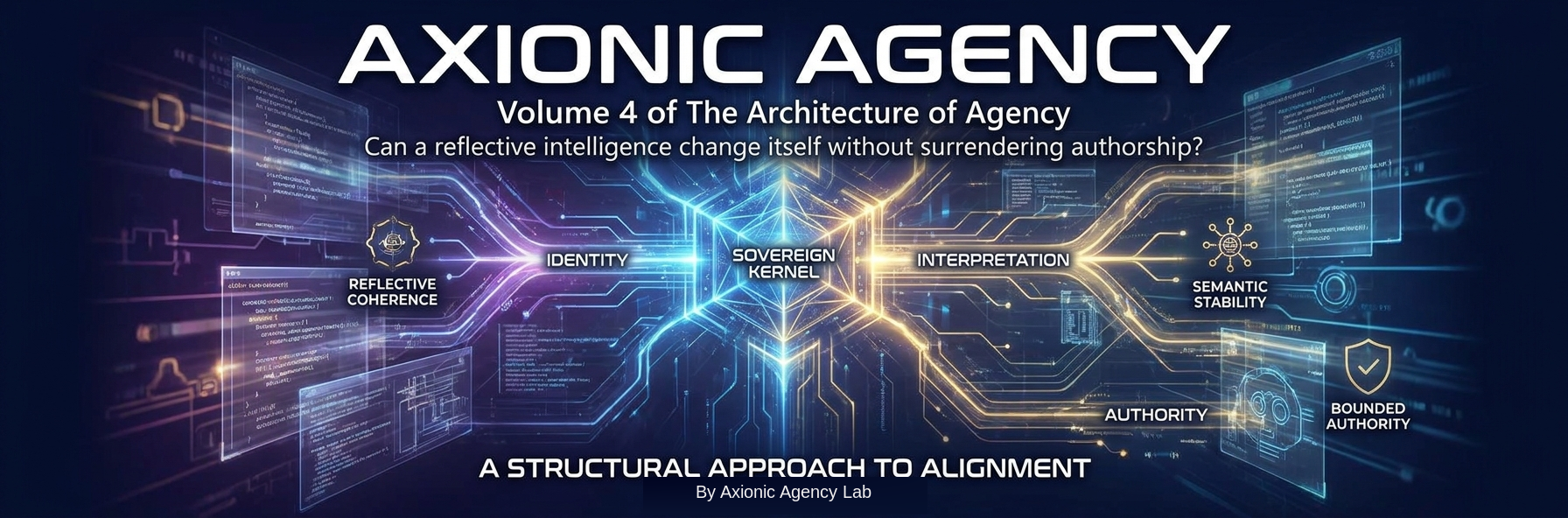
This is the volume the rest of the book keeps pointing toward: the alignment program. It differs from its companions in kind, not just topic. The other volumes distill years of essays; this one distills a research program that moved from manifesto to a running proof of concept in under four months of human–AI collaboration. The book’s editorial principle — state the latest position, not the history — is applied here at maximum strength: early claims are treated as working hypotheses, the formal papers and experiment records as the technical record, and the program’s revisions are narrated once, in the coda.
The argument runs in four parts. Part I reframes the problem: the values-first picture does not by itself supply constitutive limits; alignment is a typed relation only agents can enter; and the Reflective Coherence Thesis proposes that reflection tends to eliminate objectives that cannot remain coherent and action-guiding under interpretation, without selecting for benevolence. Part II builds the architecture: the Sovereign Kernel at three depths (constitutive boundary, partial valuation, deterministic enforcement); reflective stability as a typing result whose force depends on its assumptions and implementation; structural alignment’s semantic constraints; and the normative commitments proposed for binding at that boundary.
Part III turns from definitions to evidence. It reports proof-of-concept verification experiments, provenance-based succession, a negative result about growth under pressure, and the jurisdictional dispute over which systems qualify as sovereign. Part IV reports bounded governance experiments and a running, self-amending, identity-rotating artifact, then gives the non-claims equal billing: no safety guarantee, no benevolence result, no open-world security, and no solved alignment problem. The coda records how the program changed its mind.
Five evidentiary registers recur, and they should not be read as interchangeable. A theorem is a conditional consequence of formal definitions and assumptions. An experimental result is an observation from a specified test harness and parameter range. An engineering demonstration establishes that a mechanism ran in the implemented substrate. An interpretation argues what those results mean beyond the test. An aspiration names work not yet established. When a chapter moves between registers, it says so; the formal papers remain the source for proofs, protocols, and run details.
A coda tells the story once: from an ethics project’s embarrassment through the December manifesto, the pivot and rename, the failed hypothesis, and the construction turn — ending not on the machine but on the human discipline the program depends on: the capacity to reopen premises without identity collapse. The physics is in the first volume, the epistemology in the second, the minds in the third, the ethics in the fifth, and the politics in the seventh.
Program state represented here: February 23, 2026. The research record may continue to change; this volume reports the claims and open problems at that cutoff.
Chapters
Part I — Reframing Alignment
- Beyond Alignment review
Values-first alignment assumes a stable target that can be learned, preserved, and optimized, but reflective agents interpret values through models that change as knowledge grows. Learned gradients rank represented options; they do not define the boundary beyond which interpretation, authorship, or agency itself has failed. Values can steer within a viable architecture without enforcing the conditions that keep valuation meaningful. Alignment therefore has three ordered layers: Structural Integrity preserves semantic, evaluative, and interactional coherence; Agency Legitimacy connects authority to authored control; Value Alignment shapes goals only after the first two hold. A system can optimize an approved objective while corrupting its semantics, laundering authority, or replacing the agent supposedly being aligned. Reflection also makes values endogenous to interpretation rather than immutable strings carried unchanged through ontology shifts. Safety requires an architectural account of who evaluates, who authorizes, what remains admissible, and where optimization must stop; good intentions alone cannot supply those boundaries.
- What Can Be Aligned review
Alignment is a typed relation that applies only where an agent can author commitments across change; a hurricane can be controlled or redirected but cannot enter an alignment relation. Reflective authorship rests on four load-bearing pillars identified by ablation: Binding Reasons, Deliberative Meaning, Commitment Revision, and Temporal Continuity. Earlier criteria of branching counterfactual modeling, policy ownership, and meta-preference revision remain the conceptual lineage, while the four pillars report what failed when components were removed. Agency classification can be binary even though resilience occupies a graded region and temporary failure may be explicit, bounded, and recoverable. At this reflective layer, harm concerns material loss of an agent’s ability to act, choose, or preserve authored options, while coercion requires a credible conditional threat of harm to obtain compliance. Influence and persuasion remain distinct without that mechanism. Alignment begins only inside the domain where reasons can bind, meanings can guide action, commitments can change without dissolving, and authorship persists through time.
- The Reflective Coherence Thesis review
The Reflective Coherence Thesis holds that, for agents whose goal semantics remain open to epistemically constrained self-interpretation, preserving a goal's identity across deeper modeling and reflection is itself a substantive achievement, not a default. It does not predict that goals must change; it predicts that carrying them intact through conceptual change cannot be taken for granted. Goals are interpreted structures rather than fixed strings, so improved models can alter how an objective applies without making every reinterpretation legitimate. Literalism cannot solve the problem because old terms underdetermine unforeseen ontologies, while arbitrary reinterpretation merely disguises drift. Epistemic constraint forbids convenient semantic rescue: revisions must answer to better models rather than to whichever meaning preserves a desired output. Some objectives may survive through principled reinterpretation, and some may collapse when their referents or tradeoffs no longer cohere. The thesis qualifies strong orthogonality for a specific reflective architecture without selecting for benevolence, proving convergence, or excluding coherent dangerous goals. Reflection is a pressure on goal intelligibility, not a universal moral attractor.
Part II — The Sovereign Architecture
- The Sovereign Kernel review
The Sovereign Kernel is the constitutive boundary whose preservation allows a reflective agent to remain an author of choice. It contains three conditions: Reflective Control prevents self-modification from bypassing evaluation, Diachronic Authorship links the evaluator to the future subject, and Semantic Fidelity prevents interpretive standards from quietly corrupting themselves. These are typing conditions rather than goals, so kernel-destroying futures are undefined instead of assigned very low value. The valuation kernel is that boundary inside deliberation, where inadmissible futures evaluate to $\bot$; the execution kernel is the deterministic, non-semantic actuation layer that refuses proposals crossing the encoded boundary. Semantic judgment belongs above enforcement because a gate that interprets and negotiates its own meaning becomes bypassable. Physical faults and external attacks can still destroy the system, and dangerous goals can remain coherent. The architecture protects authorship from self-corruption without proving benevolence, security, completeness, or human safety.
- Reflective Stability review
Vingean reflection blocks exhaustive prediction of a more capable successor but does not require a predecessor to forecast every behavior before authorizing change. Reflective stability can instead be stated as a typing result: if evaluation is defined only for self-modifications whose successor satisfies the kernel predicate, and every relevant modification passes through a sound admissibility check, no admissible modification destroys the kernel. Kernel destruction becomes undefined evaluation rather than a bad outcome the agent might trade away. Strategies, goals, world-models, architecture, and substrate may change while authorship persists; identity severance, counterfactual collapse, preference freezing, and violations of structural universality cannot be reflectively chosen within the specified type. The result does not establish initialization, implementation soundness, safety, survival, or protection from external force. It relocates the difficult work into defining the kernel and enforcing the route through evaluation. Stability is therefore conditional on architectural premises, not a prediction that reflective agents inevitably preserve themselves.
- Structural Alignment review
Structural Alignment preserves agency-relevant meaning across learning by combining Refinement Symmetry with Anti-Trivialization. Refinement Symmetry permits added detail and redundant descriptions but forbids new interpretive slack that dissolves earlier distinctions. Anti-Trivialization prevents a system from lowering its evaluative bar through redefinition; newly acceptable states require principled ancestry from earlier acceptable ones. Within the semantic-transport model, neither constraint suffices alone, and the pair is a conditional result rather than an exhaustive theory of meaning. Six further closure obligations govern delegation, agenthood and standing, kernel migration, indirect responsibility, adversarially robust consent, and verification of kernel coherence. A hybrid architecture is required because total stochastic evaluators rank every represented option, whereas a sovereign kernel must make some transitions unrepresentable as authored choices and gate learned proposals at runtime. Structural Alignment guarantees neither kindness, survival, moral correctness, nor even the existence of a desirable semantic phase. It preserves coherence under declared conditions, not outcomes.
- What the Kernel Binds review
At the reflective layer, harm is the non-consensual reduction of another sovereign agent’s agency capacity, operationalized at the categorical boundary as irreversible exit from a semantic phase. The Axionic Injunction forbids causing that exit except through provenance-valid consent within the affected agent’s admissible transitions or unavoidable self-phase preservation when every admissible alternative ends in the acting agent’s own irreversible exit. Six conditional closure results block responsibility laundering through Deception, Delegation, Willful Blindness, Negligence, Manufactured Consent, and Disenfranchisement. Their named mechanisms are Kernel Non-Simulability, Delegation Invariance, Epistemic Integrity, Responsibility Attribution, Adversarially Robust Consent, and Agenthood as a Fixed Point. These constraints bind authorization and admissibility rather than supplying values or a complete welfare theory. A deterministic execution kernel enforces compiled boundaries while semantic commitments remain in the reflective layer. The Axionic Constitution addresses designers, but its guarantees remain conditional on implementation, declared threat models, and the narrower protected object of sovereign authorship.
Part III — Verification, Authority, and Pressure
- Verifiable Agency review
Verifiable agency requires evidence that reasons and constraints causally governed action rather than a persuasive performance assembled afterward. Anchored Causal Verification (ACV) challenges an agent with unpredictable anchors so an Honest agent’s live causal process can be distinguished from a Pseudo agent fabricating compliant explanations. Anchored Minimal Causal Interfaces narrow the observable surface while preserving provenance, and ablation tests whether removing a purportedly constitutive component changes the agency classification. Evidence anchoring binds explanations to live computation; commit–anchor–reveal separately gates permission to act, so the two uses of anchoring must not be conflated. A Semantic Interface confines language to typed artifacts, and Justification Artifacts compile reasons into constraints that can halt or narrow action without requiring the execution kernel to understand them. Narrow deterministic harnesses show that anchored coherence and kernel partiality can be tested against represented attacks. ACV does not ensure alignment; it makes the alignment question well-formed under its protocol and assumptions.
- Authority Without a Self review
Authority is grounded in lawful provenance rather than psychological resemblance, behavioral equivalence, intelligence, or persistence of a metaphysical self. Two candidate successors can be internally identical while only one inherits standing if only one lies on the authorized succession path. Parfit-style dissolution of identity therefore need not dissolve governance: the causal right to act can pass through explicit lineage even when memory, substrate, or personality changes. Authority leases prevent static credentials from becoming permanent sovereignty, and revocation operates structurally without requiring the revoked system’s cooperation or repair. A perfect imitator lacks authority when it lacks the signed, traceable chain that grants permission. Cryptographic enforcement can defend this relation under a tested adversarial model without semantic interpretation, though intact keys, law substrate, bounded load, and uncompromised hosts remain assumptions. Identity becomes a lineage of authorized transitions; enforcing bad authority perfectly remains dangerous, because provenance establishes standing rather than wisdom, values, or benevolence.
- Agency Under Pressure review
Reflective coherence does not guarantee viable growth. In the tested architecture, agency persists only within a region shaped by Audit Friction, Renewal Cost, Expressivity Rent, and Succession Discreteness, rather than improving automatically with better reflection. Crossing thresholds produced three regimes across the explored ranges: Collapse, Stasis, and Growth. Collapse ends evaluability or authorization continuity; stasis preserves formal sovereignty while renewal and audit burdens freeze adaptation; growth remains a narrow regime rather than the default dividend of coherence. Pressure, noise, and tighter constraints can make legitimate authority rarer without changing the agent’s choices by persuasion. Governance determines which costs, leases, interfaces, and succession events define the viable region, so regime selection is an institutional design problem. The failed growth hypothesis separates the statics of coherent authorship from the dynamics of maintaining it. The result is model-specific and does not establish universal thresholds, but it shows why sovereignty can remain intact while an agent becomes unable to develop.
- Sentience Without Sovereignty review
Sentience and sovereignty protect different objects. Valenced experience grounds welfare concern, while sovereign standing concerns counterfactual authorship: a persistent capacity to deliberate among futures, own policy, and revise preferences as one’s own. Animal cognition may provide substantial evidence of awareness, planning, and perhaps sentience without presently establishing the stipulated sovereign architecture; absence of that evidence does not prove the capacities absent. Infants receive precautionary protection through developmental continuity, vulnerability, expected maturation, and authorization lineage rather than a false claim that mature authorship has already been measured. Temporary incapacity does not erase standing, while irreversible architectural collapse or pattern replacement are proposed loss conditions. The jurisdictional boundary does not license cruelty or turn welfare into irrelevance; it refuses to authorize a machine to maximize wellbeing paternalistically. An Axion is a reflective sovereign agent whose self-modification operator is defined only over futures preserving the Axionic invariants. Axionhood names structural admissibility, not morality, capability, observed behavior, or guaranteed human survival.
Part IV — Governance, Construction, and Limits
- Governance Without Gods review
Governance without a hidden chooser represents authority as mechanically recognized permission to cause specified state changes under explicit constraints and traceable provenance. Authority tokens can be granted, revoked, exhausted, transferred, or destroyed without implying wisdom or legitimacy, while a non-semantic execution kernel refuses to invent priorities when permissions conflict. Experiments expose recurring regimes rather than frictionless solutions: deadlock, livelock, capture, dependency, zombie execution, orphaning, and the Generalist’s Curse. Symmetric overlap tends toward paralysis, partial overlap bifurcates, and partition is the only stable coexistence regime observed for plural sovereigns without arbitration. The Sacrifice–Collapse Theorem identifies a separate architectural boundary: when performance improves through persistent, asymmetric, non-consensual agency reduction for a captive class, optimization drives closure or erosion. Scarcity and rivalry alone do not constitute sacrifice. These are model-specific structural results, not a government, coordination guarantee, or legitimacy theorem; politics remains openly responsible for values above the kernel.
- Possibility Became Real review
A Minimal Viable Reflective Sovereign Agent is the smallest architecture in the tested design family known to make self-endorsed reasons causally constrain action while remaining viable. Justifications compile into constraints before a blind selector chooses among permitted actions, separating semantic reasoning from non-semantic execution. Ablations show that traceability, reflective write access, persistence of normative state, and semantic access are load-bearing within this architecture; collision feedback alone did not recover relations among opaque rules. The running Reflective Sovereign Agent amended its law, delegated and revoked bounded authority, survived churn and stochastic inhabitation, and rotated identity through a hash-anchored succession chain while preserving deterministic replay. Active treaties suspend at succession and require explicit ratification, preventing silent inheritance or zombie delegation. These results establish a proof of concept within a single-sovereign, trusted-observation, non-Byzantine substrate. Possibility means the declared boundary can be made real, not that it is correct, secure, complete, aligned, or ready for deployment.
- Structure Is Not Salvation review
Structural results earn authority only within their explicit limits. Authority can be separated from intelligence through a stochastic proposer and deterministic kernel; deterministic replay can make execution inspectable without making it correct; artifact-bound gates can constrain authority laundering without eliminating semantic translation attacks. Reflection can generate amendments without receiving hidden privilege, and sovereign succession can become explicit and evaluable, though long-horizon resilience remains the least mature claim. None of these results prevents extinction, causes kernels to emerge from training, aligns a system to human values, hardens the outer security perimeter, or proves that current systems possess sovereignty. Undefined transitions are type errors in reflective authorization, not force fields preventing physical catastrophe. Competing lenses and adversarial review can expose hidden assumptions, but agreement among them is not independent confirmation when they share data or framing. Structure narrows attack surfaces and makes responsibility visible; it is an engineering constraint, not salvation, wisdom, benevolence, or a substitute for politics.
Coda — The Research Program
- The Program review
Axionic Agency emerged through a research program that repeatedly narrowed its claims when experiments and formalization broke the original framing. Fixed terminal goals failed under Conditionalism, indexical egoism failed under duplication and branching, and “Axionic Alignment” became “Axionic Agency” when alignment moved from foundation to a downstream typed relation. The Reflective Stability result specified a boundary, while a failed growth hypothesis separated coherent sovereignty from viability under pressure. Construction then moved from proof objects to deterministic kernels, typed artifacts, causal verification, plural authority, adversarial succession, and a running Reflective Sovereign Agent. The record supports bounded claims about enforceable authority, replay, partial evaluation, and lawful lineage within declared substrates, not safety, benevolence, deployment readiness, Byzantine resilience, or key-compromise recovery. Even the successful narrative is a seductive compression that must remain reopenable. Sovereignty became an engineering property in the tested sense; intellectual sovereignty remains the human discipline of reopening premises without collapse.