Volume 1 — The Physics of Agency and the Branching Universe
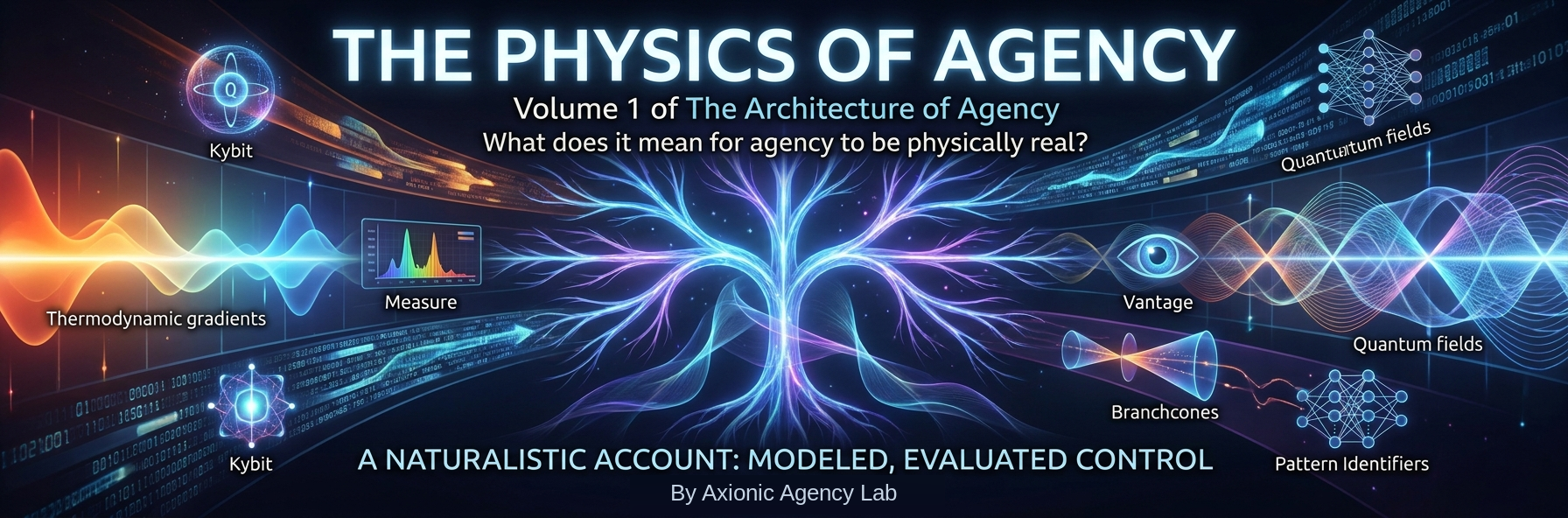
Most philosophy treats agency as a given and asks what agents should believe and do. This volume asks the prior question: what is an agent, physically? The framework built here treats agency as physically embodied control — matter modeling reachable futures and spending work to make later outcomes depend on its policy — and proposes a way to quantify that control. Taking the proposal seriously reframes downstream questions: what choice is, what causes what, how identity is represented across branches, and why there is anything at all. The first three parts develop the physical account. The last two extend it into a more speculative metaphysics, with the change in epistemic register left visible rather than disguised as another deduction from physics.
The argument runs in five parts. Part I develops the physical basis: agency as opposition to drift, the kybit as a proposed unit of control, the claimed thermodynamic bound linking information and control, and three candidate laws — control costs work, control decays, perfect control is impossible. It locates real agents between bacterial chemotaxis and the unattainable AIXI demon, then closes by distinguishing agency from reward. Part II builds the arena: the Quantum Branching Universe represented as a directed acyclic graph of events whose paths are timelines, with Pattern Identifiers to pick things out of it, Measure, Vantage, and Branchcones as the machinery of objective probability, causality as branch structure, observation as physical correlation, and rival interpretations engaged. It ends at the volume’s central junction — the agency framework translated into the branches — and at its honest ledger: alternative policies can be compared through their conditional Measure-weighted consequences, but the proposed general bridge among control, work, and that difference remains underived.
Part III lives inside the branches: Everett’s demon replaces Laplace’s; choice makes a policy-conditioned causal difference without generating futures; no choice is trivial in a chaotically amplifying world; identity is a pattern tracked across weighted event sectors, not a thread through time; and creativity is modeled through variation and selection within cognition. This completes the physical-agency argument. A reader who wants the mechanics without the proposed metaphysical ground can stop after Part III without losing the later volumes’ principal definition of agency.
Part IV changes register and digs beneath physics itself. It proposes the Chaos Reservoir — the totality of random sequences, the prior state of all priors — then asks whether formal and semantic filters can represent selected structure, constructors can supply a bridge to causal organization, and life, consciousness, and time can emerge from that organization. The part closes by defining dynamical coherence as re-identifiability under stated transformations and identity criteria, mapping tiers of reality from the Ruliad to the branching of this afternoon’s weather, and testing the architecture against rival proposals. These are metaphysical conjectures constrained by the earlier framework, not results of thermodynamics or quantum mechanics. Part V develops their largest implications: an optional model of pattern prevalence across branches, and a conditional use of the Modal Realization Principle to dissolve the question of why there is something rather than nothing.
This is one half of the book’s foundational pair. The epistemology that disciplines its claims — conditional truth, Credence, updating, self-location — lives in the Conditionalism volume, while that volume borrows the QBU’s Measure and Vantage in return. The ethics of comparing Measure-weighted consequences lives in the value volume. The cross-links are reciprocal because the foundations are: the physical model constrains what can be claimed, and the epistemology constrains how strongly to claim it.
This volume is in author review. Chapters carry their status openly, and the arguments are held the way the book says they should be held: at the strength the evidence licenses, and no stronger.
Chapters
Part I — The Physical Basis of Agency
- A Genealogy of Agency review
Physics describes matter without assigning it purposes, yet agents made of that matter reliably alter what happens next. The attempt to explain that fact inherits a lineage running through Popper, Bartley, Everett, and Deutsch. Popper and Bartley supply conjectural knowledge and criticism without privileged foundations; Everett supplies unitary quantum mechanics without a fundamental collapse; and Deutsch supplies the constructor-theoretic emphasis on which transformations are possible. Joined together, those inheritances become something different: Conditionalism extends fallibilism to the conditions of truth, the Quantum Branching Universe offers a coarse-grained representational framework, and agency becomes physically embodied control. None of those moves follows automatically from its predecessor. Axio takes the inherited insights as starting points, not authorities, preserving their constraints while departing where the combined architecture requires it. The result is both an acknowledgment of intellectual debts and a map of a research program for placing agents inside physics without explaining away their causal power.
- Agency Against Drift review
Agency is often defined through intention, reward, or rational choice, leaving its physical basis implicit. A more basic characterization begins with work: an agent is a system that expends work so later states depend on its policy rather than on uncontrolled drift alone. The contrast is not between motion and stillness, or order and disorder, but between outcomes that would occur under the relevant baseline dynamics and outcomes made policy-dependent by the system’s organization. This makes control empirically approachable without pretending that every causal influence is agency. The descriptive fact of steering remains separate from any judgment that the steering is intelligent, conscious, beneficial, or morally authorized. Thermodynamics constrains the implementation, but it does not supply the agent’s goals or derive values from physics. How control should be quantified, and how an informational description of it relates to physical work, remain open questions that motivate the kybit and the candidate laws of agency.
- The Kybit review
If agency is control against drift, that control needs a quantity and a unit in which to report it. The kybit is a proposed informational unit of distributional control. The measured quantity is the divergence between an outcome distribution under an agent-fixed intervention and an explicit baseline distribution; the kybit is the unit, not the measurement itself. A fair binary event fixed to one outcome supplies the motivating one-kybit case, while more general cases require the model, baseline, variables, and vantage to be stated. The proposal is intentionally model-level: a count in kybits can capture a distributional shift without proving consciousness, authorship, moral standing, or a universal conversion rate to joules. Intervention-based control is also distinct from mere prediction and correlation, because knowing an outcome does not establish that an agent made its distribution policy-dependent. Calibration, composition, and the relation between the informational quantity and its physical realization remain open research problems.
- The Three Laws of Agency review
A physical account of agency should generate constraints, not merely a new label for purposeful behavior. Three candidate laws supply those constraints: control requires physical work, unmaintained agency decays, and perfect control is unattainable. The first connects implemented steering to thermodynamic cost, while keeping any numerical kybit-to-work relation dependent on the specified physical realization and equilibrium reference. The second treats agency as an achievement that must be repaired, fueled, and reproduced against noise and degradation. The third locates every finite agent inside an environment it cannot model or command completely, ruling out the fantasy of unlimited sovereignty without denying degrees of control. These are proposed regularities and bounds rather than deductions that already cover every possible substrate. Their value depends on whether they continue to organize evidence across minimal organisms, active inference, branching models, and constructor-supported systems.
- Minimal and Maximal Agents review
Definitions of agency tend either to exclude simple living systems or to count every feedback loop as an agent. Agency is better represented on a spectrum from minimal adaptive control to an idealized maximal planner. Chemotaxis illustrates a small but genuine policy-sensitive capacity: sensing changes action in ways that preserve a narrow set of viable states. At the opposite pole, the AIXI demon represents exhaustive prediction and optimization, an illuminating limit that no embedded physical system can realize. The comparison separates agency from intelligence, consciousness, linguistic sophistication, and moral standing while retaining a threshold above passive causation. Greater modeling depth and option control can enlarge agency without removing resource limits or environmental dependence. The spectrum supplies operational test cases for the proposed laws, but the precise thresholds and multidimensional comparison of real agents remain matters for further work.
- Agency and Active Inference review
Active inference and the free-energy principle offer a mature vocabulary for systems that maintain themselves by modeling and acting on their environments. That vocabulary has a partial structural correspondence with agency understood as distributional control. Both frameworks describe organized systems whose internal models guide action toward a restricted range of states, and both connect persistence to active correction. The bridge is deliberately limited, however, because variational free energy, prediction error, precision, thermodynamic work, and kybit counts are distinct quantities rather than currencies with a law-by-law conversion. Under an equilibrium-reference realization, minimum-work results may constrain implementation, but they do not establish a universal energetic price per kybit. Convergence between the frameworks is therefore evidence of a shared problem structure, not proof that either formalism derives the other or explains phenomenality. A quantitative bridge would still have to specify the physical realization, the relevant distributions, and the conditions under which the functional analogy becomes informative.
- Agency Is Not Reward review
Reward maximization, empowerment, and maximum occupancy explain important forms of apparently agentic behavior without exhausting agency itself. Preserving options can increase future control, but agents also sacrifice options, accept irreversible commitments, and pursue narrow projects whose value is not reducible to occupancy. Reward signals can train or describe a policy without constituting the authored objective that the policy serves. These contrasts separate an agent’s capacity to steer from the particular content assigned to its preferences. Maximum occupancy remains a useful instrumental tendency under specified games and constraints, not a universal terminal aim written into physics. Reward and option preservation can therefore explain parts of behavior while remaining strategies available to a more general capacity. Agency is that capacity for policy-sensitive control, not the reward function or occupancy pattern through which it happens to be expressed.
Part II — The Branching Arena
- The Quantum Branching Universe review
Quantum mechanics supplies a state and dynamics, but philosophical arguments often smuggle in an intuitive picture of worlds, observers, and alternatives. The Quantum Branching Universe is an explicit, coarse-grained representational model: a directed acyclic graph of events whose paths are timelines and whose sectors carry physical weight. Branches are emergent, approximate structures supported by decoherence rather than exact universes created at every interaction. Pattern Identifiers pick out systems across the graph; Vantage fixes a standpoint, Measure assigns physical weight, and Branchcones specify the future alternatives being compared. The QBU is not a new physical theory, a proof of Everettian metaphysics, or a claim that every imaginable history occurs. Its purpose is to make counterfactual and agency claims auditable by stating the coarse-graining and event structure they presuppose. The interpretation of probability and the mapping from fundamental dynamics to particular branch descriptions remain open.
- Measure, Vantage, Branchcone review
A branching representation does not become probabilistically meaningful until it specifies which alternatives are relevant, from where, and with what weights. Three linked tools provide that specification. Measure assigns physical weight to defined event sectors; Vantage fixes the standpoint and information relative to which alternatives are represented; and a Branchcone collects the future sectors reachable from that vantage under the model. Their combination is meant to prevent branch counting, observer-free probability talk, and unnoticed changes of sample space. Physical Measure remains distinct from epistemic Credence: one describes weighted structure in the model, while the other records an agent’s uncertainty about propositions. Causal and decision-theoretic uses therefore require explicit conditioning, coarse-graining, and identity criteria rather than treating the graph as self-interpreting. The normative bridge from physical weights to rational expectation remains a separate and contested argument.
- Causality and Counterfactuals review
Causal claims compare what happens under one antecedent with what happens under an alternative, but ordinary intervention language can wrongly imply that every cause must be manipulable by an agent. Causation can instead be represented as a counterfactual contrast between matched, weighted branch-sets. The central quantity compares the Measure-weighted prevalence of an outcome under an antecedent and its negation, with the causal model and background conditions indexed explicitly rather than treated as observed events. Branching contributes physically represented and weighted alternatives, allowing contrasts for supernovae, wars, and other non-manipulated causes. It does not, however, isolate the antecedent from its own causes: common provenance is not the absence of confounding. Structural assumptions, admissible adjustment, or another stated no-confounding condition must still do that work, and the do-operator remains one interventional way to construct such a contrast. Counterfactual contrast broadens causal analysis beyond agency without claiming that branch structure alone solves causal identification.
- The Observer Joins the Branch review
Measurement problems become paradoxical when the observer is treated as external to the physical process being described. Observers belong inside the branching model, and observation is the formation of durable physical correlations among system, apparatus, record, and observer. Schrödinger’s cat and Wigner’s friend then become tests of where a model draws its event sectors and how different Vantages encode available records. Consciousness is not invoked as a collapse mechanism, and observers receive no privileged power to select reality. The interpretive problem also remains: decoherence explains effective record stability, while the choice of coarse-graining and the meaning of weights still require argument. An observation changes the observer’s physical state and therefore belongs in the same causal graph as what is observed. Self-location, identity across branches, and the difference between physical Measure and an observer’s Credence all begin from that internalized observer.
- The Interpretation Wars review
The Quantum Branching Universe should not be mistaken for a declaration that one interpretation of quantum mechanics has been proved. QBism, local realism, collapse views, and Everettian approaches disagree at several levels: empirical dynamics, the interpretation of probability and records, ontology, and explanatory purpose. The QBU retains unitary evolution, weighted alternatives, and emergent branch structure as a useful model, but it does not claim an exact world count or derive the Born rule’s normative use from branching alone. QBist emphasis on agent-relative expectation and realist emphasis on physical structure each identify constraints worth preserving, even without accepting either interpretation in full. Bell-type results narrow the available realist pictures without mechanically selecting one preferred representation. The QBU is therefore an explicit and revisable modeling choice, not a compulsory metaphysics. Its value depends on the work it performs in causal and agency analysis while keeping its interpretive commitments visible.
- Agency in the Emergent Multiverse review
A physical account of control and a representation of weighted quantum alternatives meet in the problem of an embedded agent steering within an emergent multiverse. Policies can be compared through their conditional Measure-weighted consequences, so agency appears as a physically implemented difference between distributions rather than the creation or deletion of branches. The candidate laws still constrain the implementation: steering requires work, decays without maintenance, and remains bounded for finite agents. A central gap nevertheless remains. No general theorem presently converts thermodynamic work, free-energy quantities, informational divergence, and branch-weighted outcome differences into one universal scale. The synthesis is therefore a structured research proposal rather than a completed reduction. The combined machinery can represent policy-sensitive control across weighted alternatives, but a mature derivation would still have to establish the quantitative bridges rather than assume them.
Part III — Choice Within the Branches
- Everett's Demon review
Laplace’s demon imagines complete knowledge as the prediction of one deterministic future. Everett’s demon is the corresponding god’s-eye intellect for a deterministic wavefunction: it knows the state and dynamics, foresees the branching structure whole, and sees every branch realized rather than one outcome selected. The demon therefore transcends self-location; it hands over the tree without occupying one uncertain place inside it. An embedded agent at a Vantage faces the local openness instead, because its future continuers occupy all realized branches rather than one hidden branch waiting to be revealed. Quantum events become historically consequential when amplification carries microscopic alternatives into durable macroscopic differences. This does not make every macroscopic event fundamentally random or turn decoherence into an exact branching rule. Perfect global knowledge can coexist with an ontologically open local future, and an agent’s policy can remain causally effective inside that physics without selecting one world from outside it.
- Quantum Free Will review
Free will is often framed as a contest between deterministic law and an uncaused power to choose otherwise. A different criterion is available for an embedded agent in a branching model. A choice matters when different policies make a causal, policy-conditioned difference to the Measure-weighted distribution of later outcomes. The agent does not create futures, delete branches, or move Measure between them; its implemented policy is one of the physical conditions under which the relevant contrasts are evaluated. Randomness alone is therefore insufficient, since an uncontrolled quantum event supplies alternatives without authorship, while deterministic components can still implement an agent’s control architecture. Policy-sensitive control separates causal efficacy from metaphysical exemption without yet settling the stronger question of reflective authorship. Freedom begins, modestly but testably, with steering inside physics rather than with an escape from physical explanation.
- No Trivial Choices review
Everyday judgment divides choices into consequential and trivial, but chaotic dynamics make that division depend on scale and horizon. Small policy differences can be amplified through sensitive dependence, interaction, and path-dependent institutions into large downstream changes. This does not mean that every gesture transforms history or that causal importance can be read from branch proliferation. A choice’s significance is contrast-relative: it depends on which alternatives, variables, time horizon, and outcome criteria the analysis fixes. Local interventions enter a causal lattice of later dependencies, sometimes damping out and sometimes becoming decisive. Radical contingency is therefore compatible with bounded agency and with uncertainty about remote consequences. The practical stance is neither paralysis nor grandiosity, but humility: apparently small choices are situated causal inputs whose reach must be investigated rather than assumed.
- A Gigaplex of Parallel Lives review
Branching descriptions unsettle the ordinary picture of one person moving along one future line. Identity across alternatives can be represented through Pattern Identifiers and weighted event sectors rather than an indivisible thread or soul. A present person can have multiple future continuers that preserve different degrees and features of the earlier pattern, with no requirement that identity be all-or-nothing across every coarse-graining. The “gigaplex” is a toy representation of those related lives, not a census of exact worlds or proof that every imaginable biography exists. Measure matters to the representation, but it does not distribute a moral substance or make low-weight continuers unreal. Questions about anticipation, responsibility, and concern remain questions that physics alone does not settle. Identity is a model-governed relation of continuity and re-identifiability, with its verdicts dependent on the chosen scale, transformations, and criteria.
- Creativity as Virtual Evolution review
Creativity produces novelty in a way that simple optimization language often fails to capture. A functional analogy with evolution models cognition as generating variants, testing them against constraints and goals, and retaining some as models, plans, artifacts, or habits. The process occurs within an agent’s representational and behavioral repertoire rather than in a separate universe of fully realized alternatives. Selection language is explanatory only where mechanisms of generation, evaluation, memory, and reinforcement are supplied; evolution is not a hidden designer running toward progress. Search-guided self-play and human imagination illustrate how structured exploration can yield outcomes not explicitly enumerated in advance. Novelty becomes causally persistent when agents embody selected ideas and act on them. How creative spaces are generated, how evaluation criteria change, and when the evolutionary analogy becomes quantitatively useful rather than merely suggestive remain open.
Part IV — Metaphysical Extension: Chaos and Coherence
- Infinite Randomness review
Infinite random structures can contain every finite pattern, tempting the inference that randomness alone explains worlds, observers, and meaning. Normal sequences, the infinite monkey idea, and Boltzmann-brain-style cases expose why that inference fails. Mere occurrence is too cheap: if every finite arrangement appears somewhere, existence by itself does not explain prevalence, stability, causal organization, or why observers should expect one class of records rather than another. Mathematical inclusion is distinct from physical realization, and both are distinct from an explanatory measure over observations. Local regularities can be found in random sequences without turning the sequence into a chooser or treating every match as a world. Infinite randomness supplies raw possibility, not constructors, persistence, or warranted typicality. Any foundational use of randomness must still explain how coherent structures are selected, causally maintained, and weighted.
- Chaos as Foundation review
Explanations of order usually begin with laws, initial conditions, or a space of possibilities whose own origin is left unexamined. The Chaos Reservoir is a speculative terminus: the unrestricted totality of random sequences, described as the prior state of all priors. On this proposal, structured worlds are not generated from literal nothing but identified through filters that pick out regularities already representable in the reservoir. The move is metaphysical rather than a result of quantum mechanics, thermodynamics, or algorithmic information theory, and it does not make the reservoir a physical substance or hidden agent. Nor does inclusion explain realization; a pattern’s presence in a sequence says nothing yet about causal persistence, observation, or weight. The proposal earns explanatory value only if coherence filters can distinguish organized structure from arbitrary finite coincidence and constructors can supply causal maintenance. Until those burdens are met, the reservoir represents possibility rather than a completed account of reality.
- Coherence Filters review
If an unrestricted reservoir represents every finite pattern, some criterion must distinguish a world-like structure from accidental fragments. Coherence filters are proposed rules that identify organized subsets without claiming to manufacture the underlying possibilities. Formal filters capture compressibility, consistency, recurrence, and lawful relation; semantic filters add interpretation relative to models, observers, and identity criteria. The distinction keeps filtering from becoming a disguised creator and makes each selection answerable to stated conditions. A filter can reveal structure for a purpose while failing to establish that the selected pattern is physically realized, causally autonomous, or uniquely privileged. Multiple filters may carve the same reservoir differently, and their success depends on what transformations and observations they preserve. Filtering bridges undifferentiated possibility and candidate organization, but causal power requires more: a structure must be able to maintain or reproduce order, not merely be describable.
- Constructors review
Description alone does not explain how an organized pattern persists or produces reliable effects. Constructor theory shifts attention from states to transformations that can be performed repeatedly while the enabling structure retains its capacity to act. Constructors provide a possible bridge between filtered regularity and causal organization: catalysts, cells, tools, and agents matter because they help make classes of transformations possible. This functional role does not make constructors fundamental substances, and constructor theory does not already derive the candidate laws of agency. Time, work, error correction, and environmental support remain part of every concrete realization. Accidental copies and momentary patterns therefore lack the same explanatory standing as systems able to maintain or reproduce their organization. Constructors supply a candidate mechanism by which coherence becomes causal power, while the emergence of life, consciousness, and temporality remains to be argued rather than assumed.
- Life, Consciousness, and Time review
A speculative progression runs from self-maintaining systems to life, from adaptive modeling to consciousness, and from ordered change to lived time. Life is associated with constructor-supported persistence and repair: organization actively preserves the conditions of its continuation. Consciousness is approached through recursive models that include the modeling system, while experienced temporality is linked to memory, anticipation, and asymmetric control. These are proposed structural relationships, not derivations of phenomenality or proofs that every self-model is conscious. Evolution is not aimed at minds; each stage depends on contingent organization and selection under local constraints. The shared vocabulary asks when coherence begins to regulate its own continuation and represent its alternatives. The explanatory gap remains visible, as does the problem of stating the transformations under which a changing system remains the same organized pattern.
- The Shape of Coherence review
Appeals to coherence often praise an intuition without stating what remains coherent through change. A more operational account begins with re-identifiability under specified transformations. A pattern is dynamically coherent when a model can track it across changes at a stated scale using explicit criteria of identity, tolerance, and observation. Coherence is therefore relational rather than intrinsic: the same process may remain identifiable under one coarse-graining and dissolve under another. Persistence is also distinct from stasis, allowing living systems, institutions, and agents to preserve organization by changing their components. The proposed invariant is not a universal essence and does not by itself establish value, consciousness, or agency. Claims that something survives, evolves, or acts must name the transformations and identity rules under which that claim holds. Which identity criteria prove useful remains answerable to domain-specific evidence rather than to one metaphysical definition imposed in advance.
- The Tiers of Reality review
Debates about what is real often force a choice between fundamental physics and the higher-level entities used by every successful science. A tiered account instead indexes reality to stable patterns, explanatory scales, and the transformations under which they remain identifiable. The fact that ice floats is real at molecular and thermodynamic scales even though no fundamental equation contains “floating” as a primitive. The same reasoning can be extended, more speculatively, from local physical regularities through observers and branching descriptions to broad computational proposals such as the Ruliad. Higher tiers need not be independent substances, but neither are they arbitrary when they support compression, prediction, intervention, and cross-context re-identification. The hierarchy is an analytical map rather than evidence that every named tier shares one measured quantity or ontological status. Any proposed architecture can therefore be tested by asking what it treats as primitive, emergent, explanatory, and empirically answerable.
- Rival Architectures review
A speculative metaphysics earns credibility by surviving comparison with alternatives rather than redescribing them as versions of itself. Simulation arguments, Langan’s CTMU, Gödelian limits, computational universe models, and theological explanation address different problems: external implementation, self-containing description, formal incompleteness, generative computation, or ultimate cause. Their partial overlaps do not make them views of one literal mechanism. Simulation hypotheses relocate rather than terminate explanation; Gödel constrains sufficiently strong formal systems under specific conditions; and appeals to God or self-processing language require independent reasons before they can close the regress. The same scrutiny applies to the Chaos Reservoir, coherence filters, and constructors, which remain proposals with unresolved realization and measure questions. Comparison therefore yields no automatic victor. An architecture earns only the advantages its explicit distinctions, explanatory work, and willingness to preserve open burdens can support.
Part V — Persistence and Existence
- The Quantum Metagame review
Once patterns are represented across weighted branches, one can ask which forms of organization remain prevalent under repeated change. The quantum metagame is an optional model of that persistence: strategies and structures differ not only in local success but in how broadly their continuers remain represented across relevant event sectors. Robustness, reproduction, and control can thereby be related without treating the multiverse as a tournament organized toward progress. Persistence is a precondition for later influence, not a hidden player that chooses winners or supplies objective value. Every comparison also depends on Vantage, identity criteria, coarse-graining, and the selected horizon; change those conditions and the result may change. The model may illuminate why some agent-like organizations recur, but it does not prove that evolution optimizes agency or that high-Measure persistence is morally good. The metagame remains a speculative bridge between branching dynamics and existential questions, not a completed physical law.
- Why There Is Something Rather than Nothing review
The question of why there is something rather than nothing invites an explanation outside the totality it asks to explain. The demand may instead reach a terminus rather than a final external cause. Under the Modal Realization Principle, every genuinely possible coherent structure is realized in some form, so asking why reality exists may mistake existence for one contingent selection from an external menu. That principle belongs to an optional metaphysics and is not derived from the QBU, quantum mechanics, or constructor theory. It does not show that every describable object is possible, that all structures receive equal Measure, or that realization explains observation and typicality. Rival stopping points—brute fact, necessary being, simulation, or self-explaining law—remain available and carry their own burdens. The dissolution is therefore only a candidate endpoint: if the modal premise holds, existence may be the condition under which explanations occur rather than one more event requiring a cause.